

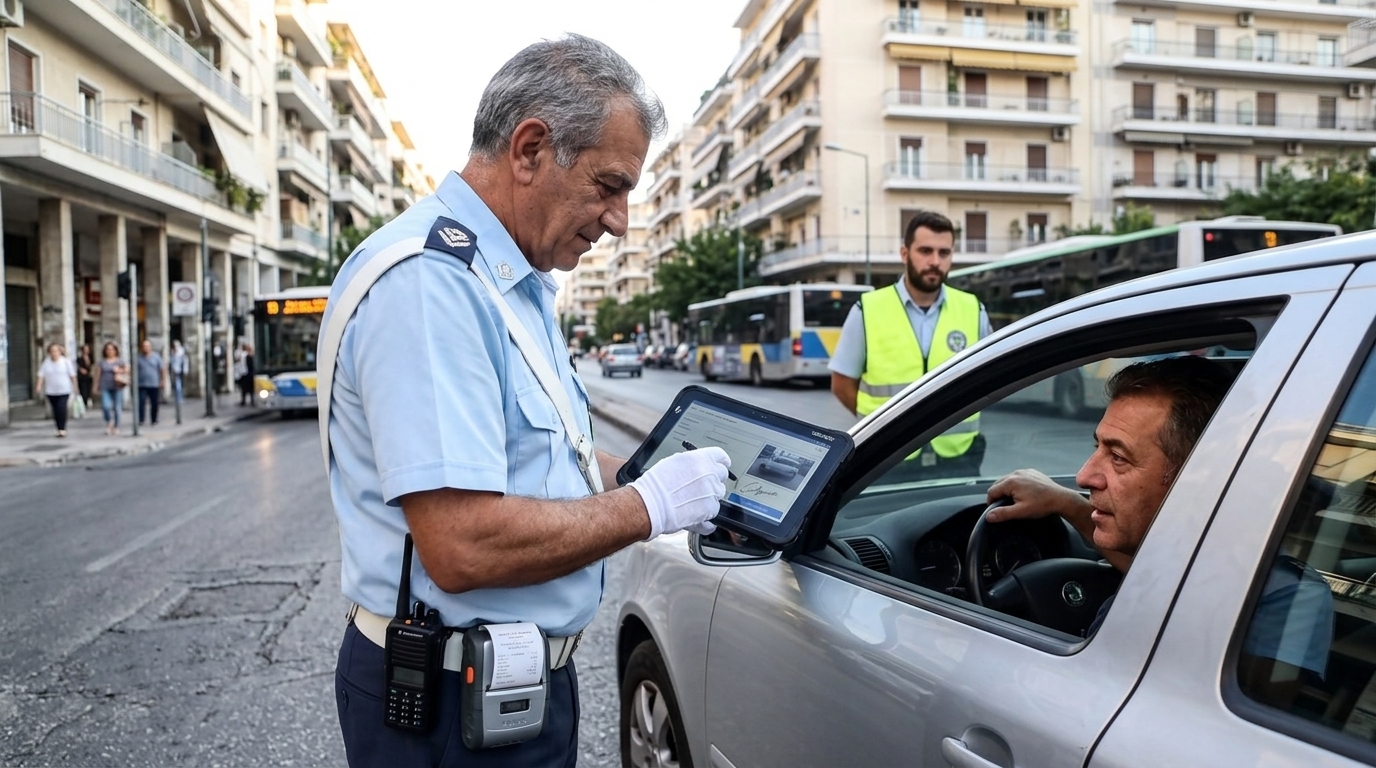
The classic image of a traffic officer standing by the roadside, meticulously scribbling violation details onto a pink or yellow slip of paper, is fast becoming a relic of the past. Greece, as part of its broader digital state transformation, is entering a new era of road policing. The replacement of traditional paper ticket blocks with modern mobile devices (tablets) is not merely a technical upgrade; it is a structural shift in how the state interacts with its citizens behind the wheel.
A Seamless Digital Ecosystem
The new system, implemented by the Ministry of Citizen Protection in collaboration with the Ministry of Digital Governance, is built on the foundation of real-time data access. Traffic officers equipped with specialized tablets can now, by simply entering a vehicle's license plate or a driver's Tax Identification Number (AFM), retrieve all necessary information instantly. Integration with the 'MyAuto' platform and the National Vehicle Registry allows officers to verify immediately if a vehicle is insured, has passed its technical inspection (KTEO), or has been declared as 'off-road'.
The citation process is handled digitally, and the fine is automatically sent to the citizen's personal digital inbox on gov.gr. Simultaneously, the driver receives an immediate notification via SMS or email. This automation drastically reduces the time an officer spends at the scene, allowing for better traffic flow and more efficient policing. The days of deciphering illegible handwriting on a weathered carbon copy are over.
The Death of the 'Favor' Culture
Perhaps the most significant social implication of this reform is the elimination of the ability to intervene and cancel a fine—a practice colloquially known in Greece as 'svisimo' (erasing). For decades, using political or personal connections to annul a traffic ticket was a systemic malaise that undermined the principle of equality before the law. With the new digital system, the violation is recorded instantaneously in the central databases of the Independent Authority for Public Revenue (AADE) and the Hellenic Police.
Once the 'enter' key is pressed on the tablet, the process becomes irreversible at a local level. This transparency bolsters public trust in institutions. When drivers know that a violation will be recorded without exceptions, compliance with the Highway Code tends to increase. Furthermore, the system allows for the automatic deduction of points from the driver's license (Point System), eliminating the months-long delays currently caused by manual data entry.
Economic Efficiency and Revenue Collection
From an economic perspective, the state anticipates a significant boost in revenue—not necessarily through more fines, but through more effective collection. To date, a large percentage of traffic fines were lost in bureaucracy or never reached the tax office due to a lack of personnel to manually transcribe handwritten notes. Now, the fine appears immediately in the citizen's Taxisnet obligations, with the option for electronic payment within minutes.
Beyond revenue, the use of technology allows for better mapping of traffic violations. Digitally collected data can be analyzed to identify 'black spots'—specific road segments where accidents or violations frequently occur. This enables the Traffic Police to deploy their forces more strategically and proactively, focusing on prevention rather than just punishment. This data-driven approach is a hallmark of modern European policing.
Challenges and Data Privacy
Naturally, this transition is not without its hurdles. Data privacy (GDPR) is a central concern, as police access to sensitive national databases must be governed by strict protocols and traceability. Every time an officer accesses the system, a digital footprint is created to prevent the misuse of information for personal reasons. Ensuring that this 'digital eye' is focused only on public safety is a delicate balance.
Furthermore, there is the challenge of digital literacy among older members of the force. Training thousands of officers to use new hardware and software is a massive undertaking that requires time and consistent support. Finally, the reliability of the infrastructure—5G network coverage, battery life, and the durability of the tablets in extreme weather conditions—will be tested in the field, particularly in remote mountainous or island regions where connectivity remains a challenge.





