

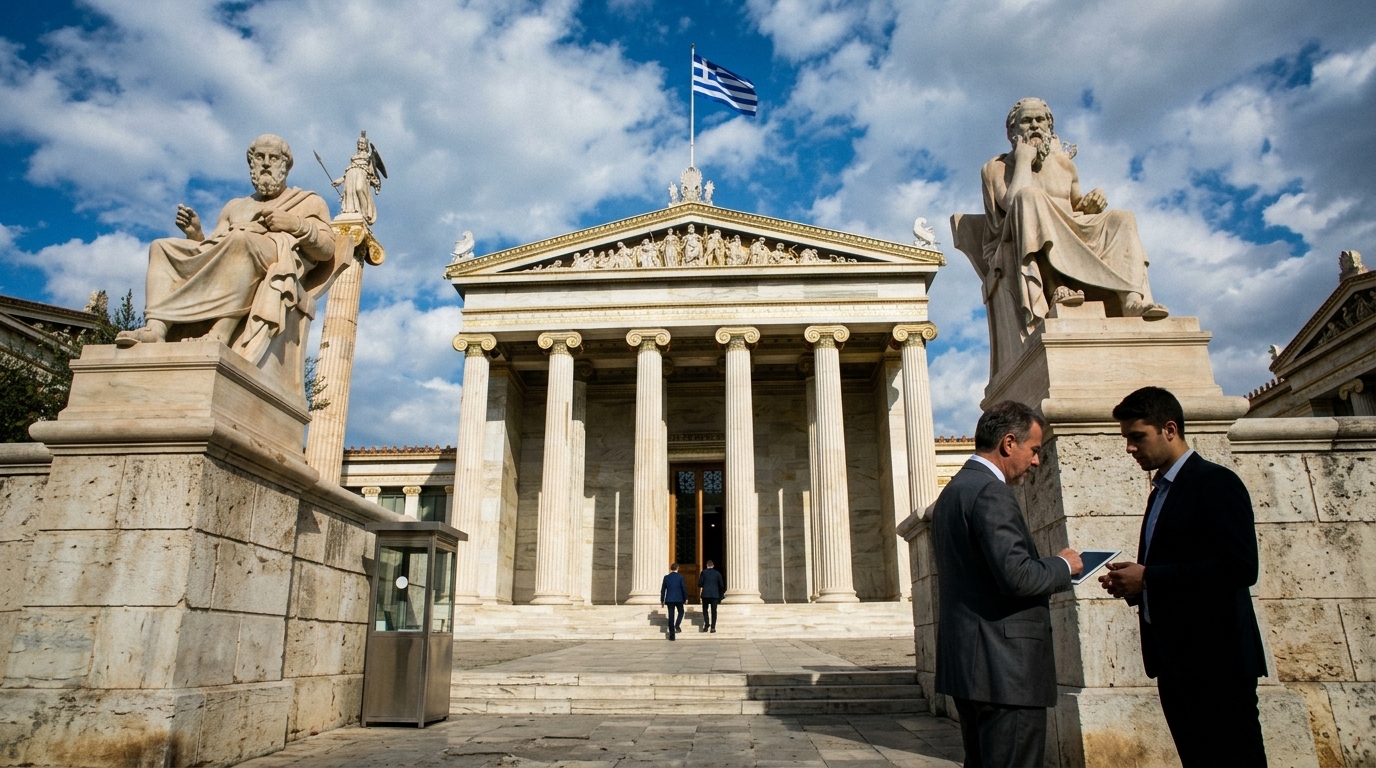
The era when Greece was Europe’s 'cheap bet'—a market where investors entered solely in hopes of a quick, high-risk recovery—appears to be firmly in the past. According to a recent analysis by Bank of America (BofA), the Greek economy and the Athens Stock Exchange have transitioned into a new phase of maturity. This shift is not merely a change in analyst terminology but a fundamental reassessment of how global capital perceives the country.
From Recovery to Quality
For nearly a decade, the Greek market was labeled as 'distressed.' Corporate valuations were exceptionally low, reflecting massive systemic risk and uncertainty regarding Eurozone membership. Today, BofA points out that the 'Greek discount' relative to European markets has narrowed significantly. Investors are no longer buying Greece because it is 'cheap,' but because it offers quality characteristics that are becoming scarce across the rest of the Continent: robust growth, fiscal discipline, and a fully rehabilitated banking sector.
The American bank's report emphasizes that Greece has managed to turn a crisis into a structural reform advantage. Regaining investment grade status was the milestone that allowed large institutional portfolios—previously prohibited from investing in 'junk' rated assets—to allocate capital to the Greek market. This has created a new investor base with a long-term horizon, reducing the volatility previously driven by speculative hedge funds.
The Banking Sector as a Catalyst
Greek banks are the spearhead of this new era. BofA notes that the return to dividend distributions after 16 years is not just a financial event but a powerful signal of normalcy. The profitability of Greek banks is supported by high interest rates and the drastic reduction of Non-Performing Exposures (NPEs). Currently, Greek banks are directly compared to their Southern European peers in Spain and Italy, stripped of the 'stigma' of the past decade.
- Capital adequacy remains high, allowing for further credit expansion.
- Digital transformation has significantly lowered operational costs.
- The Hellenic Financial Stability Fund (HFSF) stake has been nearly zeroed out, returning control to the private sector.
However, BofA warns that the challenge for banks now lies in maintaining this profitability in an environment where ECB interest rates may begin to decline. The focus must shift from net interest income to fee-based income and the financing of large-scale infrastructure projects.
Macroeconomic Stability and Risks
The Greek economy is expected to grow at rates above the Eurozone average in the coming years, fueled by the Recovery and Resilience Facility (RRF) funds. BofA views Greece as a 'safe haven' within the periphery, given the country's relative political stability compared to other European powers. The debt-to-GDP ratio reduction is the fastest in Europe, a fact that bolsters market confidence.
"Greece is no longer a crisis recovery story; it is a story of convergence with the European core," the report states.
Despite the optimism, clouds remain on the horizon. BofA points out that the Greek market remains vulnerable to external shocks, such as geopolitical tensions in the Eastern Mediterranean and fluctuations in energy prices. Furthermore, the need for continued reforms in the judicial system and public administration remains imperative to sustain the country's attractiveness as a long-term investment destination. Greece is no longer the 'cheap bet,' but to become Europe's 'premium asset,' it must prove that its growth has both depth and duration.





