

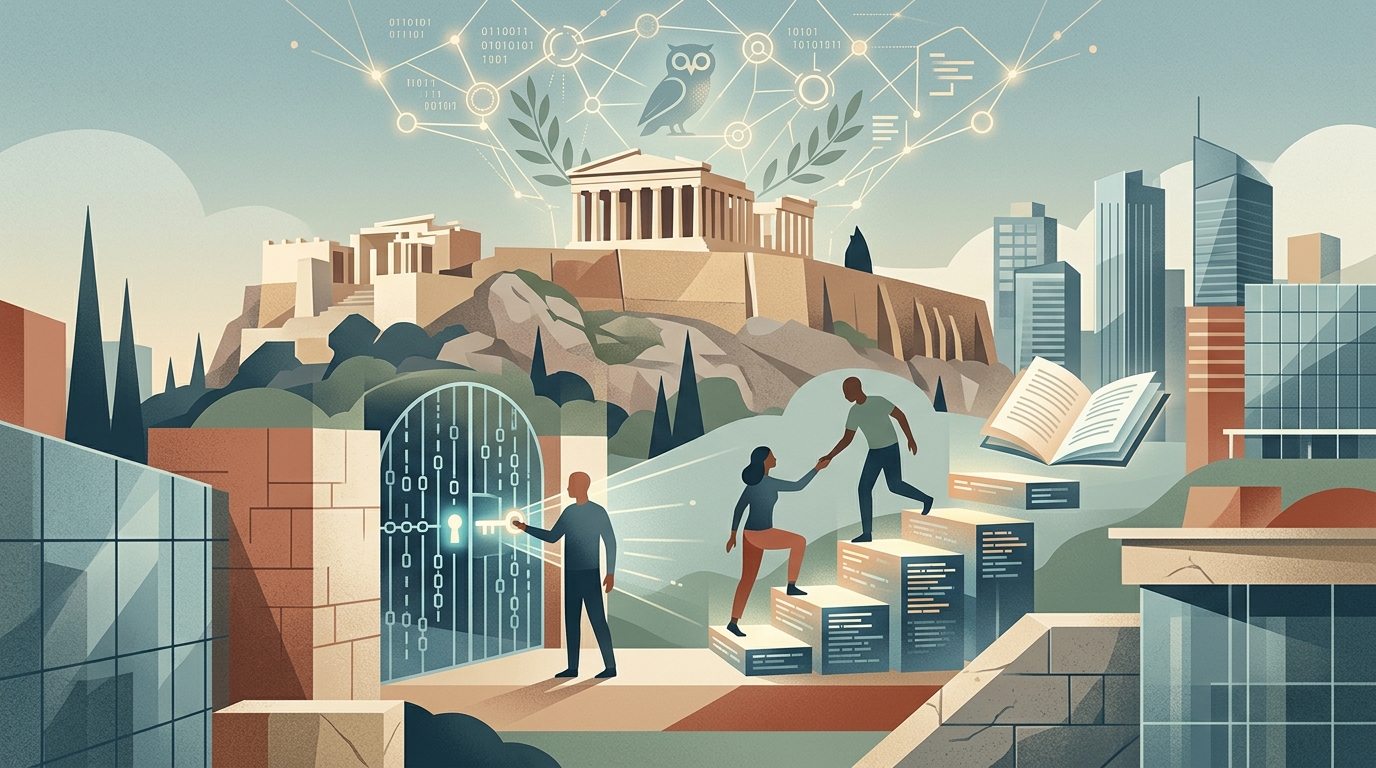
In an era where digital transformation is no longer an option but a prerequisite for social participation, Domna Michailidou places the issue of digital literacy at the heart of social policy. Through the 'Everyone Digital' (Oloi Digital) program, the Greek government is attempting to bridge the gap that separates vulnerable social groups from modern state and market services. For Michailidou, knowledge of digital tools is not merely a technical skill, but an act of liberation that allows citizens to regain their autonomy.
Digital Inclusion as a Social Contract
The digital revolution in Greece, which accelerated rapidly in recent years via the gov.gr platform, has created a paradox: while services became more accessible for the average user, they simultaneously became more remote for those lacking basic digital skills. Seniors and people with disabilities (PwDs) found themselves facing a new type of exclusion—'digital illiteracy'—which makes them dependent on third parties for simple daily tasks, such as prescriptions, banking transactions, or communicating with the state.
Domna Michailidou emphasizes that an individual's freedom is restricted when they cannot manage their personal information and needs autonomously. The 'Everyone Digital' program does not just aim at teaching how to use a tablet or a smartphone; it aims at fostering a culture of self-confidence. When a senior learns to make a video call to their grandchildren or book a medical appointment online, they don't just gain a convenience; they break the chains of isolation and dependency.
The 'Everyone Digital' Program and Its Focus
The operational arm of the program includes a series of targeted actions spanning the entire country. In collaboration with municipalities, social structures, and volunteers, 'digital corners' are being created where citizens can receive personalized support. The approach is human-centric: instructors do not function as IT teachers, but as companions in digital daily life.
- Training in the use of basic communication apps (WhatsApp, Viber).
- Familiarization with the gov.gr portal and electronic prescriptions.
- Internet safety and protection against digital scams.
- Accessibility for PwDs through specialized software and support tools.
Particular emphasis is placed on people with disabilities, for whom technology can serve as the ultimate equalizer. From screen reading systems for the visually impaired to voice command applications for those with mobility difficulties, the digital world offers solutions that physical reality often fails to provide. Ms. Michailidou points out that investing in accessibility is an investment in democracy.
Autonomy and Dignity in Old Age
The demographic aging of the population in Greece makes the digital integration of the elderly an imperative. Loneliness and social isolation are the 'silent epidemics' of our time. The ability of seniors to participate in social networks, stay informed, and find digital entertainment has been proven to significantly improve their mental health and cognitive function.
"We do not want a two-speed society, where technology is a privilege of the few and the young. We want a society where age is not a barrier to progress," the Minister states emphatically.
This strategy is also inextricably linked to the 'Silver Economy.' The active participation of the elderly in the digital market has not only a social but also an economic impact. The ability to make online purchases or use digital health services reduces costs for the state and boosts consumption, creating a sustainable ecosystem for all generations.
Challenges and the Future of Digital Equality
Despite the positive prospects, significant challenges remain. The lack of infrastructure in remote areas, the cost of equipment, and natural resistance to change are obstacles that require continuous effort. Ms. Michailidou acknowledges that 'Everyone Digital' is only the beginning. The challenge for 2026 and beyond is to ensure that digital education becomes a continuous process rather than a one-off seminar.
The vision for a digitally inclusive Greece requires cooperation between the public and private sectors. Technology companies must design products with Universal Design in mind, while the state must guarantee that no citizen is left behind because they didn't have the chance to learn. Ultimately, digital literacy is the new 'highway code' of social life: without it, you remain stationary in a world that is moving fast.





