

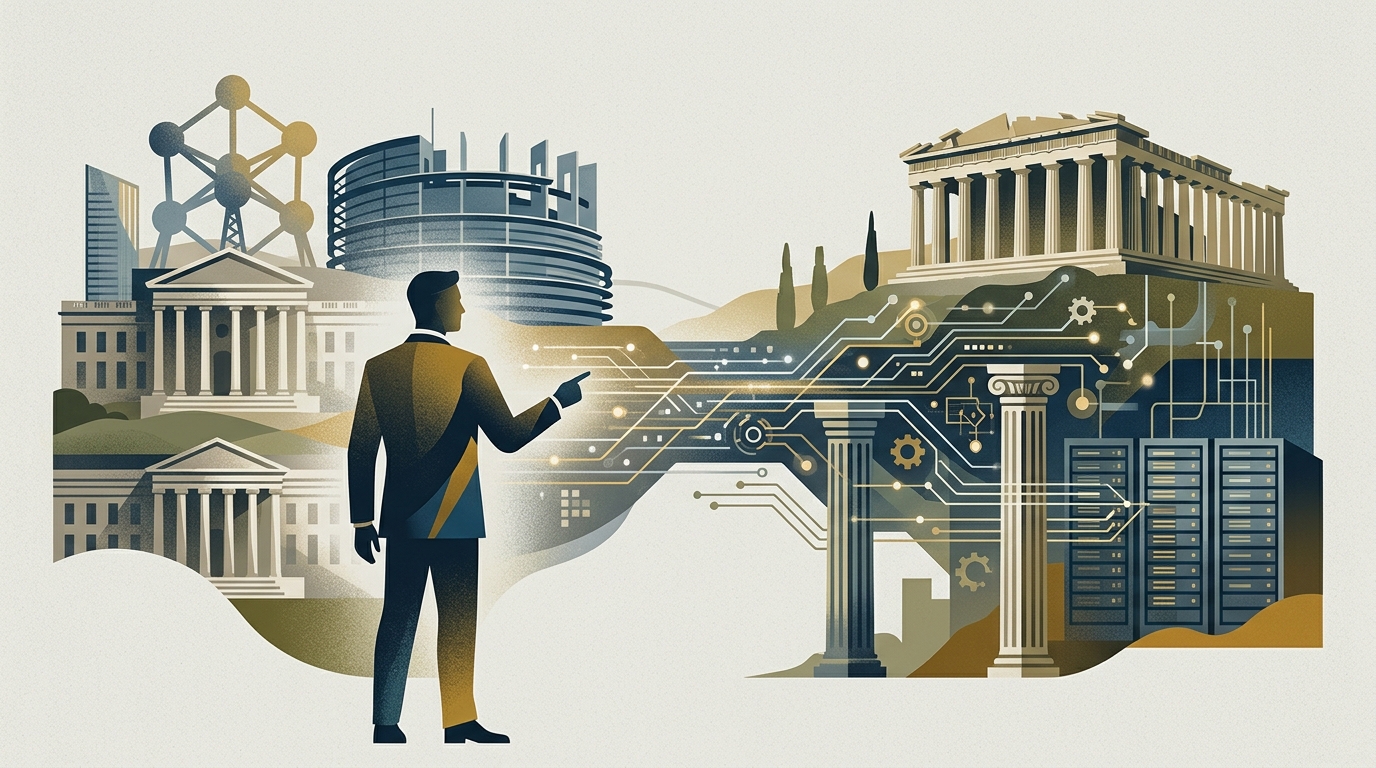
At the heart of European developments in Brussels, the discussion on Artificial Intelligence (AI) has taken on an existential character for the European Union. New Democracy MEP Dimitris Tsiodras stood at the center of this debate as a keynote speaker at a seminar dedicated to the impact of AI on society, the economy, and democracy. His intervention was not merely a political statement, but a sophisticated analysis of the delicate balance Europe must maintain between innovation and ethical standards.
Mr. Tsiodras, possessing a deep understanding of the communication and political landscape, emphasized that Artificial Intelligence is not a future threat or promise, but a present reality reshaping the production model. In his speech, he highlighted that Europe, through the AI Act, attempted to set the first global rules; however, the challenge is now shifting from legislation to implementation. Greece, according to the MEP, is in a privileged position to utilize these tools for modernizing public administration and strengthening the competitiveness of small and medium-sized enterprises (SMEs).
The Challenge to Democracy and the Threat of Deepfakes
One of the central points of Mr. Tsiodras's speech was the protection of democratic institutions from the manipulation enabled by advanced technology. In an era where deepfakes and automated disinformation can shake citizens' trust, the MEP called for an "alliance of truth" between politics, tech giants, and civil society. He stressed that algorithmic transparency is not just a technical issue, but a matter of freedom.
"Our democracy is based on the informed choice of the citizen," he noted. "If this choice is tainted by artificially generated lies, then the foundation of our polity is at risk." His proposal includes stricter labeling frameworks for AI-generated content and investment in media literacy so that citizens can develop critical thinking against the digital deluge.
Competitiveness and the "Greek Opportunity"
Beyond the risks, Dimitris Tsiodras focused on the vast economic prospects. He analyzed how AI could serve as an accelerator for the European economy, which often lags behind the US and China in high-tech investment. For Greece, Mr. Tsiodras sees a historic opportunity: the transition from a service-based economy to a knowledge-intensive one.
- Utilizing AI in tourism for personalized experiences.
- Enhancing agricultural production through precision farming.
- Digitalizing justice for faster adjudication.
- Creating an attractive ecosystem for startups developing specialized AI applications.
The MEP noted that Kyriakos Mitsotakis's government has already laid the groundwork by establishing the Advisory Committee on Artificial Intelligence, staffed by leading scientists globally. His presence in Brussels acted as a bridge, conveying the message that Greece is no longer a "laggard" in developments but an active co-shaper of the European digital agenda.
The Social Contract in the Digital Age
Closing his remarks, Mr. Tsiodras referred to the need for a new "social contract." Artificial Intelligence will change the nature of work, eliminating some positions but creating many more, provided there is massive investment in reskilling the workforce. Europe must ensure that this transition is fair and leaves no one behind.
"Technology must serve humanity, not the other way around. The human-centric nature of the European approach is our comparative advantage against authoritarian control or unchecked commercialization," he concluded.
The seminar in Brussels highlighted that the political management of AI is perhaps the most critical bet of the current European term. Dimitris Tsiodras, with his measured yet decisive stance, confirmed that Greek representation in the European Parliament possesses the reflexes and depth required by the times.





