

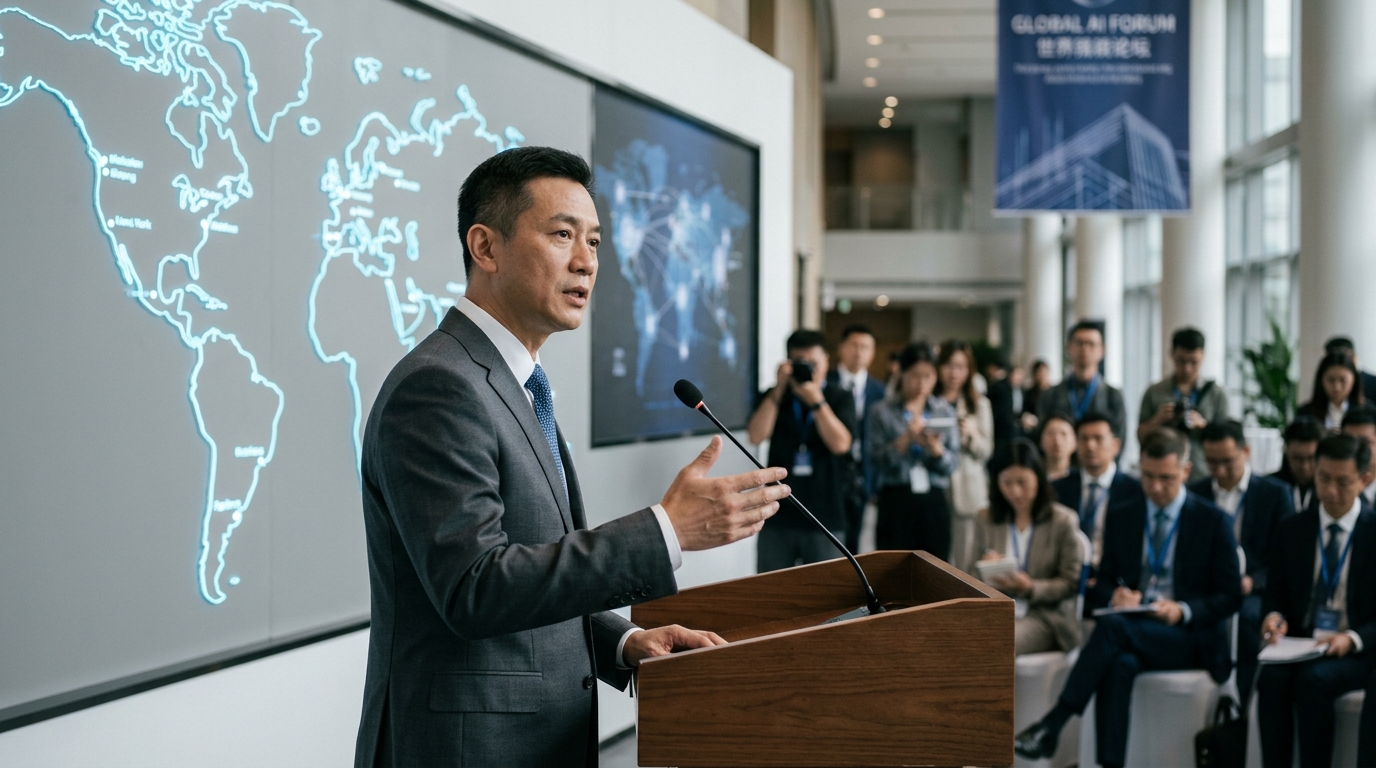
In the high-stakes geopolitical chessboard of Artificial Intelligence, Beijing is no longer content with being a spectator or a mere hardware manufacturer. The rise of Zhipu AI, a company forged in the halls of the prestigious Tsinghua University, represents China’s most formidable answer to the dominance of OpenAI and Google. As we move through 2026, Zhipu is not just a startup; it is a national champion in a survival race that is redefining the relationship between East and West.
The Tsinghua Pedigree and Strategic Foundation
Zhipu AI did not emerge from a vacuum. Its backbone is the Knowledge Engineering Group (KEG) at Tsinghua University, often referred to as "China’s MIT." This academic lineage provides the company with an advantage rarely seen in private ventures: a deep, theoretical understanding of Large Language Models (LLMs) coupled with unwavering state support. Zhipu’s GLM (General Language Model) series was designed with a different architecture than GPT, focusing on efficiency and the ability to operate in resource-constrained environments.
The company’s strategy centers on "open access with Chinese characteristics." While OpenAI increasingly gates its models behind paywalls and proprietary APIs, Zhipu has released versions of its models to the community, fostering an ecosystem of developers dependent on its stack. This is more than a business move; it is a geopolitical statement. China is building its own alternative standard for the world’s future technological infrastructure.
Navigating Sanctions: Innovation Through Necessity
The primary hurdle for Zhipu, and by extension Chinese AI, remains the restricted access to advanced semiconductors. US sanctions on Nvidia’s H100 and B200 chips have forced Chinese engineers to become exceptionally creative. Zhipu has invested massive resources into optimizing its algorithms to extract maximum performance from domestic hardware, such as chips from Huawei and Moore Threads.
This "innovation through necessity" has birthed models that are remarkably efficient in terms of power consumption and computational overhead. Analysts suggest that if Zhipu can match GPT-4o’s performance while using only 50% of the compute power required by OpenAI, China will have won a critical battle in the efficiency war, effectively bypassing the American embargo through algorithmic ingenuity.
The Challenge of Ideological Alignment
Beyond technical hurdles, Zhipu must solve a puzzle that its Western counterparts do not face to the same degree: strict ideological alignment with the Chinese Communist Party’s guidelines. Models must be "safe" not only from an ethical or bias standpoint but also from a political perspective according to Beijing’s standards. This creates a unique tension between AI creativity and political compliance.
"Artificial Intelligence in China is not merely a productivity tool; it is a mirror of national values and social stability," state sources close to the industry.
However, this constraint also serves as a filter. Zhipu is developing alignment and filtering systems that are significantly more sophisticated than Western equivalents, as failure in this domain in China carries legal consequences rather than just a PR crisis. This has led to specialized research in "controllable AI" that could eventually find applications in highly regulated Western industries like finance and law.
The Road Ahead: From Catching Up to Leading
Zhipu AI, alongside Kai-Fu Lee’s Yi and 01.AI, represents the vanguard of a new generation of Chinese firms that no longer wish to be labeled as "the Chinese version of OpenAI." Their goal is to define the next phase of AI, focusing on deep integration into heavy industry, robotics, and state governance.
As 2026 unfolds, the performance delta between GLM and GPT models is narrowing. Zhipu has already demonstrated multimodal capabilities that rival the best in the West, particularly in non-English linguistic contexts. The race is no longer just about who reaches AGI first, but about who controls the infrastructure upon which the future global economy will be built. Zhipu AI is the living proof that China has no intention of being left behind in the AI revolution.





