

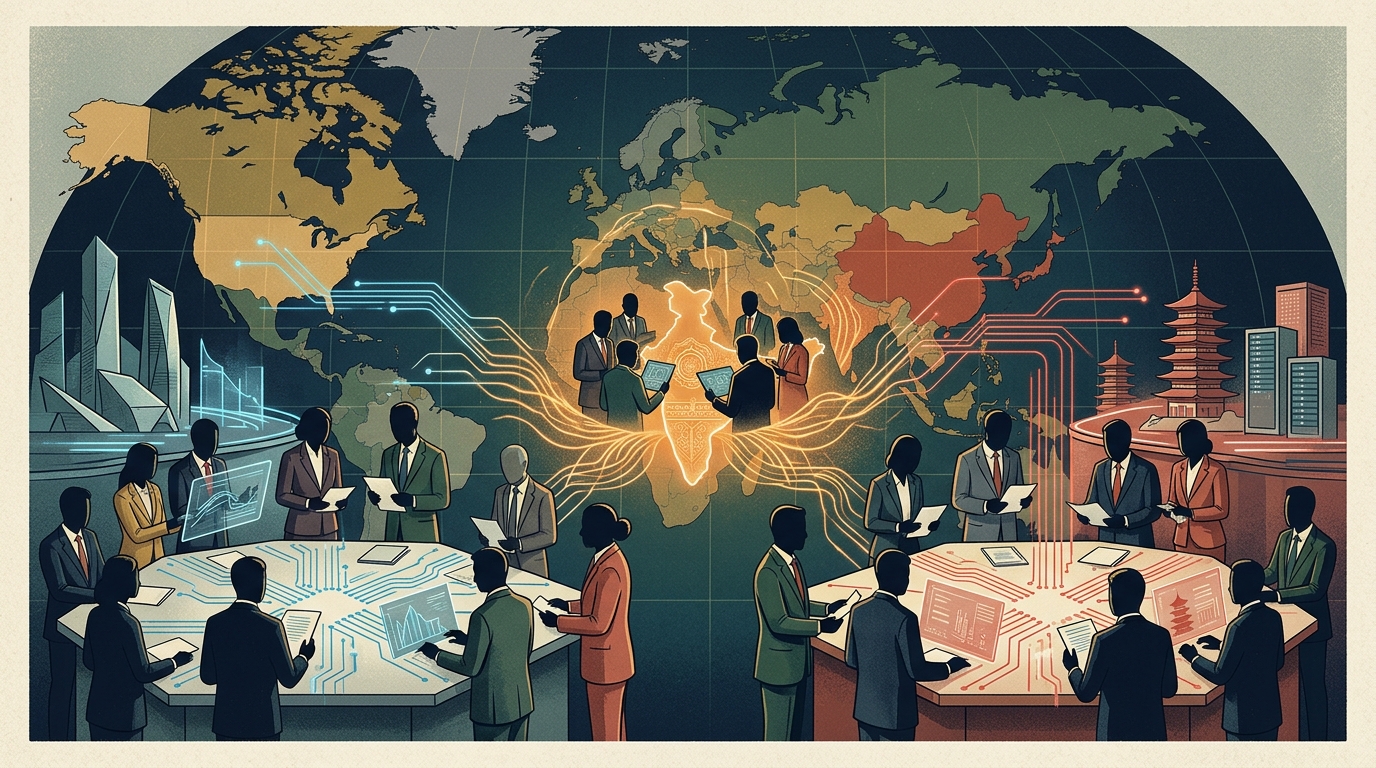
As we navigate through June 2026, the global geopolitical chessboard is no longer defined by physical borders or traditional armaments, but by lines of code and semiconductor capacity. The clash between the United States and China for dominance in Artificial Intelligence (AI) has entered a new, more complex phase, where theories of "technological power" are being radically revised. In this context, India is emerging not merely as a passive observer or a market, but as a strategic architect proposing an alternative path to digital sovereignty.
The Frontier Theory and American Strategy
The traditional American approach is based on the "technological frontier theory." According to this, power stems from possessing the most advanced, cutting-edge technologies—the fastest chips, the largest language models (LLMs), and the most sophisticated quantum computing. Washington, through the Department of Commerce, has imposed strict export controls on high-end technology to Beijing, betting that maintaining a 2-3 generation lead in semiconductors will ensure its geopolitical supremacy.
However, this theory is facing criticism. Many analysts argue that in the AI era, power lies not just in invention but in diffusion. The ability of an economy to integrate AI into its daily operations, from agriculture to manufacturing, may prove more significant than possessing the world's most powerful supercomputer.
The Chinese Response: Self-Reliance and Applied Power
Facing exclusion from the Western "frontier," Beijing has shifted its focus toward building vertical self-reliance. The Chinese theory of power centers on "Applied AI" and "Big Data." With a population of 1.4 billion people who are fully digitized, China possesses the "fuel" to train models that, while perhaps less elegant than American ones, are exceptionally effective in specific industrial and social applications.
"Technological power in the 21st century is not measured by what you can build in a lab, but by what you can scale across society," notes a tech executive from Shanghai.
China is promoting its own vision of the "Digital Silk Road," exporting surveillance systems and AI infrastructure to countries in the Global South, thereby creating a sphere of technological influence that operates independently of American standards.
The India Narrative: Digital Public Infrastructure as a Model
This is where India's originality lies. New Delhi refuses to be trapped in the U.S.-China binary. The Indian narrative is built on the concept of "Digital Public Infrastructure" (DPI). Through systems like Aadhaar and UPI, India has demonstrated that technology can function as a public good, accessible to all, rather than a closed monopoly of large corporations or authoritarian states.
India is now promoting "AI for All." Instead of competing with the U.S. in hardware, India focuses on developing open standards and leveraging its vast workforce for data labeling and software development. The Indian approach argues that true technological power lies in "data sovereignty" and the ability of a state to protect its citizens while fostering innovation.
- Development of indigenous language models supporting India's 22 official languages.
- Partnerships with the West for technology transfer while maintaining strategic autonomy.
- Promotion of DPI as an exportable product to other developing nations.
Conclusions and Outlook
The U.S.-China conflict is not just a trade war; it is a conflict over which theory of power will prevail in the century of intelligence. India, acting as a "swing state," holds the keys to the balance. If the Indian model of democratic, accessible, and scalable technology succeeds, then the future of AI may be neither American nor Chinese, but multipolar and deeply human-centric.





