

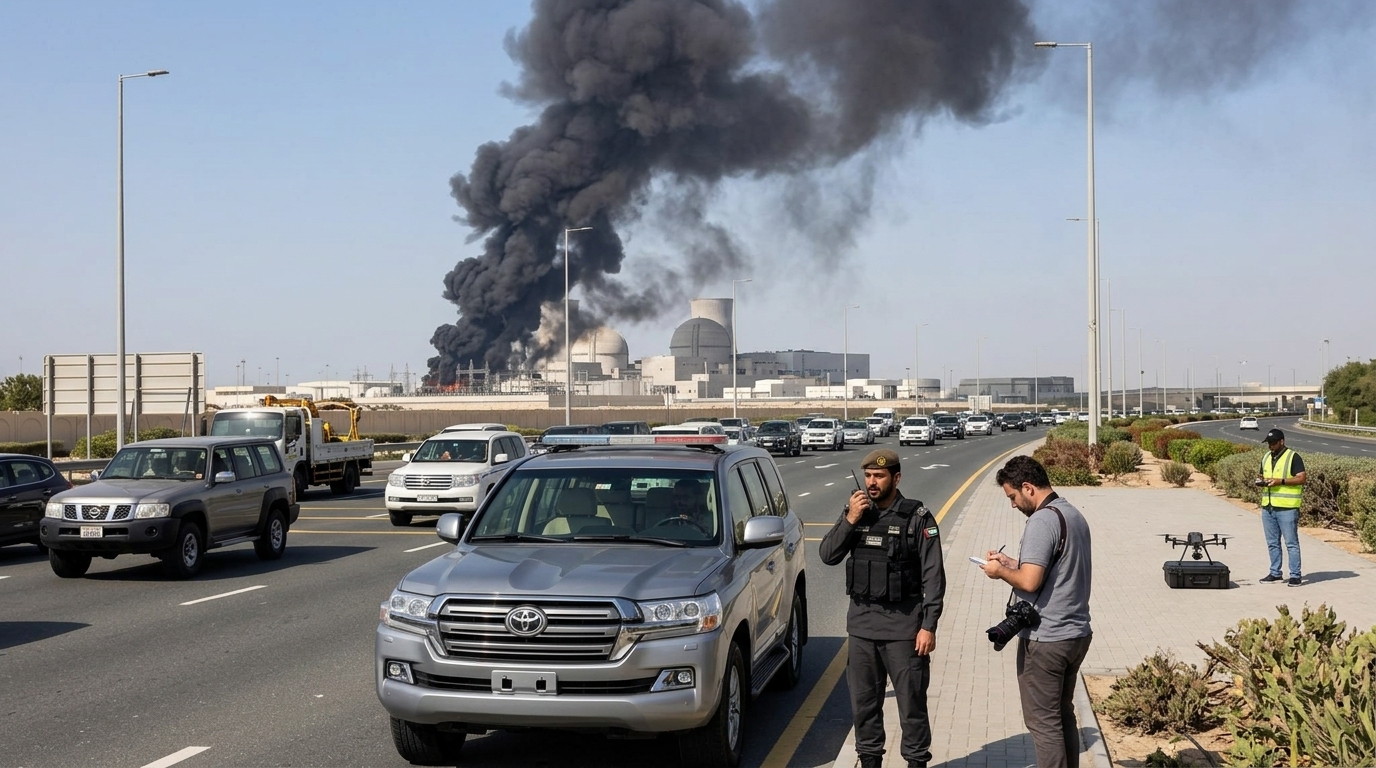
The news of the interception of unmanned aerial vehicles (drones) near the Barakah nuclear power plant in the United Arab Emirates (UAE) is not merely a military incident; it is a stark reminder of the geopolitical instability prevailing in one of the world's most critical energy arteries. The UAE Ministry of Defense is on high alert, conducting exhaustive investigations to determine the origin of the drones, in an attempt to decipher who lies behind this provocative action aimed at the country's energy heart.
The Strategic Importance of Barakah and the Doctrine of Deterrence
The Barakah nuclear power plant, located in the Al Dhafra region of Abu Dhabi, is the crown jewel of the Emirates' energy program. With four APR-1400 reactors, the plant is designed to meet up to 25% of the country's electricity needs, drastically reducing its carbon footprint. However, the very nature of nuclear energy makes the plant a high-value target for anyone wishing to cause not only economic damage but also a psychological shock to the international community.
This attack comes at a time when the UAE has invested billions in air defense systems, including American Patriot and THAAD systems, as well as advanced Israeli technologies following the Abraham Accords. The fact that drones managed to approach such a well-guarded area raises questions about the effectiveness of existing systems against small, low-altitude, and potentially autonomous threats that use artificial intelligence to evade radar detection.
The Attribution Problem and 'Gray Zone' Warfare
The biggest challenge facing UAE authorities is 'attribution.' In the modern era of asymmetric warfare, the use of drones allows states or paramilitary organizations to carry out attacks while maintaining 'plausible deniability.' Whether it is the Houthi rebels in Yemen, who have launched similar attacks in the past, or Iranian-backed militias in Iraq, identifying the exact geographical starting point of the drones is a technically arduous process requiring the analysis of debris, electronic circuits, and flight data.
The geopolitical chessboard in the region is extremely complex. Iran, despite the recent diplomatic rapprochement with Saudi Arabia and the UAE, continues to use its proxies as a means of leverage. On the other hand, the UAE's increasing cooperation with the West and Israel in the security sector irritates Tehran. The attack on Barakah can be interpreted as a message that no infrastructure, no matter how protected it is considered, is immune.
Drone Technology as a Tool for Geopolitical Instability
The evolution of drone technology has radically changed the cost of war. While a Patriot interceptor missile can cost millions of dollars, a 'kamikaze' drone can be built for a few thousand dollars using commercially available components. This economic asymmetry favors the attacker. Furthermore, the integration of AI algorithms allows drones to fly in swarms, overwhelming air defense systems.
In the case of Barakah, authorities are examining whether the drones were satellite-controlled, followed a pre-programmed GPS path, or even used visual terrain recognition to navigate without a signal—which would make jamming ineffective. The analysis of propulsion systems and explosive warheads will reveal whether this is technology coming directly from state arsenals or if it is the product of improvised workshops.
International Reactions and the Path Forward
The international community is watching with bated breath. A successful attack on a nuclear plant could have catastrophic environmental consequences, even though APR-1400 reactors have extremely robust containment structures. The International Atomic Energy Agency (IAEA) has repeatedly emphasized that nuclear facilities must remain outside military conflicts under international law.
For the UAE, the response will be multi-layered. Beyond strengthening physical security, an intense diplomatic campaign is expected to condemn the perpetrator once identified. The stability of the UAE as a business and tourism hub relies on the image of absolute security. Any breach in this image could affect foreign investment and market confidence. The search for the originating country is not just a matter of military justice, but of the survival of the Emirati economic model in an increasingly unpredictable world.




