

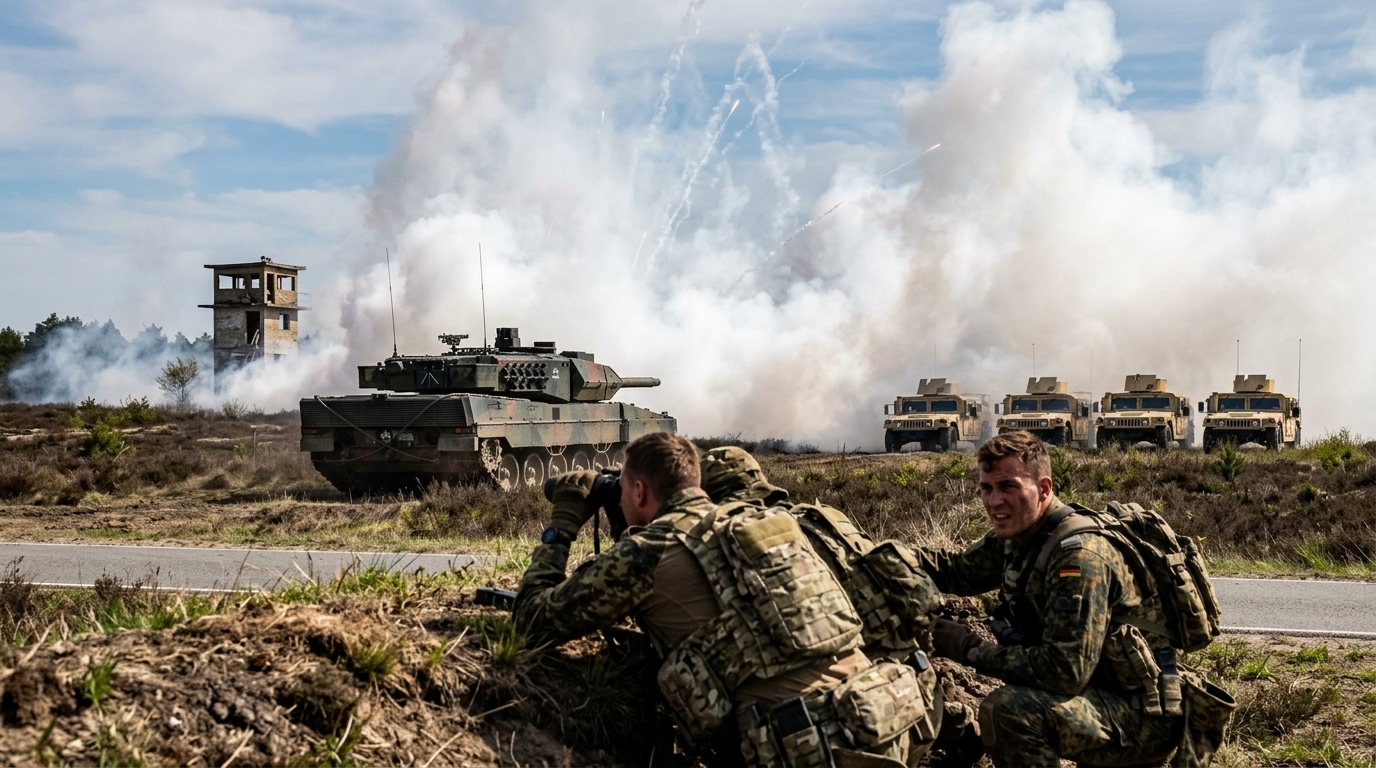
In a move that threatens to dismantle the post-WWII security architecture of Europe, President Donald Trump has announced his intention to reduce the U.S. military footprint in Germany "a lot further" than the previously discussed drawdown of 5,000 troops. This announcement, which hit the Pentagon like a lightning bolt, represents more than just a tactical shift; it is a direct assault on the traditional alliances that have defined Western stability for decades.
Blindsided in Real Time
According to senior defense officials, the leadership across the various branches of the U.S. military had no prior knowledge of the scale or timing of this withdrawal. "We learned about the specifics in real time, alongside the general public," a Pentagon source stated. This profound lack of coordination between the White House and the professional military establishment highlights a widening chasm between political directives and national security expertise.
Germany currently hosts approximately 35,000 U.S. troops, serving as the operational heart for U.S. missions across Europe, Africa, and the Middle East. Facilities like Ramstein Air Base and Landstuhl Regional Medical Center are not merely bases; they are the logistical backbone of American power projection in the Eastern Hemisphere. A drastic reduction in these forces would severely hamper the U.S. ability to respond rapidly to global crises, from the ongoing tensions in Ukraine to instability in the Persian Gulf.
The 'America First' Doctrine vs. Strategic Reality
Trump’s rhetoric has remained remarkably consistent: Germany is framed as a "delinquent" partner within NATO for failing to meet the 2% GDP defense spending target at a pace acceptable to Washington. To the President, troop presence is a transactional commodity rather than a strategic investment. "We’re protecting Germany, and they don’t pay. Why should we stay there?" he remarked in a recent address, largely dismissing the complex geopolitical benefits that a stable, U.S.-aligned Germany provides to American interests.
However, analysts argue that this move is driven more by domestic political signaling than by a coherent national security strategy. With an eye on his base, Trump frames the withdrawal as a cost-saving measure for the American taxpayer. This ignores the reality that relocating and re-establishing these forces in other jurisdictions—or bringing them back to the continental U.S.—could ultimately cost billions of dollars in infrastructure and logistics, potentially exceeding the costs of maintaining them in Germany.
Berlin’s Reaction and the Push for Strategic Autonomy
In Berlin, the government is struggling to maintain a facade of calm while preparing for a worst-case scenario. Germany has already embarked on a massive rearmament program following the Russian invasion of Ukraine, but a sudden American vacuum creates a security gap that cannot be filled overnight. "Europe's security cannot be subject to the whims of a single individual in Washington," a senior German diplomat noted, reflecting a growing sentiment of betrayal.
This development has breathed new life into the debate over the European Union's "Strategic Autonomy." If the U.S. can no longer be relied upon as the ultimate guarantor of continental security, European powers—led by France and Germany—will be forced to develop an independent military capability. Yet, such a transition requires a level of political unity and financial commitment that remains elusive among many EU member states who fear a permanent rupture with Washington.
Implications for the Eastern Flank
Perhaps the most concerned parties are those on NATO's Eastern Flank. Poland and the Baltic states view the U.S. presence in Germany as the primary deterrent against Russian expansionism. While Trump has hinted that some troops might be shifted to Poland, the overall weakening of the U.S. posture in Europe sends a signal of fragmentation to Moscow. At a time when Russia is reorganizing its military and China is expanding its global influence, the alienation of traditional allies could be viewed as a historic strategic blunder.
Ultimately, the decision to bypass military experts and blindsided the Pentagon erodes the institutional trust necessary for global leadership. As the U.S. pulls back, the world watches to see if Europe can stand on its own, or if the void will be filled by powers less friendly to the democratic order.
- The decision involves withdrawing over 5,000 troops, with hints of even deeper cuts to follow.
- Pentagon officials claim they were not consulted, leading to significant internal friction.
- Trump continues to use troop presence as leverage over Germany's defense spending.
- The move accelerates the debate over European Strategic Autonomy and military independence.




