

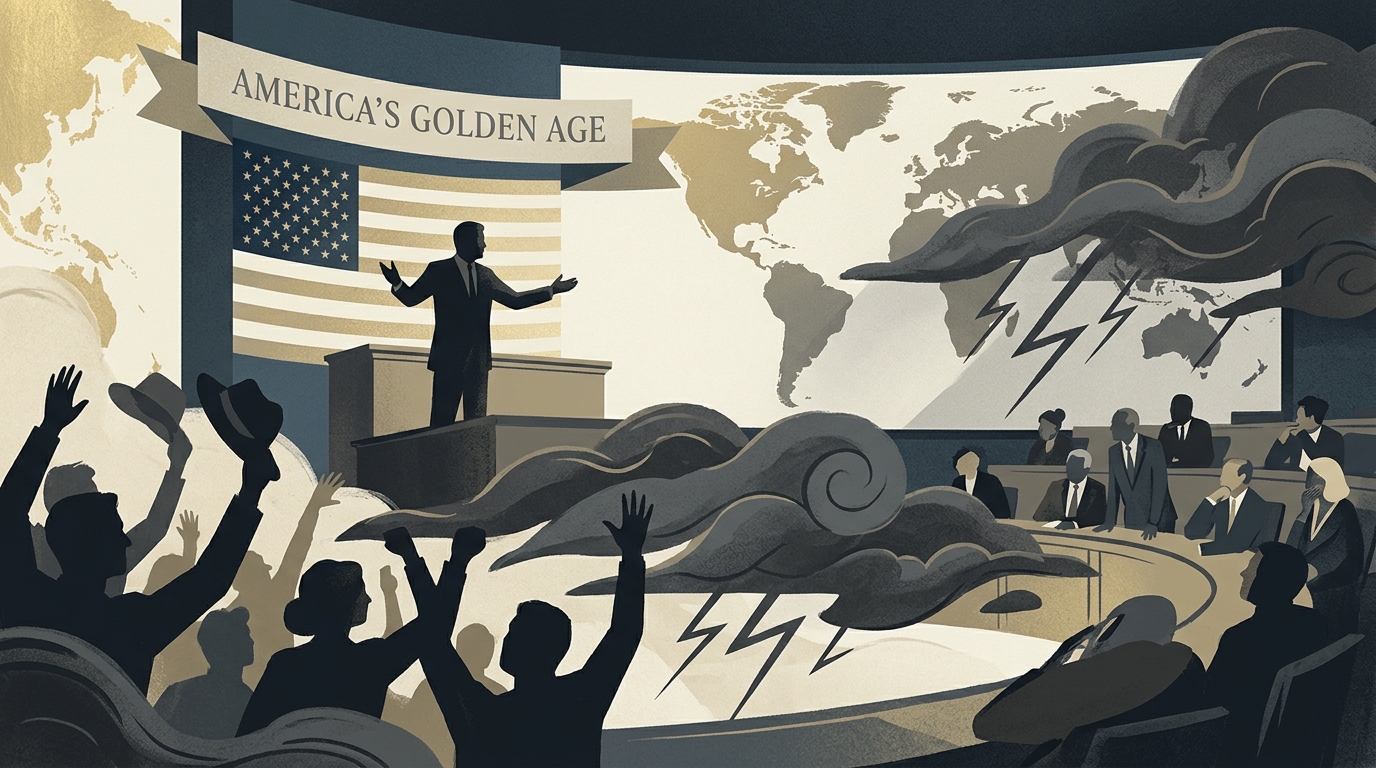
July 4, 2026, in Washington D.C. will be remembered not just for the traditional fireworks and parades, but for the stark contrast between triumphant political oratory and the raw power of nature. Amidst a sudden and violent thunderstorm that threatened to derail the celebrations, Donald Trump delivered a 40-minute address declaring the dawn of a new "Golden Age" for the United States, asserting that the nation's destiny is "written by God." The imagery was potent: a leader standing defiant against the elements, mirroring a political stance that seeks to weather global storms through sheer national will.
The Rhetoric of Destiny: A New Manifest Destiny
Trump’s speech at the National Mall was less a policy briefing and more a messianic manifesto. By invoking a "Golden Age," he tapped into a deep-seated American desire for renewal and dominance. This narrative of divine destiny—reminiscent of the 19th-century concept of Manifest Destiny—is designed to frame his administration's goals not as mere political choices, but as historical imperatives. He focused heavily on the themes of industrial rebirth, border security, and the restoration of American prestige, suggesting that the country is on the cusp of an era of unparalleled prosperity.
"This is only the dawn," he proclaimed, his voice amplified over the rolling thunder. For his supporters, this language provides a sense of purpose and certainty in an increasingly chaotic world. However, for critics, the conflation of religious destiny with state policy is a troubling development that risks alienating secular citizens and international partners alike, creating a narrative where dissent is framed as an opposition to the national fate itself.
Geopolitical Implications of the 'Golden Age'
Beyond the domestic theater, the "Golden Age" rhetoric carries significant weight for global affairs. The "America First" 2.0 doctrine is characterized by a more aggressive form of protectionism and a transactional approach to diplomacy. Trump signaled that American prosperity would no longer be sacrificed for the sake of international stability or the interests of allies. This stance comes at a time of profound global shifts, with China asserting its own regional dominance and the European Union struggling to find a unified voice in a post-globalization world.
The metaphorical storm hovering over the capital is emblematic of the geopolitical instability that defines the current era. As the U.S. retreats into a more isolationist posture, the vacuum left behind is being filled by competing powers, leading to a more fragmented and unpredictable international order. The promise of a domestic "Golden Age" may come at the cost of the global leadership role the U.S. has held since the end of World War II, raising questions about the long-term sustainability of such a vision.
A Nation Divided Under One Flag
The Fourth of July is traditionally a day of unity, yet the 2026 celebrations highlighted the deep fissures within the American body politic. While the crowds at the Mall cheered the President's vision, a significant portion of the country remains skeptical, if not outright hostile, to this brand of nationalism. The storm that broke over the event served as a reminder of the environmental and social challenges that cannot be solved by rhetoric alone.
The success of this promised "Golden Age" depends on more than just economic indicators or military strength; it requires a level of social cohesion that currently seems out of reach. As the country moves further into the late 2020s, the tension between the vision of a glorious, divinely-ordained future and the reality of a polarized, climate-threatened present will be the defining struggle of the American experiment. Whether the storm will pass or become the new normal remains the ultimate question for the republic.
Key Takeaways
- Trump framed the current era as the beginning of a divinely-ordained "Golden Age."
- The speech emphasized a return to aggressive industrial and border policies.
- Severe weather during the event served as a literal and symbolic backdrop to political tension.
- The "America First" 2.0 stance signals further shifts away from traditional multilateralism.





