

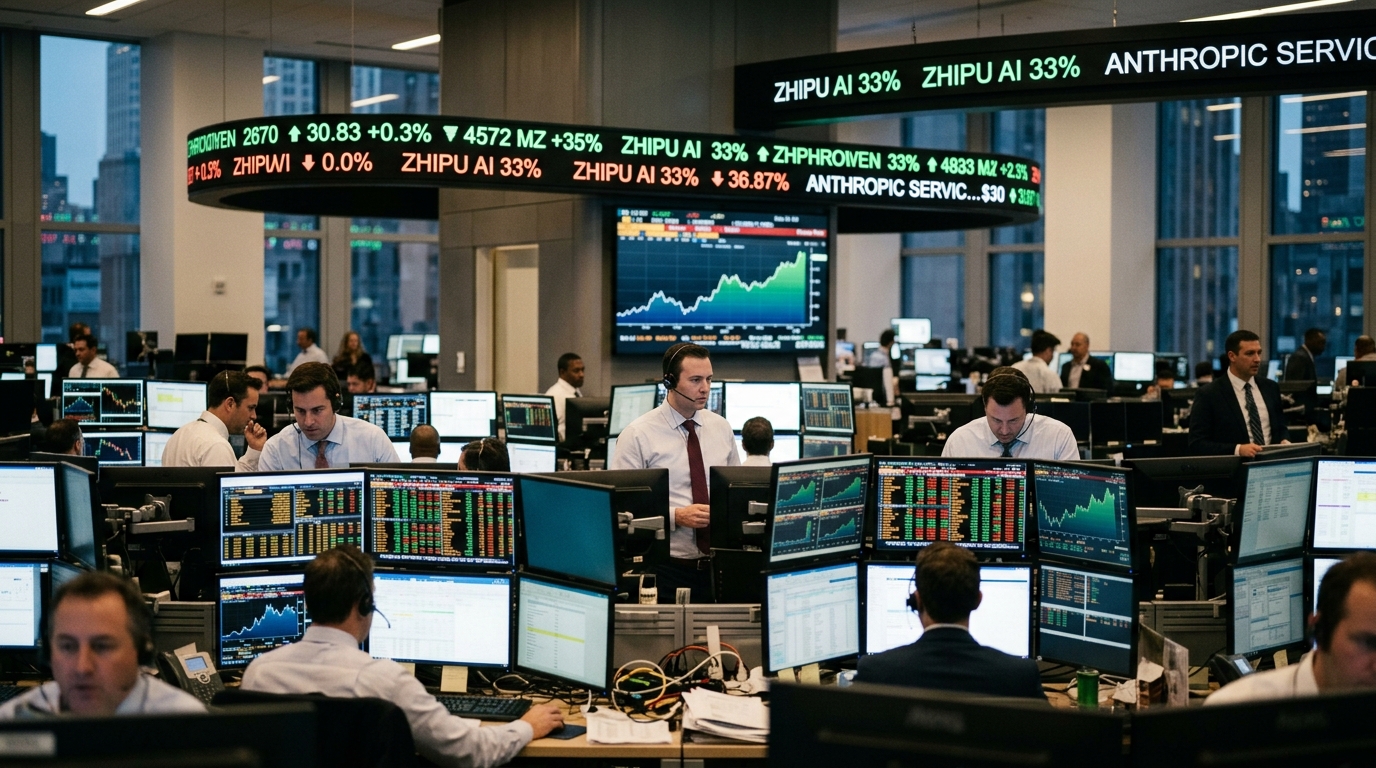
In a striking realignment of the global technology landscape, China’s Zhipu AI has seen its investment profile surge by 33%, as Wall Street recalibrates its strategies in response to shifting geopolitical sands. This development follows the decision by leading US AI labs, including Anthropic and OpenAI, to strictly enforce service restrictions and geofencing against users in mainland China. What was initially perceived as a major setback for the Chinese AI ecosystem is rapidly transforming into a powerful catalyst for domestic growth and capital reallocation.
The Rise of the 'AI Tigers'
Zhipu AI, a powerhouse originating from the prestigious Tsinghua University, is now positioned as the vanguard of China’s push for Large Language Model (LLM) sovereignty. Backed by industry titans like Alibaba, Tencent, and Meituan, the startup has developed models that rival GPT-4 in several key benchmarks. The recent 33% jump in valuation sentiment and investor interest underscores a fundamental market truth: capital abhors a vacuum.
When Anthropic announced it would restrict API access to Chinese developers, citing compliance and safety concerns, thousands of enterprises were left searching for alternatives. Zhipu AI, alongside peers like MiniMax and Moonshot AI, immediately launched aggressive 'migration packages,' offering low-cost transitions and dedicated technical support. Wall Street, observing this massive migration of users, is increasingly betting that Chinese champions will dominate their home market regardless of Washington's export controls.
Geopolitical Chess and Technological Sovereignty
This situation highlights the paradox of US tech restrictions. While the goal of export controls is to decelerate Beijing's technological advancement, denying access to American AI models is inadvertently accelerating China’s drive for self-reliance. Zhipu AI is no longer just a local alternative; it is the symbol of a full-scale decoupling from the Western technology stack.
- Sovereignty: Developing domestic models reduces vulnerability to Washington’s policy shifts.
- Localization: Zhipu’s models are inherently optimized for the Chinese language and specific regulatory environment.
- Capital Flows: Despite sanctions, global capital is finding indirect routes to participate in the Chinese AI boom, attracted by lower entry valuations compared to Silicon Valley.
"Anthropic’s exit was the ultimate marketing gift for Zhipu," says a senior technology analyst based in Hong Kong. "It created a sense of urgency and national purpose that no amount of government subsidy could have replicated."
Wall Street’s Dilemma and the Efficiency Gain
The increased betting from Wall Street is not without significant risk. US regulators are closely monitoring capital flows into Chinese AI firms, concerned that these investments might inadvertently fund military-dual-use technologies. However, the valuation arbitrage is becoming too lucrative to ignore. While Silicon Valley AI startups are trading at astronomical multiples, Chinese leaders like Zhipu offer a high-growth alternative at a fraction of the price.
Furthermore, Zhipu AI has demonstrated a remarkable ability to achieve high performance using less sophisticated hardware—a necessity born from Nvidia chip export bans. This 'efficiency gain' is now viewed as a competitive advantage. If Zhipu can deliver state-of-the-art results on restricted hardware, its long-term viability in a resource-constrained environment is significantly higher than its Western counterparts.
Conclusion: A Bifurcated AI Future
The 33% surge in Zhipu AI’s market standing is a landmark event for 2026. it signals the end of the era of American AI hegemony. The emergence of two distinct ecosystems—a Western stack led by the likes of OpenAI and Anthropic, and an Eastern stack led by Zhipu—is now a reality. For global investors, this bifurcation offers a new frontier of opportunity, but it also demands a sophisticated understanding of how technology and geopolitics are now inextricably linked. The world is no longer looking for a single AI leader; it is preparing for a divided one.





