

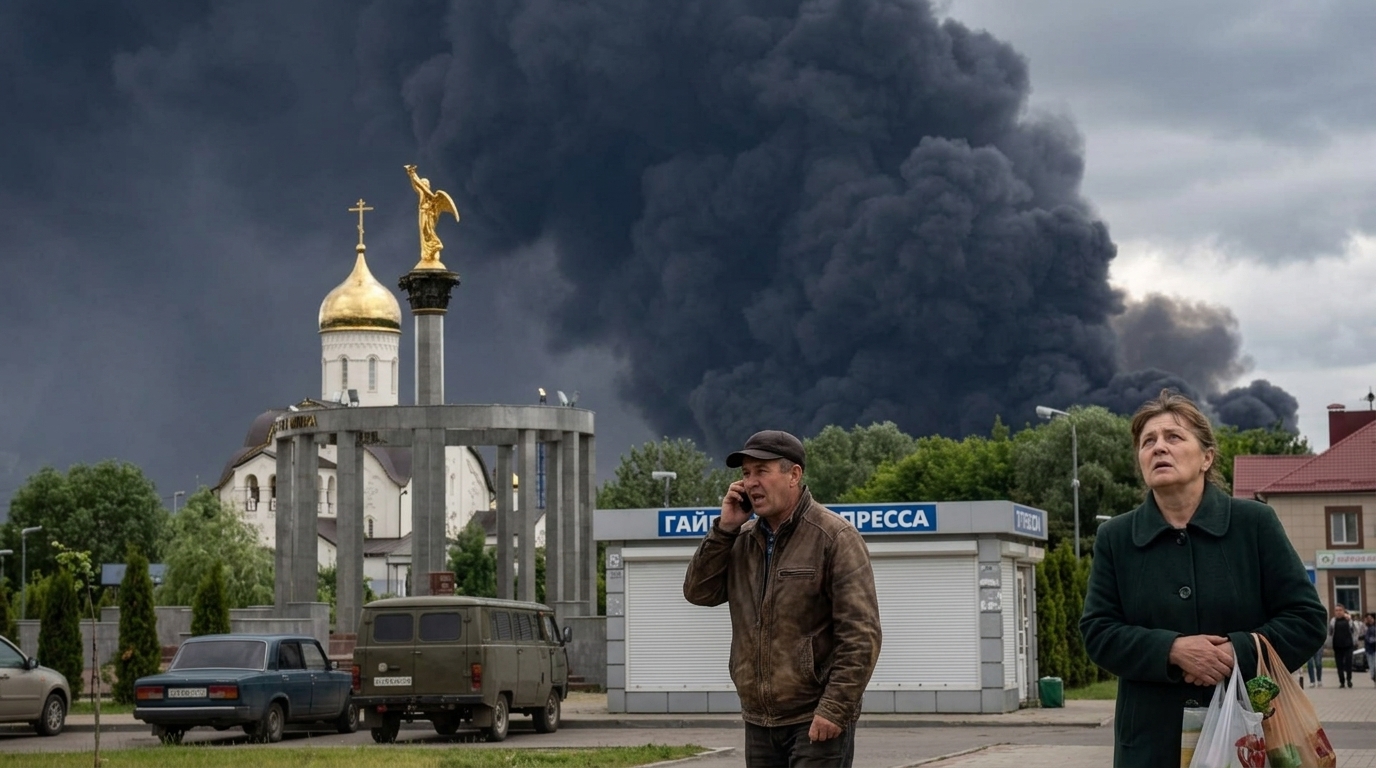
June 18, 2026, is already being recorded as a landmark date in the evolution of modern warfare in Eastern Europe. The massive attack involving nearly 200 unmanned aerial vehicles (drones) launched by Ukraine against Moscow and its suburbs is not merely a military operation; it is a clear declaration of intent. The chilling message, "If Ukraine burns, your Moscow will burn too," reflects Kyiv's new doctrine: bringing the cost of war directly to the doorstep of the Russian elite and citizens who previously viewed the capital as an invulnerable fortress.
The Technological Superiority of Asymmetry
This attack highlights the staggering advancement of the Ukrainian drone industry. Unlike the sporadic strikes of the past, the current operation utilized "swarming" techniques designed to oversaturate Russian air defense systems. Despite the presence of sophisticated S-400 systems and Pantsir-S1 batteries surrounding Moscow, the sheer volume of incoming targets created "digital and physical chaos." Many of these drones are constructed from composite materials that are difficult for radar to detect, flying at extremely low altitudes while following the terrain's contours.
This strategy is rooted in economic asymmetry. While a long-range Ukrainian drone may cost a few tens of thousands of dollars, the interceptor missile required to shoot it down costs millions. When the ratio is 200 to 1, the economic and operational attrition of air defenses becomes unsustainable in the medium term. Furthermore, the use of artificial intelligence for autonomous navigation in environments with heavy GPS jamming indicates that Kyiv has overcome the technical hurdles previously posed by Russian electronic warfare (EW).
Targeting Refineries: Economic Attrition
For the second time in a short period, a major refinery in the Moscow region was targeted by multiple strikes. This choice is not accidental. The Russian war machine is fueled by hydrocarbon revenues, and destroying oil processing infrastructure hits Russia on two levels. First, it diminishes the ability to supply the front lines with fuel, and second, it causes shortages in the domestic market, leading to price hikes and social discontent.
"Our strategy is simple: Russia must feel the price of its aggression. You cannot level Kharkiv and Kyiv and expect Moscow to continue living in a glass tower of safety," stated a high-ranking official from the Ukrainian intelligence service.
The attack on the refinery caused large-scale fires visible for miles, debunking the Kremlin's narrative that "all drones were successfully intercepted." Visual confirmation via social media videos serves as a potent tool of psychological warfare, reminding Russian citizens that the war is no longer a distant television image but a reality that can arrive at their doorstep.
The Political Dimension and Kremlin's Reaction
Moscow is now under immense pressure. Vladimir Putin has built his image as the guarantor of stability and security. An attack of this scale at the heart of his power directly challenges this image. The Russian response is expected to be harsh, with likely new waves of missile strikes against Ukrainian cities; however, the effectiveness of these reprisals is waning as Ukraine continuously strengthens its own air defenses with Western systems.
The international context is also critical. While Ukraine's Western allies were initially hesitant about strikes within Russian territory, the ongoing Russian escalation seems to have shifted the "red lines." Kyiv is now using domestically produced weapons for these operations, bypassing the restrictions set by the US and Europe regarding the use of their long-range missiles. This grants Ukraine the necessary strategic autonomy to conduct a war of attrition that forces Russia to withdraw resources from the front lines to protect its rear.
Conclusions for the Future of Conflict
The 200-drone attack on Moscow signals the entry into a new phase of the war. Unmanned system technology has democratized the ability for precision strikes over long distances. For the global geopolitical stage, the lesson is clear: no center of power is entirely safe once drone technology allows a defender to strike back with such mass and precision. Moscow, which once considered itself immune due to its geographical distance from the front, is now forced to confront a new, burning reality.





