

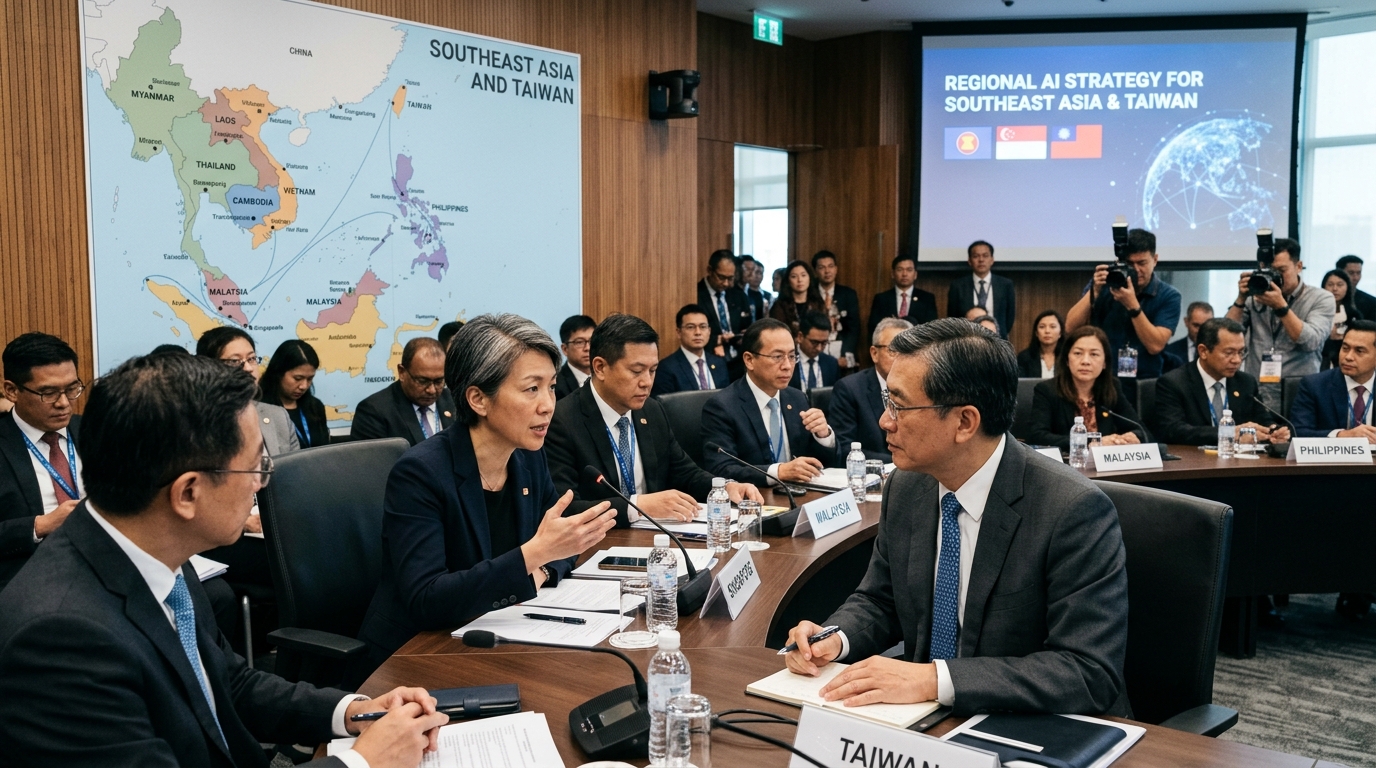
In the twilight of the first decade of the true Artificial Intelligence explosion, the geographical zone stretching from the Taiwan Strait to the Indonesian archipelago is becoming the most critical hub of the global digital economy. The recent strategic analysis for Southeast Asia and Taiwan is not merely an economic plan, but a manifesto for survival in a world divided between the technological spheres of influence of Washington and Beijing. As we move through 2026, the convergence of these economies highlights a new reality: AI is no longer just a matter of algorithms, but a matter of sovereignty over semiconductors, data, and supply chains.
The Silicon Shield and the New Southbound Policy
Taiwan, the undisputed leader in advanced semiconductor manufacturing through TSMC, now realizes that the famous "Silicon Shield" is no longer sufficient on its own to guarantee its security. Taipei's "New Southbound Policy" has evolved from a simple effort at trade diversification into a comprehensive digital alliance. The need to transfer part of the manufacturing capacity and AI software development to countries like Vietnam, Thailand, and Malaysia is the response to the growing pressure from mainland China.
For Taiwan, cooperation with Southeast Asia offers strategic depth and a vast market of 670 million people. On the other hand, for the ASEAN (Association of Southeast Asian Nations) states, Taiwan's expertise is the "golden key" that will allow them to leapfrog from simple product assembly to high technology and the development of indigenous AI models (Large Language Models) that respect local languages and cultural nuances.
ASEAN: Pragmatic Neutrality in the Algorithmic Age
Unlike the European Union, which has adopted a strict regulatory framework (AI Act), Southeast Asia is following a more flexible and pragmatic path. The ASEAN Guide on AI Ethics and Governance focuses on innovation and economic growth, avoiding harsh bans that could discourage investment. This approach makes the region an attractive destination for "digital capital" seeking an escape from the Sino-American competition.
However, the challenge remains: how can such a diverse group of states—from technologically advanced Singapore to the developing economies of Cambodia and Laos—formulate a unified strategy? The answer seems to lie in the creation of regional data centers and shared computing power infrastructure. Taiwan can provide the hardware, but Southeast Asia offers the space, energy, and human capital.
The Supply Chain as a Geopolitical Tool
Supply chain security is the central point of the new strategy. The pandemic and subsequent geopolitical crises taught the international community that concentrating production in a single point is dangerous. The "China Plus One" strategy, where companies maintain production in China but also expand to other Asian countries, finds its new catalyst in AI. The use of AI to optimize logistics and production allows countries in the region to compete with China's low costs through increased efficiency.
"Artificial Intelligence in Southeast Asia is not just a productivity tool; it is the new line of defense for national sovereignty and economic independence," the report notes.
Furthermore, cooperation extends to the field of cybersecurity. With AI increasingly used for sophisticated cyberattacks, information sharing and the joint development of defense systems between Taipei and ASEAN capitals are becoming imperative. Taiwan, being a daily target of hybrid operations, possesses valuable experience that Southeast Asian states are eager to acquire.
Conclusions and Outlook
The future of the region depends on its ability to remain a "third pole" in the global AI architecture. If Taiwan and Southeast Asia manage to align their strategies, they will create an ecosystem that is not merely complementary to the West or the East, but autonomous and dominant. The challenge is immense: it requires overcoming historical suspicions and a deep commitment to workforce education. However, the stakes are even higher: whoever controls the infrastructure and application of AI in this region will control the pace of global growth for decades to come.





