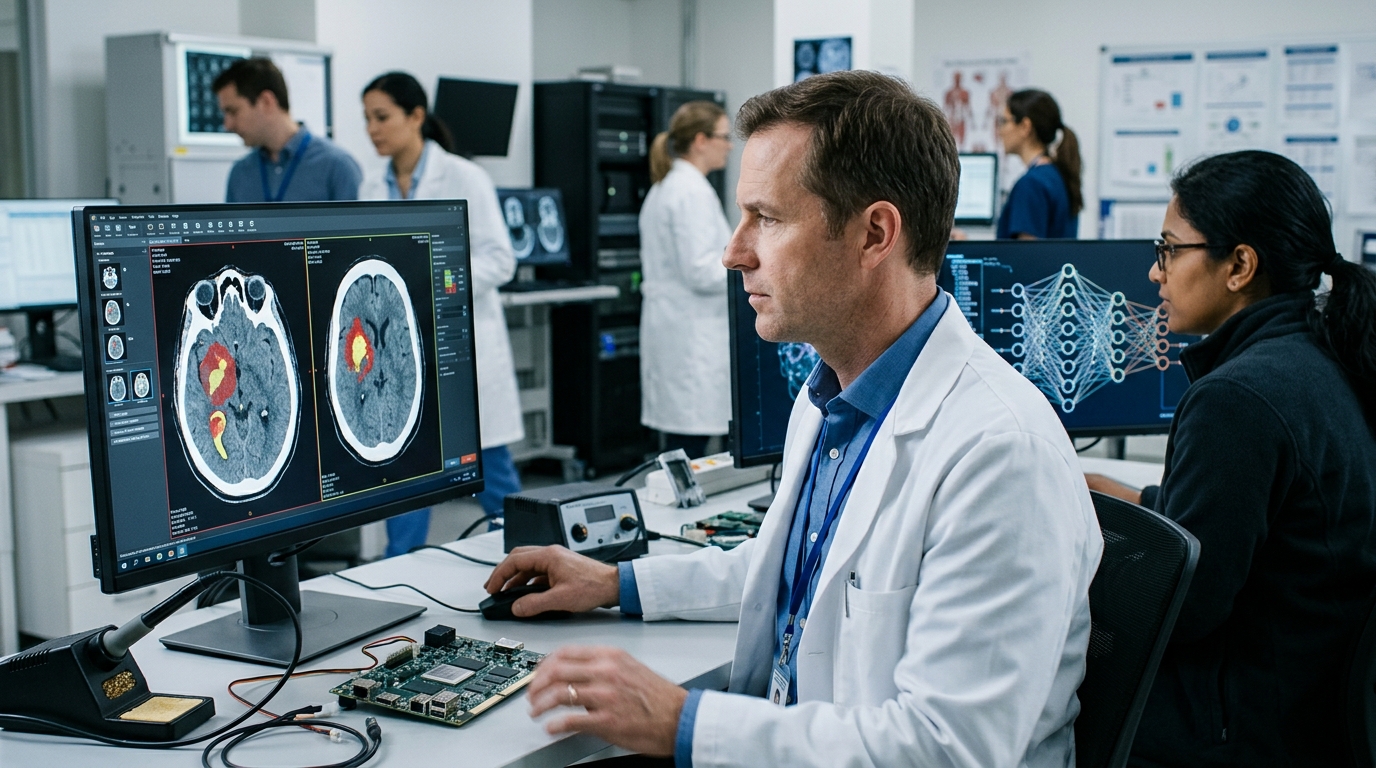
In the high-stakes environment of emergency departments, time is the most precious commodity, particularly when neurological integrity is on the line. Intracranial hemorrhage (ICH) is a critical medical emergency where diagnostic delays directly correlate with increased morbidity and mortality. A comprehensive systematic review recently published in Cureus evaluates the transformative impact of Artificial Intelligence (AI) in detecting these life-threatening events through non-contrast CT (NCCT) scans of the head.
The study meticulously analyzes data from various clinical trials to assess the diagnostic performance of deep learning algorithms. The findings suggest that AI has transitioned from a theoretical promise to a clinical reality, demonstrating diagnostic accuracy that often rivals or exceeds that of experienced radiologists, especially when human performance is hampered by fatigue, burnout, or high patient volumes.
Technological Efficacy and Methodology
The systematic review focuses on Convolutional Neural Networks (CNNs), which are specifically trained to identify patterns of hyperdensity in CT images that indicate acute bleeding. The analysis revealed that AI models achieve exceptionally high sensitivity rates. This means the likelihood of the software missing a hemorrhage—even small, subtle, or atypically located ones—is significantly lower than traditional manual screening methods in high-pressure settings.
The most significant advantage highlighted is speed. While a radiologist may take several minutes to meticulously scroll through hundreds of image slices, an AI algorithm can complete the same task in seconds. This capability facilitates immediate triage, flagging critical cases and moving them to the top of the specialist's queue. In healthcare systems struggling with staff shortages, such tools act as a vital safety net, ensuring that life-saving interventions like neurosurgery or blood pressure management are initiated without delay.
The Challenges of the 'Black Box' and Implementation
Despite the promising results, the Cureus review does not shy away from the inherent challenges. A primary concern is specificity—the algorithm's ability to correctly identify the absence of a hemorrhage. If AI generates too many false positives by misidentifying old calcifications or image artifacts as acute bleeds, it could lead to 'alarm fatigue' and unnecessary medical procedures, potentially straining hospital resources.
Furthermore, the issue of generalizability remains paramount. An algorithm trained on a specific demographic or using data from a single manufacturer's CT scanner might not perform with the same precision in a different clinical setting. There is an urgent call for 'Explainable AI' (XAI), where the system provides visual heatmaps or justifications for its findings, allowing clinicians to verify the machine's logic. Legal and ethical frameworks regarding liability in the event of an AI-assisted misdiagnosis are still being debated globally, as policy struggles to keep pace with technological acceleration.
The Future of Neuroradiology
The integration of AI into the diagnostic pipeline is not about replacing human expertise but augmenting it. The review concludes that the most effective model is a human-in-the-loop system. AI serves as a tireless assistant, screening every scan in the background and alerting the physician to anomalies, thereby allowing the radiologist to focus their cognitive resources on complex cases that require nuanced interpretation.
Looking ahead to the latter half of 2026, the challenge for healthcare providers will be the seamless integration of these algorithms into existing clinical workflows. Accuracy alone is insufficient; the technology must be intuitive and interoperable. The Cureus systematic review stands as a pivotal piece of evidence, confirming that AI is no longer a peripheral tool but a central component in the evolution of emergency medicine and the global effort to improve patient outcomes in neurocritical care.
- AI provides rapid triage for time-sensitive neurological emergencies.
- High sensitivity reduces the risk of overlooking subtle hemorrhages.
- Ongoing efforts are needed to minimize false positives and improve specificity.
- The human-AI partnership is the definitive future of diagnostic imaging.