

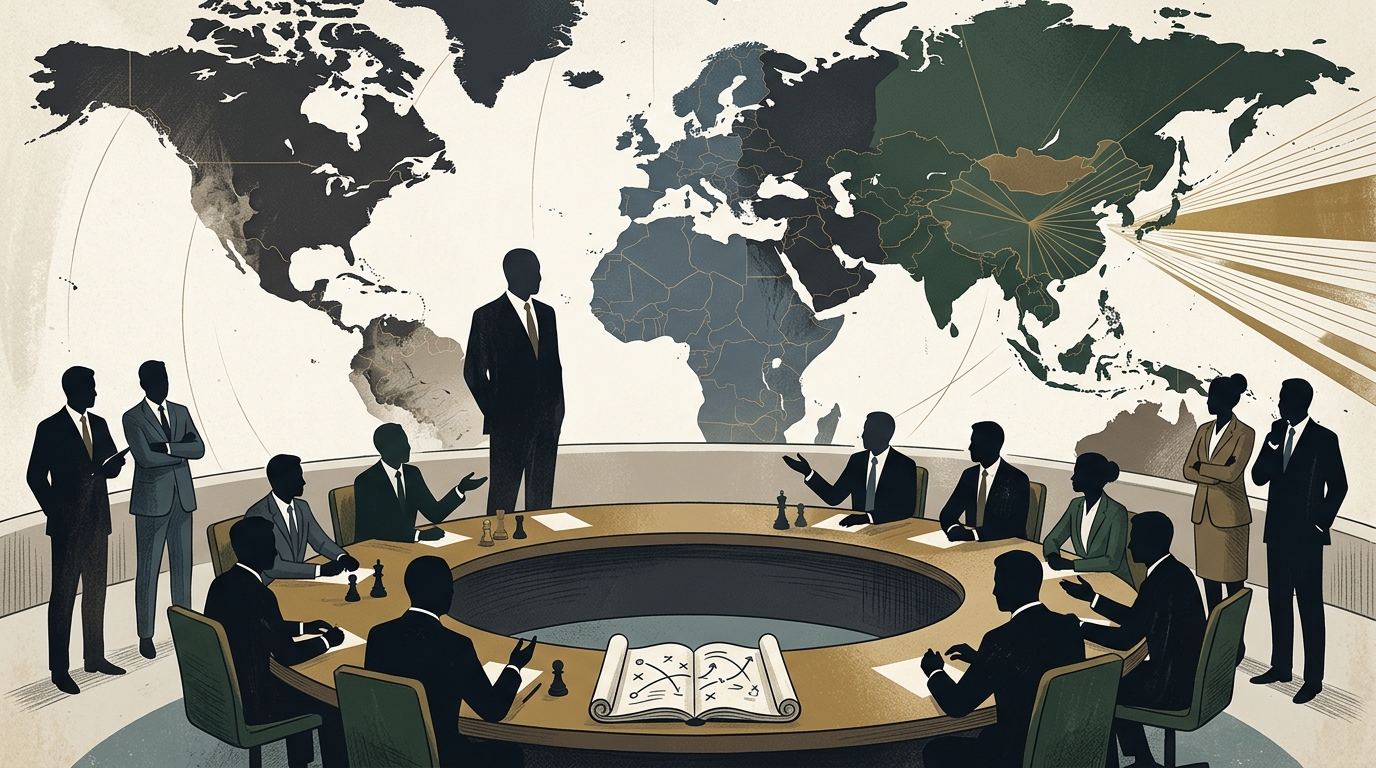
In today's geopolitical landscape of June 2026, the warnings of Ray Dalio, founder of Bridgewater Associates, resonate more urgently than ever. A man who has spent decades studying the "Big Cycles" of history, Dalio argues that China is not seeking a head-on military collision with the US, but is instead employing a strategy deeply rooted in Sun Tzu's "The Art of War": winning without fighting. According to Dalio, Washington is trapped in a dynamic that forces it into reactive spasms, while Beijing quietly constructs an alternative global order.
The Art of War in Economics and Diplomacy
Dalio's core thesis centers on the fact that China is playing a "long game." While the US is consumed by internal political strife and short-term electoral cycles, the Chinese leadership strictly follows the teachings of Sun Tzu, who believed that the supreme general is the one who breaks the enemy's resistance without a battle. This is achieved through economic interdependence, dominance of supply chains, and the gradual isolation of the US from its traditional allies in the Global South.
Dalio points out that China has successfully become the largest trading partner for most countries on the planet. This "soft power," combined with infrastructure investments through the Belt and Road Initiative, creates a network of loyalty that Washington finds difficult to dismantle with military guarantees alone. This strategy weakens the US's ability to impose sanctions, as the cost of such a move would now be self-destructive for the Western economy.
The Taiwan 'Death Trap' and the Risk of Miscalculation
One of the most contentious points in Dalio's analysis is the issue of Taiwan. The investor describes it as an "invisible death trap." For China, reunification is a non-negotiable national priority, a "red line" tied to the very survival of the Communist Party. For the US, Taiwan represents a bastion of democracy in the Pacific and a critical hub for semiconductor production.
Dalio warns that the current trajectory leads to an inevitable conflict unless there is a radical shift in diplomacy. Sun Tzu's tactics are applied here through "gray zone" warfare: China does not invade, but tightens the noose around the island, exhausting its defenses and testing Western resolve. Every time the US reacts with arms sales, China uses that reaction as a pretext for further militarization, trapping Washington in an escalatory spiral that serves Beijing's long-term interests.
The End of the Dollar and the Economic Big Cycle
Perhaps Dalio's most disturbing prediction concerns the US dollar. As a historian of financial crises, he observes that every great empire in history (from the Netherlands to Britain) lost its global dominance when its currency ceased to be the world's safe haven. Excessive money printing and the staggering US national debt have shaken the confidence of international investors.
- De-dollarization: China is actively promoting the use of the Yuan in international transactions, particularly in the energy sector.
- Alternative Payment Systems: The development of CIPS (Cross-Border Interbank Payment System) reduces reliance on the West-controlled SWIFT system.
- Gold and Digital Assets: Central banks' shift toward gold is a sign of preparation for a post-dollar era.
Dalio concludes that the US must look in the mirror. The threat is not just external. Internal polarization, the decline of education, and social inequality are the factors making the country vulnerable to Sun Tzu's strategy. If the US fails to fix its finances and restore social cohesion, the "battle" will have been won by Beijing before the first shot is even fired. Dalio's wisdom calls us to understand that a nation's strength is judged not just by its missiles, but by the resilience of its institutions and the robustness of its currency.





