

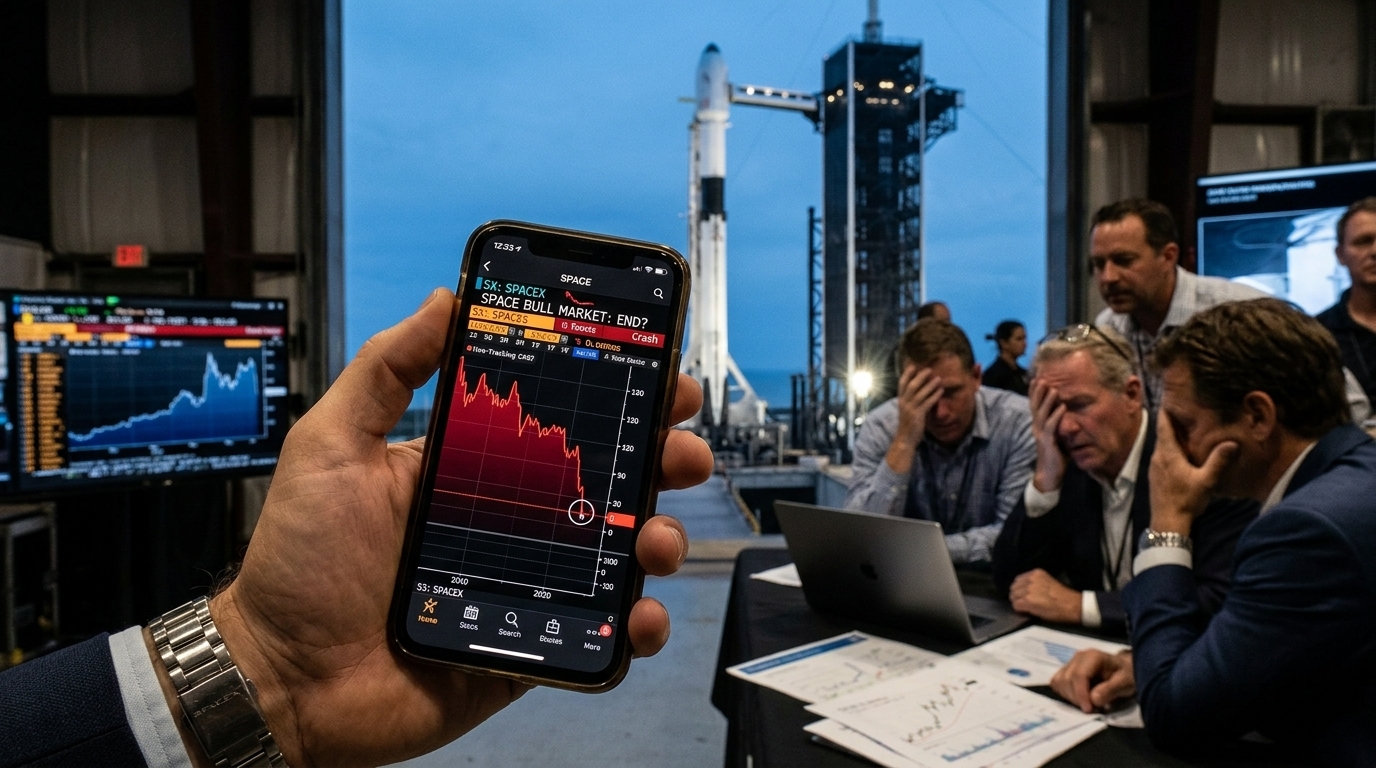
The aura of invincibility that has surrounded Elon Musk’s SpaceX for the past several years appears to be developing its first significant fractures. Following a prolonged period of explosive growth in the secondary market, where company shares were traded at prices implying a valuation exceeding $210 billion, a violent two-day sell-off has brought reality back into focus. According to market analysts and data from secondary trading platforms, the average buyer who entered the stock over the last two years is now at a 'break-even' point, having seen all paper gains evaporate.
Anatomy of the Crash: Why Now?
The decline did not occur in a vacuum. Despite the successful launches of the Falcon 9, which have now become routine, the market seems to be belatedly pricing in the risks associated with the Starship program. Recent regulatory delays from the FAA, combined with increased capital expenditures for the construction of Starbase, have raised questions about when the gargantuan vessel will become fully operational and profitable.
Furthermore, the satellite communications market, dominated by Starlink, is beginning to show signs of saturation in key geographical areas. The emergence of competitive solutions from Amazon (Project Kuiper) and the European consortium IRIS² has started to put pressure on profit margins that were once taken for granted. Investors, who were buying SpaceX shares in anticipation of an imminent Starlink IPO, appear to be losing patience as Musk continuously pushes back the timeline.
"SpaceX is no longer just a startup promising the stars. It is an industrial giant that must prove it can maintain profitability in a high-interest-rate environment and amid rising costs," a Wall Street investment bank executive noted.
The Psychology of the Secondary Market
Unlike public markets, the secondary market for private companies (unicorns) often lacks deep liquidity. This means that when sentiment shifts, the decline can be disproportionately sharp. Many SpaceX employees, who used their shares as collateral for loans or as a primary asset, now find themselves in a precarious position. The 'FOMO' (Fear Of Missing Out) psychology that drove valuations to staggering heights has been replaced by intense skepticism.
Institutional investors, such as pension funds and private equity firms that purchased stakes at valuations near $180-$200 billion, are now seeing their portfolio values shrink. This creates a chain reaction: less demand leads to lower prices, and lower prices discourage new buyers, trapping those who bought at the peak.
Geopolitics and Elon Musk: The Unpredictable Factor
One cannot analyze SpaceX without considering its founder. Elon Musk's increasing involvement in the U.S. political scene and his controversial statements have begun to affect the company's brand. While SpaceX remains NASA's primary partner, the risk of political retaliation or changes in U.S. government priorities in a potential change of administration in 2024-2025 remains a serious risk factor.
Ukraine's reliance on Starlink and discussions regarding its use in Taiwan have turned SpaceX into a major geopolitical player. However, this position carries responsibilities that often conflict with shareholder value maximization. The market is starting to wonder: Is SpaceX a technology company or a foreign policy tool of a single individual?
The Future: Correction or Collapse?
Despite the recent crash, SpaceX remains the most advanced aerospace company in the world. Its reusable rocket technology has reduced the cost of access to space by 90%. The question is not whether the company will survive, but whether its valuation can be justified based on traditional financial models.
- Starship's success is critical for NASA's Artemis mission and for Mars colonization plans.
- Starlink's profitability must prove sustainable on a global scale, beyond early adopters.
- The company must find a way to provide liquidity to shareholders without causing market panic.
In conclusion, the two-day SpaceX crash serves as a reminder that even the most ambitious visionaries cannot escape the laws of the market. For the average buyer now sitting at 'zero,' patience will be the only strategy, hoping that the next launch will also signal the stock's return to an upward trajectory.





