

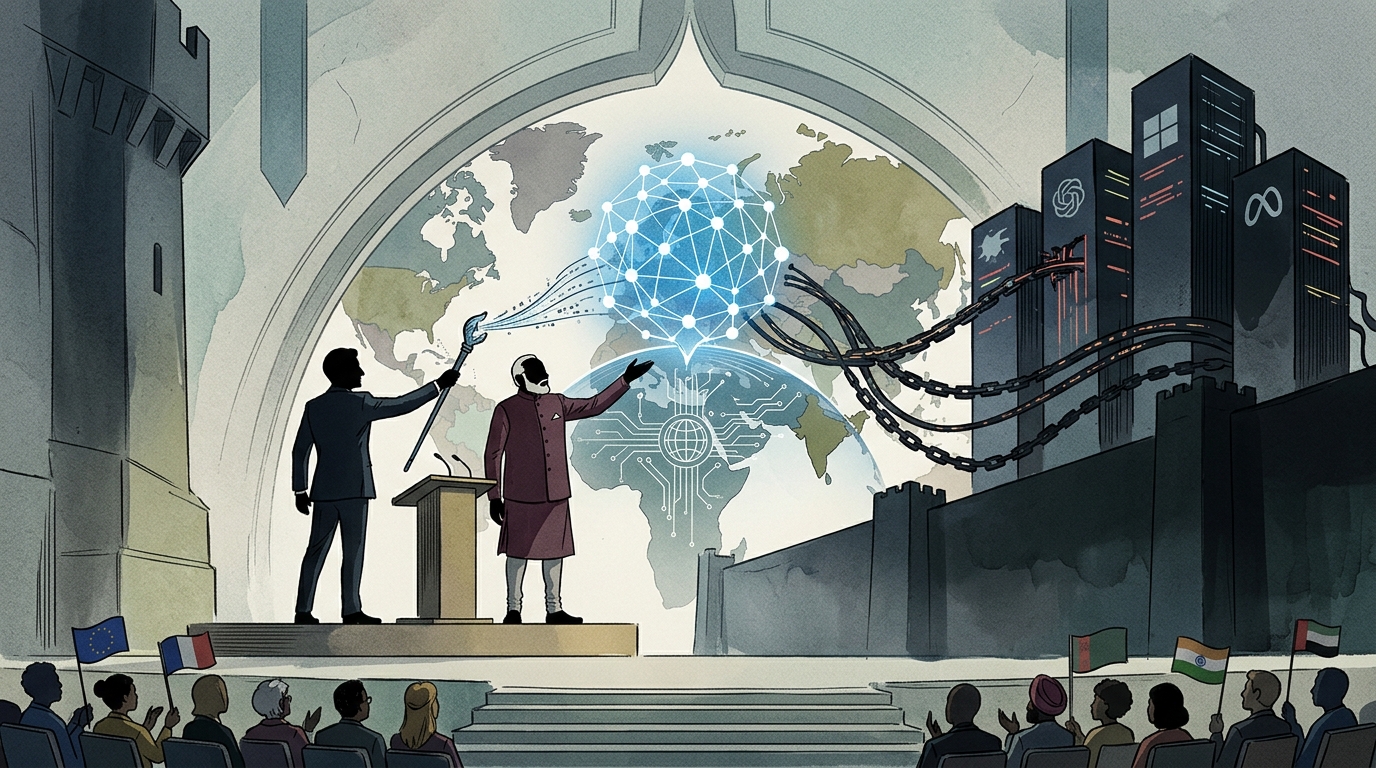
In the geopolitical chessboard of the 21st century, Artificial Intelligence (AI) is no longer merely a productivity tool; it has become the ultimate symbol of national sovereignty. As we move through the summer of 2026, two leaders known for their statist tendencies and international influence, Emmanuel Macron and Narendra Modi, appear to be coordinating their efforts to "besiege" the monopoly held by Silicon Valley's Big Tech. Their strategy is crystal clear: if American giants want access to their markets, they must pay the price through investment, technology transfer, and respect for local digital infrastructure.
The French Counter-Offensive: From Mistral to the AI Action Summit
Emmanuel Macron has made it evident that France does not intend to remain a mere consumer of American algorithms. Supported by national champions like Mistral AI and the newly emerged H (formerly Holistic AI), Paris is building an ecosystem that aspires to become the "Silicon Valley of Europe." The French approach combines aggressive funding with clever regulation. Leveraging the prestige of the AI Action Summit, Macron is pushing for a "sovereign European AI," built on European data and running on European servers.
The billions in investments recently announced by Microsoft and Amazon in France did not happen by chance. They were the result of a systematic "siege" that combined tax incentives with the threat of stricter antitrust enforcement. France now demands that Big Tech build data centers powered exclusively by nuclear energy—a French competitive advantage—and train the local workforce, ensuring that value-added benefits remain within national borders.
India and the "Democratization" of AI
On the other side of the globe, Narendra Modi is implementing a similar but larger-scale strategy. The "IndiaAI" mission, with a budget exceeding $1.2 billion, aims to build a massive compute capacity accessible to startups and researchers. For Modi, AI is the key to delivering public services to 1.4 billion people, ranging from disease diagnosis in rural areas to personalized education in dozens of languages.
India is using its market size as a point of leverage. The Modi government has signaled to Google and Meta that using Indian citizens' data to train global AI models will no longer be free or unregulated. The demand for "local data sovereignty" is forcing tech giants to invest in local infrastructure and adapt their algorithms to the cultural and linguistic nuances of the Indian subcontinent. Like France, India seeks a "Third Way" that avoids both the American laissez-faire market approach and the Chinese model of absolute state control.
Convergence of Two Worlds: A New Digital Axis?
Although their economies differ radically, Macron and Modi share a common philosophy: the belief that technology is too important to be left exclusively in the hands of private corporations based in California. Their cooperation in international forums, such as the G20 and the AI Safety Summit, indicates an effort to create a new regulatory framework that protects national autonomy.
"Artificial Intelligence cannot be a closed club for a few companies. It must be a public good that respects the identity and sovereignty of every nation," Macron recently stated, echoing Modi's views on "AI for All."
The siege of Big Tech is not just about money; it is about controlling the narrative. When France funds open-source models and India creates its own "AI Stack," they are challenging the very core of the Silicon Valley business model, which relies on closed systems and monopolistic data ownership.
Challenges and the Future of Digital Diplomacy
Of course, this path is not without obstacles. Big Tech companies possess capital that exceeds the budgets of many nations and an innovative capacity that is difficult for state-led initiatives to replicate. Furthermore, there is the risk that "digital nationalism" could lead to a fragmented internet (splinternet), where technologies are incompatible, limiting global cooperation.
However, the message from Paris and New Delhi is loud and clear: the era of naive acceptance of US technological dominance is over. The billion-dollar investments we see today are only the beginning of a long confrontation over who will define the rules of intelligence in the future. For Macron and Modi, winning this siege is the only guarantee that their nations will remain protagonists rather than mere spectators in the digital revolution.





