

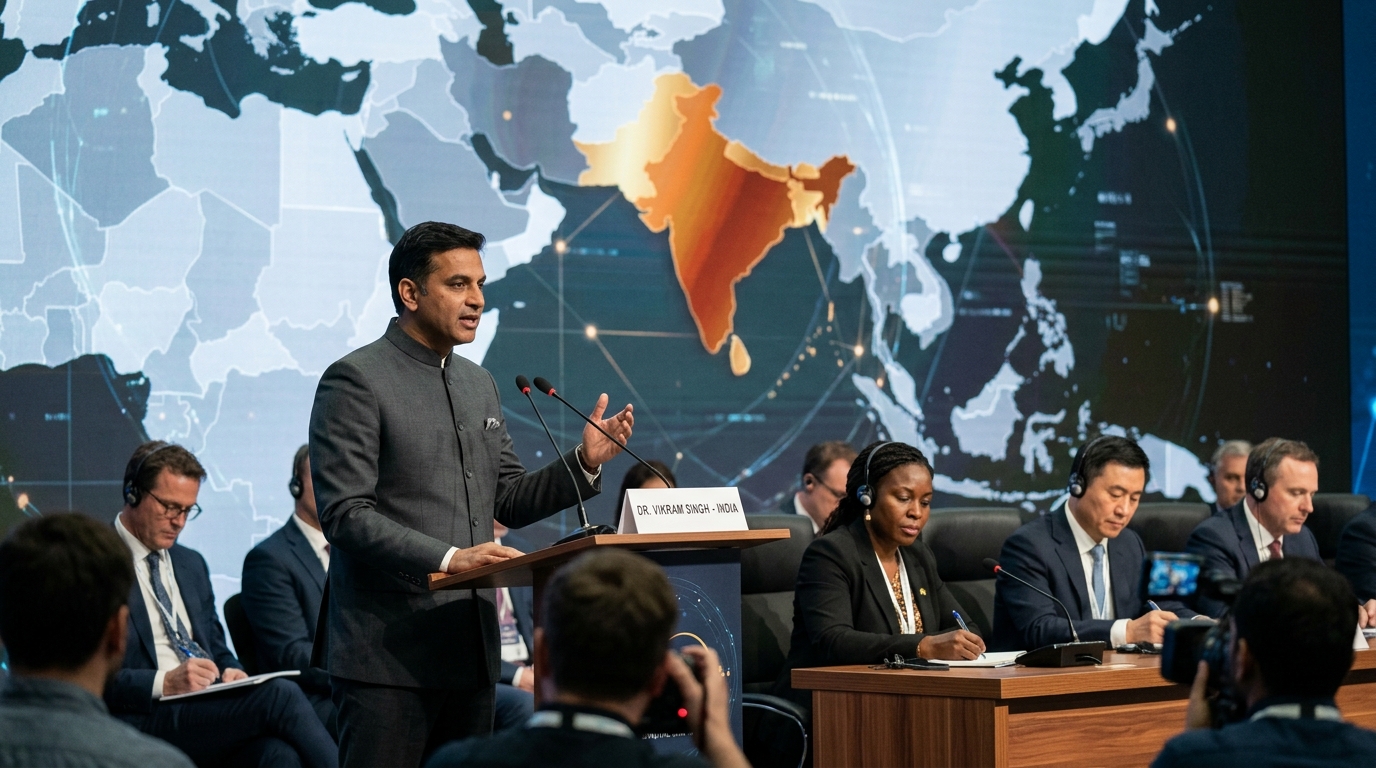
The recent news that Anthropic, one of the world's leading AI labs, imposed restrictions on access to its services within Indian territory was not merely a technical glitch. It acted as a geopolitical alarm bell that resonated through the corridors of power in New Delhi. For a nation aspiring to become the world’s 'digital warehouse,' the realization that its access to cutting-edge technology depends on the whims of private Silicon Valley corporations was a stark reminder of the risks of technological dependency.
The Anthropic Incident and New Delhi’s Awakening
Anthropic, renowned for its Claude model, implemented restrictions affecting Indian developers and enterprises, citing safety concerns and regulatory compliance. However, in India, this move was interpreted as a form of 'digital exclusion.' The government of Narendra Modi, which has been aggressively promoting the 'Digital India' program, reacted swiftly, doubling down on the rhetoric of 'Sovereign AI.' The core idea is simple yet profoundly ambitious: India must own its compute infrastructure, its own datasets, and its own foundation models.
This shift isn't just about national pride; it is a strategic survival necessity in the 21st century. Relying on models like OpenAI’s GPT-4 or Anthropic’s Claude means Indian businesses are building on 'rented land.' If the landlords of this land decide to change the terms or cut off access, the nation's entire innovation ecosystem faces potential collapse.
What Does 'Sovereign AI' Mean in Practice?
The concept of Sovereign AI rests on three main pillars. First, infrastructure. India announced the 'IndiaAI Mission,' a $1.25 billion program aimed at building massive computing power through GPUs (Graphics Processing Units), accessible to startups and researchers. Second, data. India possesses one of the world's largest and most diverse populations. Ensuring this data is used to train models that understand local languages and cultural nuances is critical. Third, models. Developing 'Bhashini,' an AI system supporting India’s 22 official languages, is the first step toward this goal.
- Establishment of national supercomputing clusters.
- Development of indigenous Large Language Models (LLMs).
- Implementation of strict rules on cross-border data flows.
- Incentives for startups developing applications for the public sector.
The Geopolitics of Compute
On the global stage, Artificial Intelligence has become the new battlefield for hegemony. While the US and China compete for the top spot, India is attempting to carve out a third path. The government argues that AI should not be controlled by a corporate oligopoly. This stance aligns with India’s broader policy of 'strategic autonomy.' Just as the country refused to align fully with blocs during the Cold War, it now refuses to remain a mere consumer of Western technology.
"Artificial Intelligence is the new electricity, and no country can afford not to have its own switch," a senior official from the Ministry of Electronics and Information Technology (MeitY) recently stated.
Challenges: From Data to Infrastructure
Despite the ambition, the road to sovereignty is fraught with obstacles. The shortage of specialized hardware, such as Nvidia’s chips, remains the biggest hurdle. Global demand is so high that even nation-states struggle to secure supplies. Furthermore, training models requires vast amounts of energy and water for cooling data centers—resources that are already under pressure in India. Finally, there is the issue of 'brain drain.' Many of India’s top data scientists already work in Silicon Valley, and attracting them back requires more than just patriotism; it requires competitive salaries and research freedom.
The Future of the Global South
India’s endeavor is being closely watched by other nations in the Global South. If New Delhi succeeds in building a functional Sovereign AI model, it could serve as a blueprint for Brazil, Indonesia, and the African Union. The battle for AI is no longer just technological; it is a battle for the democratization of knowledge and the prevention of a new form of 'digital colonialism.' India, with this move, declares itself not as a customer, but as an architect of the future.





