

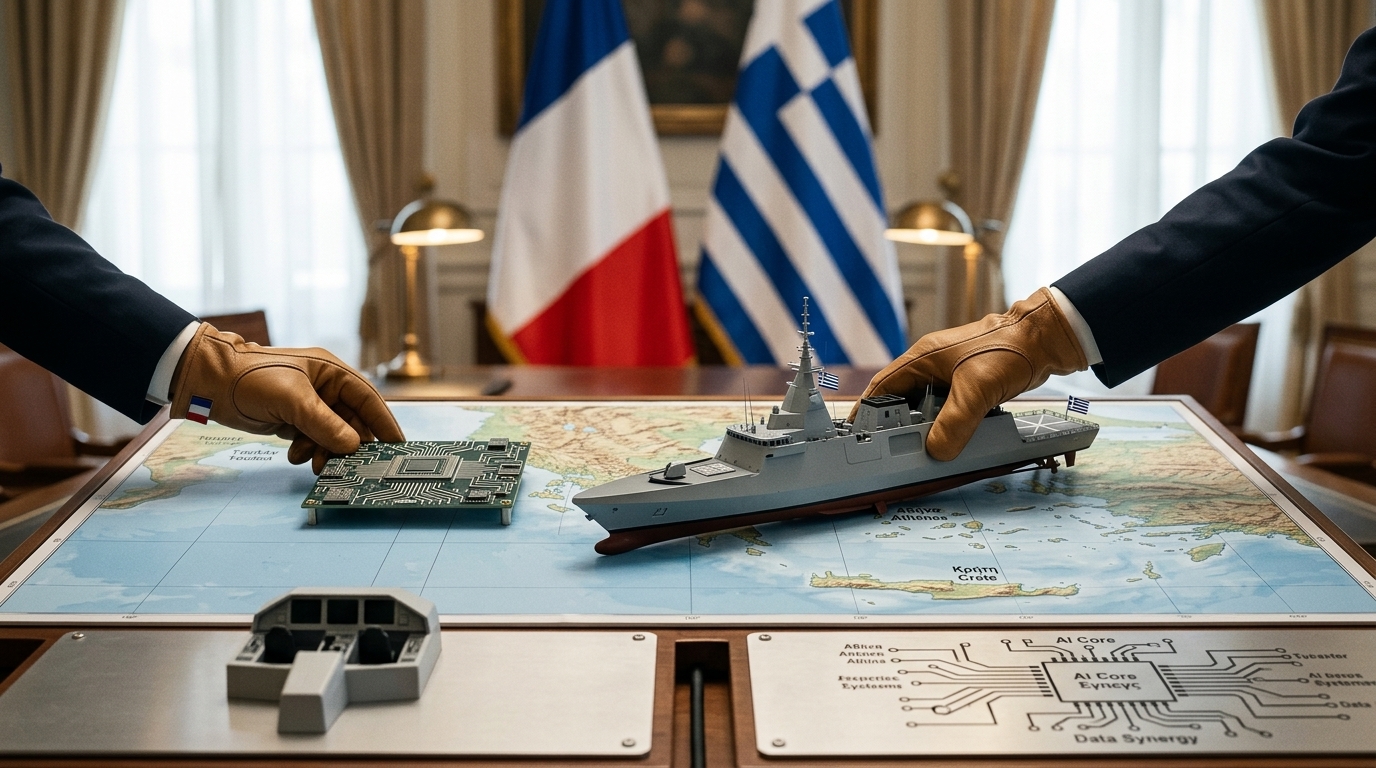
The geopolitical architecture of the Eastern Mediterranean and Europe as a whole is undergoing a phase of radical restructuring. At the heart of this transformation lies the close defensive and strategic alliance between Greece and France. While in previous years this relationship was characterized by iconic procurement programs, such as the Rafale fighter jets and the FDI (Belharra) frigates, the current phase marks a shift toward something deeper and more permanent: industrial synergy and the joint development of cutting-edge technologies.
Transitioning from Consumer to Partner
For decades, Greek defense policy relied heavily on "off-the-shelf" purchases. This model, while effective for immediate gap-filling, offered little added value to the domestic economy and failed to secure technological autonomy. The new approach promoted by the Mitsotakis and Macron administrations seeks to overturn this reality. The participation of Greek companies in the supply chains of Naval Group and Dassault Aviation is no longer a formal obligation but a strategic choice to integrate Greek expertise into the European defense ecosystem.
This industrial partnership is not limited to assembly or maintenance. It extends to Research and Development (R&D), with an emphasis on sectors such as unmanned systems (drones), cyber operations, and electronic warfare. This evolution is vital, as modern deterrence no longer relies solely on the number of tanks or ships, but on the ability to process data and the speed of decision-making on the battlefield.
Artificial Intelligence as a Power Multiplier
Within the framework of this alliance, Artificial Intelligence (AI) is emerging as a central pillar. The new FDI frigates, for instance, feature digital systems that allow for the simultaneous tracking of hundreds of targets with minimal human intervention. The integration of machine learning algorithms into combat systems enables the prediction of threats before they become visible to conventional radars. Greece and France are investing in joint programs through the European Defence Fund (EDF), aiming to create "smart" munitions and autonomous underwater vehicles.
The use of AI is not confined to weaponry. It extends to predictive maintenance, where algorithms analyze data from Rafale engines to forecast failures before they occur, drastically reducing costs and increasing asset availability. This digital dimension of defense cooperation is what will define regional dominance over the next twenty years.
The Vision of European Strategic Autonomy
Emmanuel Macron has been the primary advocate for a "sovereign Europe" that does not depend exclusively on the US security umbrella. Greece, due to its geographical position and the challenges it faces, serves as the ideal testing ground for this theory. The bilateral Mutual Defense Clause is the first step toward a European defense union that complements NATO while possessing its own will and means.
- Strengthening the common defense industry to reduce production costs.
- Creating common standards for easier force interoperability.
- Independence from external suppliers for critical components and software.
However, challenges remain. Bureaucracy in Brussels and the differing priorities of EU member states often slow progress. The Athens-Paris alliance acts as a "vanguard," showing the way for how two states can align their national interests with the broader European vision.
Challenges and the Future of Cooperation
Despite the optimism, transitioning to a fully autonomous European defense requires massive investment and political will. Greece must ensure that its domestic industry can meet the high standards of its French partners. Conversely, France must prove that this cooperation is egalitarian and not merely a vehicle for promoting its own exports.
The future of the alliance will be judged by its ability to produce innovation. Establishing joint research centers for defense AI and exchanging personnel between armed forces and tech companies is the logical next step. In a world where power is measured in bits and bytes as much as in tons of steel, the Greek-French partnership represents the most serious experiment for Europe's survival as an autonomous global player.





