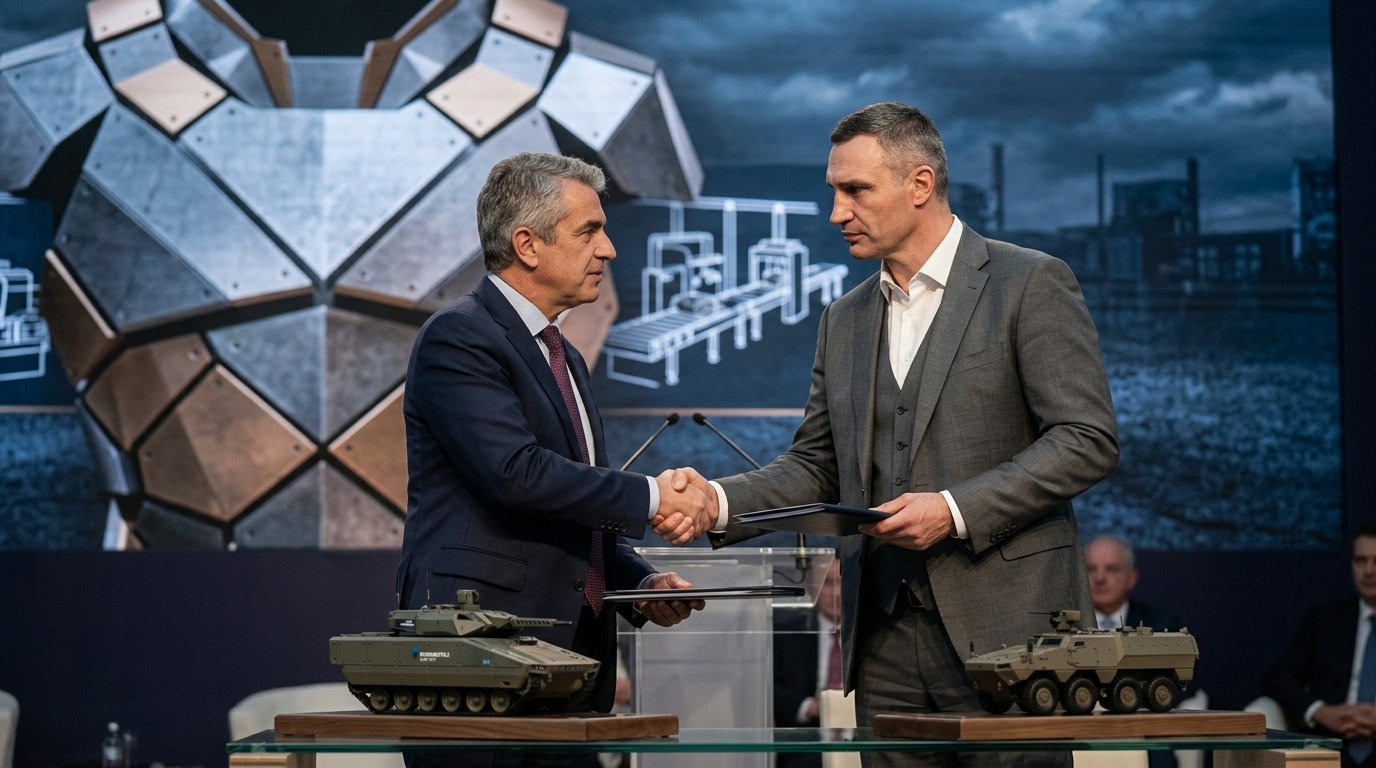
In an era where Europe's geopolitical architecture is being violently redefined, the announcement of a strategic alliance between GEK TERNA and the German defense giant Rheinmetall is not merely business news. It is a move with profound geostrategic implications, aimed at filling a long-standing gap in the Greek economy: the absence of a robust, domestic defense industry capable of supporting the Armed Forces with cutting-edge technology.
The Convergence of Two Giants
This partnership brings together two distinct yet complementary worlds. On one side, GEK TERNA, one of Greece's largest business groups with a dominant presence in infrastructure, energy, and concessions, possesses the necessary domestic expertise in large-scale project management and supply chain logistics. On the other, Rheinmetall AG, a global leader in defense systems, brings with it the technology of Lynx infantry fighting vehicles and combat systems that are considered the spearhead of NATO's land forces.
The agreement is not limited to mere representation. According to reports, the strategy includes the establishment of production and maintenance lines on Greek soil. This translates into immediate technology transfer, something Greece has pursued for decades without substantial results. The country's ability to maintain and upgrade its weapon systems independently is the very definition of strategic autonomy.
Geopolitical Context and the Need for Deterrence
The Russian invasion of Ukraine in 2022 and ongoing instability in the Middle East have forced the European Union to reassess its defense policy. Greece, as the eastern border of the EU and NATO, sits in a region where deterrence is not an option but an imperative. The GEK TERNA – Rheinmetall alliance responds to the demand for rapid reinforcement of the Hellenic Army's land forces, focusing on the modernization of tanks and air defense systems.
- Leopard 2 Modernization: Greece holds one of the world's largest fleets of Leopard tanks, and Rheinmetall is their original manufacturer.
- The Lynx Infantry Fighting Vehicle: A potential procurement that would be accompanied by domestic production.
- Supply Chain Enhancement: Creating hundreds of high-skilled jobs in the engineering and manufacturing sectors.
This move aligns perfectly with the new European Defense Industrial Strategy (EDIS), which encourages joint procurement and the strengthening of the industrial base within member states. Through this partnership, Greece ceases to be a simple off-the-shelf buyer and transforms into a co-producer and regional maintenance hub for Southeastern Europe.
Economic Impact and Industrial Renaissance
Beyond the military aspect, the economic dimension is immense. The defense industry traditionally acts as a power multiplier for the economy. The participation of Greek companies in producing components for Rheinmetall could revitalize the manufacturing sector, which was severely impacted during the financial crisis.
"Investing in defense is not just an expenditure; it is an investment in the security and technological progress of the country,"market analysts note.
However, challenges remain. Greek bureaucracy and slow decision-making processes in the armaments sector have torpedoed similar efforts in the past. The success of this alliance will depend on steady political will and the ability of both companies to navigate the complex landscape of international tenders and national priorities. If the venture succeeds, Greece will have taken a decisive step toward joining the exclusive club of nations that produce defense technology rather than just consuming it.