

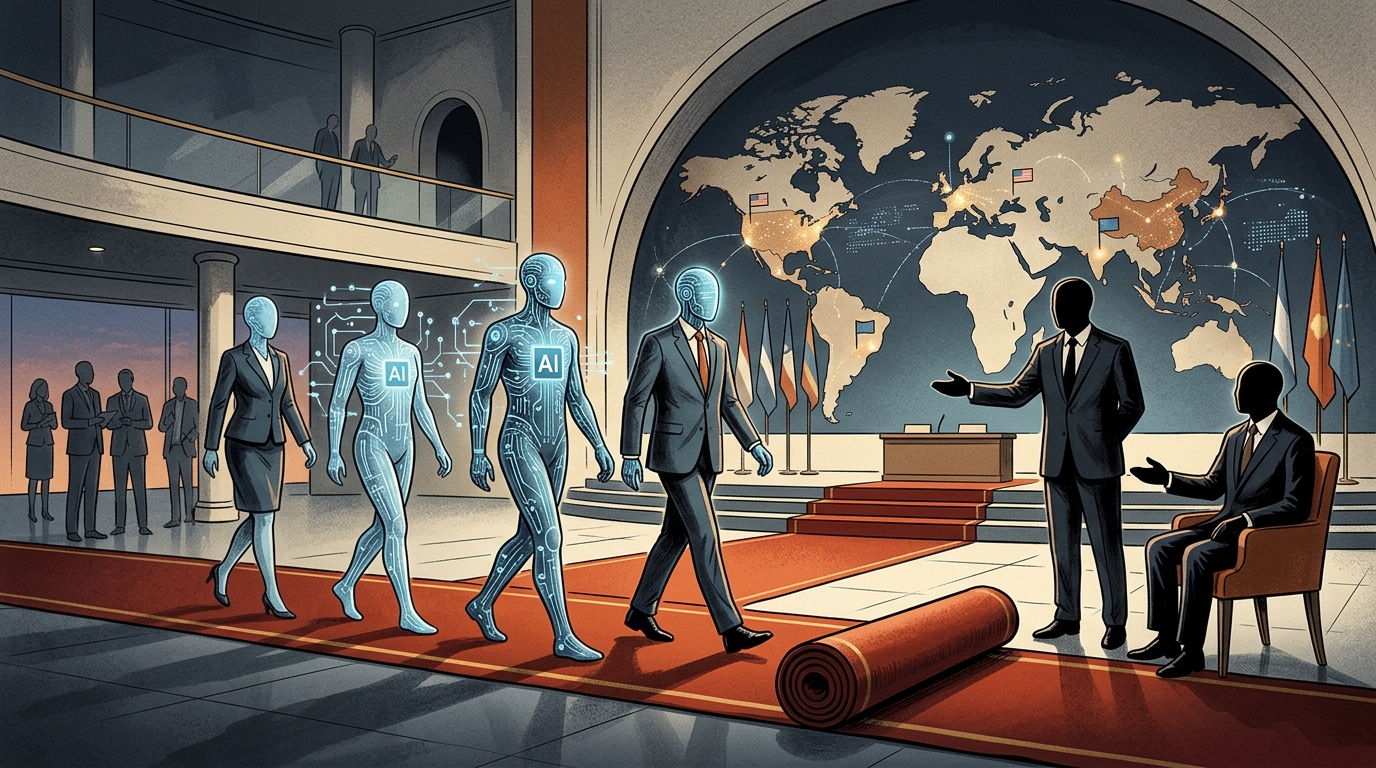
In the opulent setting of the Elysée Palace and the high-tech conference rooms of New Delhi, a new diplomatic language is being forged. It is no longer about traditional alliances or trade deals for raw materials, but about attracting the "architects of the future." From Emmanuel Macron in France to Narendra Modi in India, governments worldwide are rolling out the red carpet for Artificial Intelligence (AI) giants, offering tax breaks, energy concessions, and "regulatory flexibility" that would have been unthinkable just a few years ago.
This shift marks a critical turning point in the geopolitics of technology. While the European Union led the way with the AI Act, seeking to establish ethical boundaries, individual member states—led by France—seem to be realizing that regulation without innovation leads to dependency. Macron’s "Choose France" strategy is no longer just a slogan for foreign investment; it is an existential effort to make Paris the European hub for AI, hosting companies like Mistral AI and attracting billions from Microsoft and Amazon.
The French Offensive: Sovereignty Through Investment
Emmanuel Macron has made it clear that France does not wish to be a mere consumer of American or Chinese algorithms. During recent summits, the French president welcomed the CEOs of Nvidia and OpenAI with the honors typically reserved for heads of state. The promise is simple: access to cheap nuclear energy for power-hungry data centers, a highly trained workforce in mathematics, and a state willing to "bypass" Brussels' bureaucracy wherever possible.
The €4 billion investment by Microsoft in France, recently announced, is the culmination of this effort. Paris understands that "digital sovereignty" requires infrastructure. Without local data centers and domestic AI models, Europe risks becoming a digital colony. However, this approach is causing friction within the EU, as Germany and other nations watch skeptically as France moves away from the common European line of strict oversight.
India and the Promise of "AI for All"
On the other side of the planet, Narendra Modi is following a different but equally aggressive tactic. India, having already established itself as the world’s "back office," now seeks to become its brain. The "IndiaAI" mission, with a budget exceeding $1.2 billion, aims to create a national computing infrastructure accessible to startups and researchers.
Modi is using the scale of the Indian market as leverage. "AI must speak Indian languages," he often declares, forcing tech giants to invest in the localization of their models. His meeting with Nvidia’s Jensen Huang was not just a photo op, but the starting point for a partnership that will bring thousands of H100 chips to the Indian subcontinent. For Modi, AI is the tool that will bridge the gap between urban centers and the countryside, delivering healthcare and education services via mobile phones.
The Risk of a "Race to the Bottom"
Despite the optimism, this global rush to court Big Tech carries significant risks. Critics speak of a "race to the bottom," where governments compete over who can offer the fewest regulations and the most subsidies.
"When governments become supplicants to corporations, democratic accountability recedes," say tech policy analysts.
Furthermore, there is the issue of the environmental cost. Data centers require vast amounts of water for cooling and electricity. In countries like India, where resources are already strained, the priority given to AI infrastructure could clash with the needs of local communities. In France, the use of nuclear power provides a low-carbon advantage, but the concentration of power in a few hands remains a politically sensitive issue.
Conclusion: A New Global Order
2026 finds the world divided not just by ideologies, but by access to "compute." Leaders rolling out the red carpet today are betting that AI will be the economic engine for the next fifty years. Whether it is Macron envisioning a technological renaissance for Europe, or Modi seeing AI as the key to India’s emergence as a global superpower, the message is clear: the era of technological neutrality is over. Governments are now active players, shareholders, and sometimes hostages of the digital revolution.





