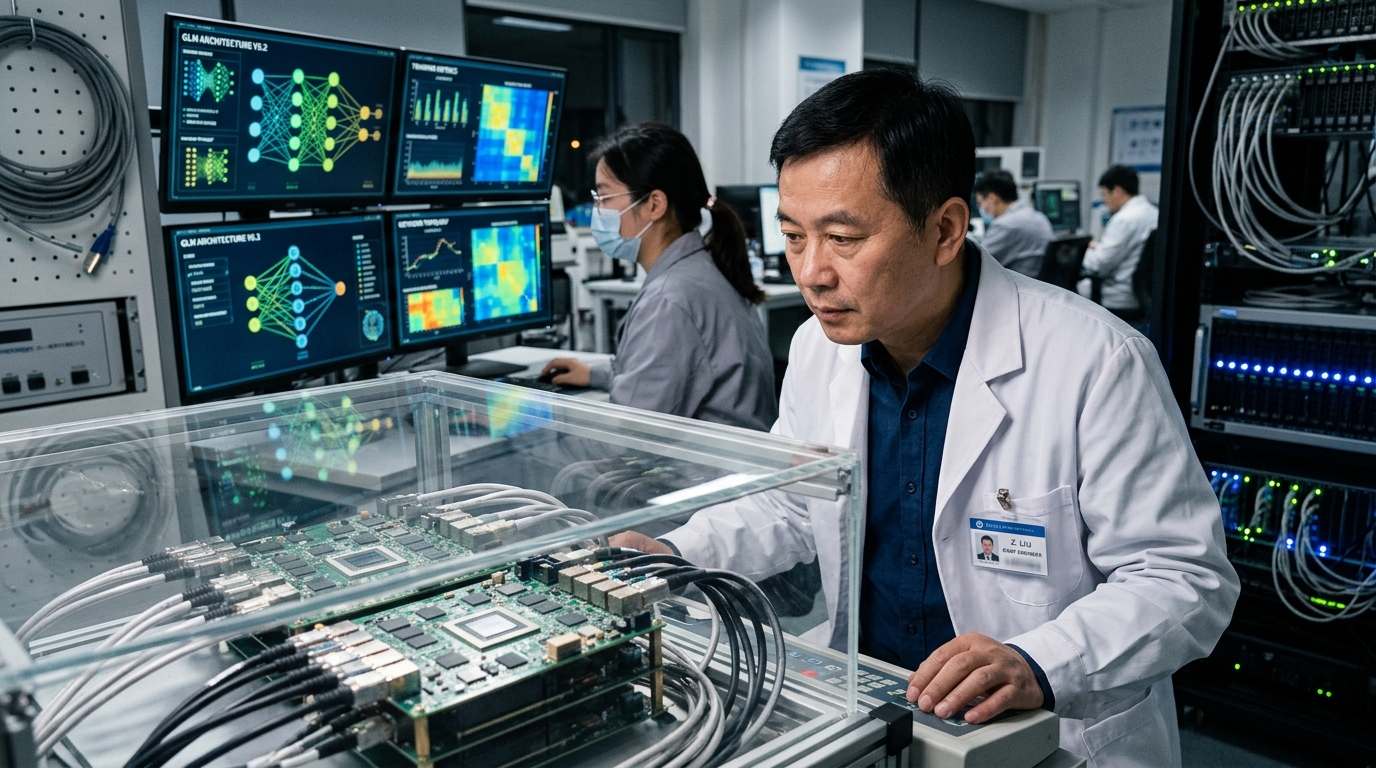
In the rapidly evolving landscape of Artificial Intelligence, the emergence of Zhipu AI as China’s “national champion” is no longer news—it is the status quo. With the unveiling of GLM 5.2, the company that originated in the laboratories of Tsinghua University is demonstrating that the gap separating Chinese Large Language Models (LLMs) from American leaders like Anthropic and OpenAI is narrowing at a pace that causes concern in Washington and celebration in Beijing.
The Architecture of Superiority: What Sets GLM 5.2 Apart
GLM 5.2 is not merely an incremental upgrade of its predecessor. It represents a total reimagining of multimodal processing and logical inference. According to initial technical reports, the model exhibits exceptional performance in domains where Anthropic’s Claude 3.5 Sonnet was previously considered peerless: coding and complex mathematical reasoning. The ability of GLM 5.2 to understand and generate code across dozens of programming languages, while maintaining a deep grasp of context, places it at the pinnacle of global benchmarks.
One of its most striking features is the expanded “context window,” which allows for the processing of massive amounts of data in a single session. This makes it ideal for enterprise applications, ranging from analyzing legal documents thousands of pages long to managing intricate databases. Zhipu AI seems to have found the sweet spot between computational efficiency and precision—a critical feat given the export restrictions on advanced chips, such as NVIDIA’s H100s, to China.
Competing with Anthropic and the Western Model
The comparison with Anthropic is not accidental. Anthropic has built its reputation on “safety” and “ethical alignment.” GLM 5.2, however, challenges this narrative by offering similar levels of reasoning and safety, tailored to the cultural and linguistic nuances of the East. While Claude excels in English-language performance, GLM 5.2 dominates in Chinese dialects and the understanding of Eastern social structures, offering an alternative that Silicon Valley struggles to match.
- Optimized Logic: The model utilizes new reinforcement learning algorithms that significantly reduce hallucinations.
- Multimodality: Built-in capabilities for real-time image and video processing.
- Ecosystem: Full integration with the platforms of Alibaba and Tencent, who are the primary investors in Zhipu.
Zhipu AI’s strategy relies on open access for the research community, a move reminiscent of Meta’s Llama but with a clear orientation toward the Chinese market. This creates a developer ecosystem that improves the model organically, accelerating its evolution beyond the confines of a closed lab.
Geopolitics and the Battle for Compute
The success of GLM 5.2 comes at a time when the US is intensifying pressure to exclude China from the semiconductor supply chain. The ability of Chinese researchers to produce models at the level of GPT-4 or Claude 3.5 using less powerful hardware or by optimizing existing resources represents a significant victory for Beijing’s technological autonomy. GLM 5.2 proves that innovation in neural network architecture can, to some extent, compensate for hardware shortages.
“GLM 5.2 is not just a tool; it is proof that knowledge cannot be contained by borders or sanctions,” says an industry analyst in Beijing.
In conclusion, the release of GLM 5.2 marks the end of American exclusivity in high-end AI. As the model becomes integrated into industrial applications, from autonomous driving to medical diagnostics, the world is witnessing the birth of a bipolar technological system. The challenge for the West is no longer just to innovate, but to understand how to coexist with a digital peer competitor.