

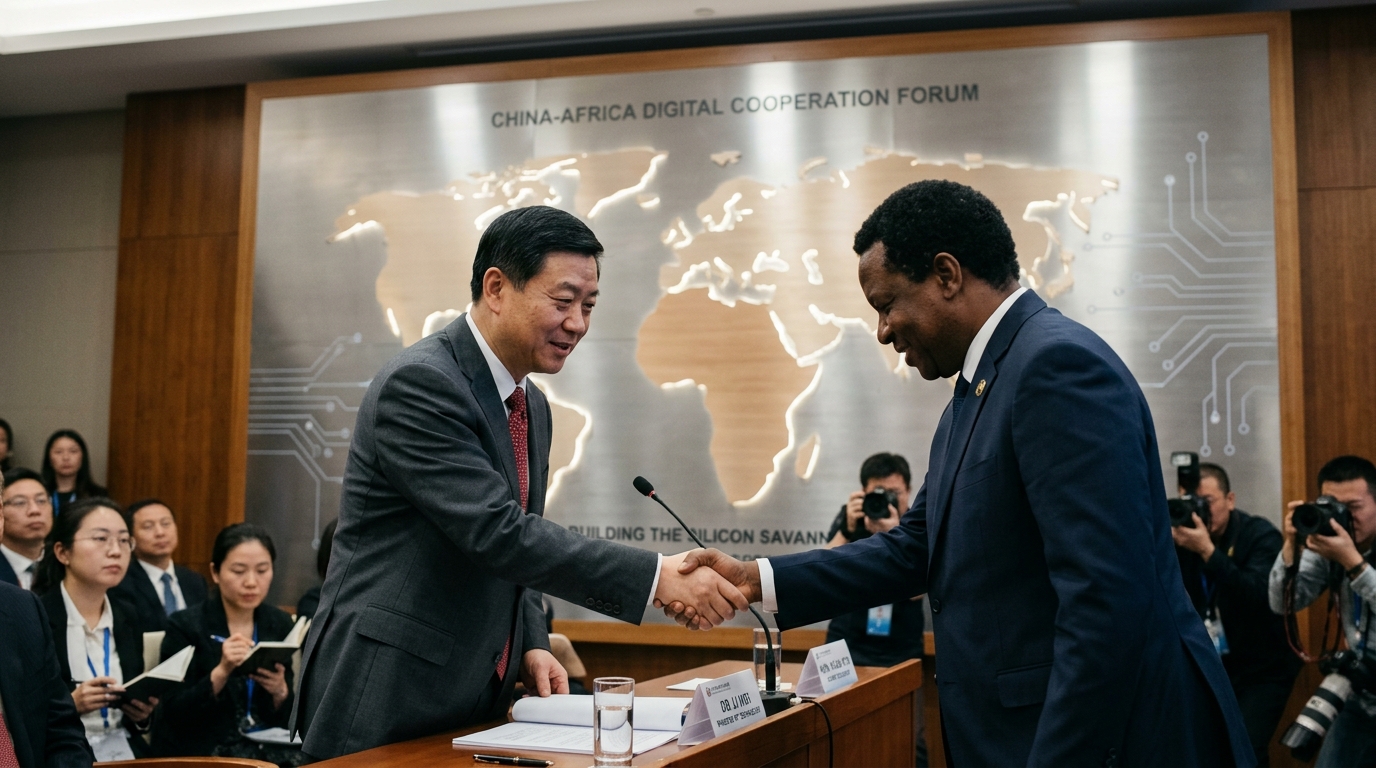
For decades, China's presence in Africa was defined by concrete and steel: railways in Kenya, ports in Djibouti, and highways in Nigeria. However, as we navigate through 2026, the nature of this partnership has undergone a fundamental shift. The 'Digital Silk Road' (DSR) has superseded traditional infrastructure, with Artificial Intelligence (AI) now serving as the spearhead of Beijing’s foreign policy and economic penetration across the continent.
A recent report by China Daily highlights an undeniable truth: Chinese AI is not merely gaining ground; it is becoming the operating system of African daily life. From smart city systems in Nairobi to Huawei’s 5G networks covering most of sub-Saharan Africa, Beijing offers something the West struggles to match: a combination of affordability, implementation speed, and technology tailored to local needs.
Infrastructure as Statecraft: The Digital Silk Road
One of the primary drivers of Chinese dominance is the ability of its firms, such as CloudWalk and Hikvision, to develop algorithms that accurately recognize African facial features and local dialects. While Western AI systems are often criticized for bias due to training data sourced predominantly from Caucasian populations, Chinese companies have invested in partnerships with African governments to collect and process local data. This has led to a 'technological symbiosis' that is increasingly difficult to decouple.
In Zimbabwe, for instance, the implementation of facial recognition systems at airports and public spaces is presented not just as a security measure, but as a tool for state modernization. China does not just sell the software; it provides the loans to purchase it, the technical support to run it, and the training for local personnel. This holistic model makes exiting the Chinese ecosystem nearly impossible for many developing economies.
The Surveillance Debate and Geopolitical Friction
The proliferation of Chinese AI in Africa is not without its detractors. Many analysts warn of the export of 'digital authoritarianism.' The use of Chinese surveillance tools by autocratic regimes to suppress dissent is a reality that alarms human rights organizations. However, for many African leaders, the priority remains security and rapid development. As officials in Ethiopia and Rwanda often argue, AI is essential for managing explosive urbanization and curbing crime.
"Africa is no longer a passive recipient of technology, but a testing ground for the future of global governance through data," says a senior analyst in Johannesburg.
The West, particularly the United States, has attempted to counter this through initiatives like the G7’s 'Build Back Better World,' but the lack of direct investment in hardware infrastructure leaves them trailing. China controls the undersea cables, the telecommunications towers, and the data centers. Without this physical layer, the 'democratic AI' promoted by the West remains a theoretical concept without a platform for deployment.
Conclusion: Africa’s Agency in a Bipolar Tech World
The pivotal question for 2026 and beyond is whether Africa can leverage Chinese technology to foster its own domestic innovation. We are already seeing startups in Lagos and Nairobi using Chinese APIs to build solutions in agriculture and healthcare. Chinese influence provides the tools, but the ultimate direction will depend on the political will and regulatory frameworks of African nations.
In conclusion, the rise of Chinese AI in Africa represents the most significant geopolitical shift of the decade. This is not just about trade; it is about setting the standards, values, and power structures that will govern the digital lives of billions in the Global South. The battle for Africa's future is being fought in bits and bytes, and China currently holds a decisive lead.





