

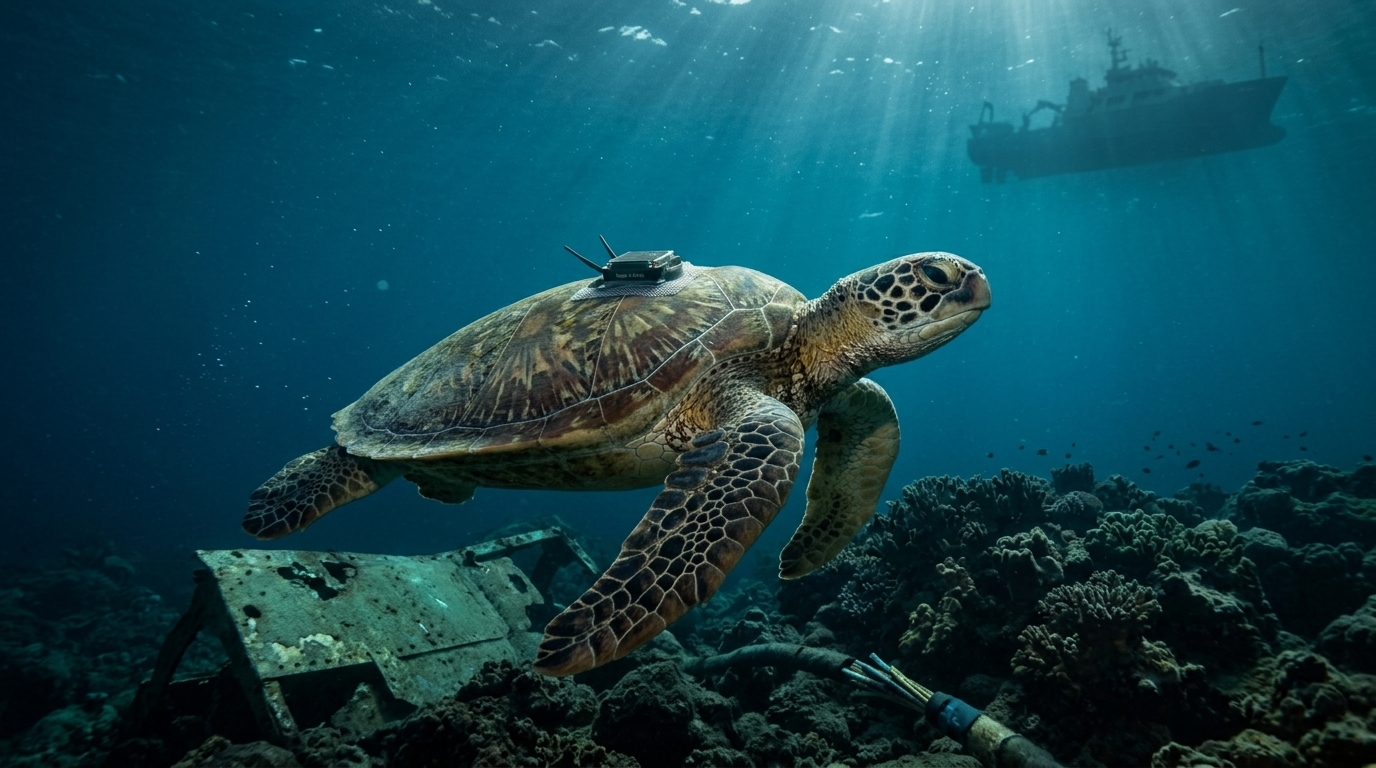
The recent announcement by China's Ministry of State Security (MSS) was not just a routine briefing. It was a stark warning that seems to have leaped from the pages of an Ian Fleming spy novel, but with a modern, dystopian twist. According to Beijing, foreign intelligence agencies have deployed 'marine spies'—ranging from trained turtles and fish equipped with sensors to sophisticated underwater devices and 'smart' buoys—to collect critical data in Chinese territorial waters.
The Doctrine of 'Total National Security'
This move is part of the broader 'Total National Security' doctrine championed by President Xi Jinping. In an era where Artificial Intelligence and Big Data define the power of nations, China views every inch of its seabed as a potential source of information that could be used against it. The Ministry of State Security claimed that these devices, disguised as scientific equipment or attached to marine species, record hydrological data and acoustic signals from submarines, mapping the seabed morphology with unprecedented precision.
This rhetoric is not accidental. China is attempting to sensitize its citizens, particularly fishermen in coastal areas, asking them to report any 'suspicious objects' found in their nets. In fact, cash rewards have been established for those who hand over such equipment to the authorities, creating a network of grassroots surveillance that extends from the sea surface to its depths.
From Cold War Dolphins to 'Smart' Turtles
The use of animals for military purposes is nothing new. During the Cold War, both the US and the Soviet Union maintained training programs for dolphins and sea lions to detect mines or protect harbors from divers. However, China's current allegation goes a step further: it speaks of turning marine fauna itself into data collection platforms via bio-sensors.
"The sea is no longer a free space, but a digital mirror of geopolitical power. Whoever controls the seabed data controls the security of maritime routes," security analysts in Beijing state.
Technology has enabled the creation of miniature sensors that can be placed on a turtle's shell or the fins of large fish, allowing them to move undetected in areas where a traditional Unmanned Underwater Vehicle (UUV) would be easily picked up by sonar. These 'living drones' can transmit data via satellite every time they surface, providing a continuous stream of information on temperature, salinity, and the acoustic signature of Chinese naval bases.
The South China Sea as a Testing Ground
The epicenter of this activity is the South China Sea, a region of immense strategic importance for global trade and rich in natural resources. China claims most of it, despite the reactions of neighboring countries and international rulings. In this context, 'seabed espionage' takes on a different dimension. Beijing fears that the US and its allies are using these means to undermine the 'Great Wall of Sand'—the network of artificial islands and military bases China has developed in the area.
Furthermore, the 'smart buoys' mentioned by the MSS are often equipped with AI that allows them to filter out ambient noise and focus exclusively on the movements of Chinese Jin-class submarines. This ability to 'listen' to the deep is crucial for deterring a nuclear strike, as submarines constitute the most stealthy leg of a nation's nuclear triad.
Conclusion: The Loss of Maritime Innocence
China's warning about 'spy' turtles may sound hyperbolic to some, but it reflects a harsh reality: the complete militarization of the natural environment. As AI technology becomes increasingly integrated into underwater systems, the distinction between scientific research on climate change and military espionage is becoming increasingly blurred.
For the international community, the question is not just whether turtles are spying, but how the freedom of the seas will be maintained in a world where every wave and every creature might hide a sensor. China, for its part, seems determined to seal its borders not only on land and in the air but also in the dark depths of the oceans, where the next war may have already begun, silently and invisibly.




