

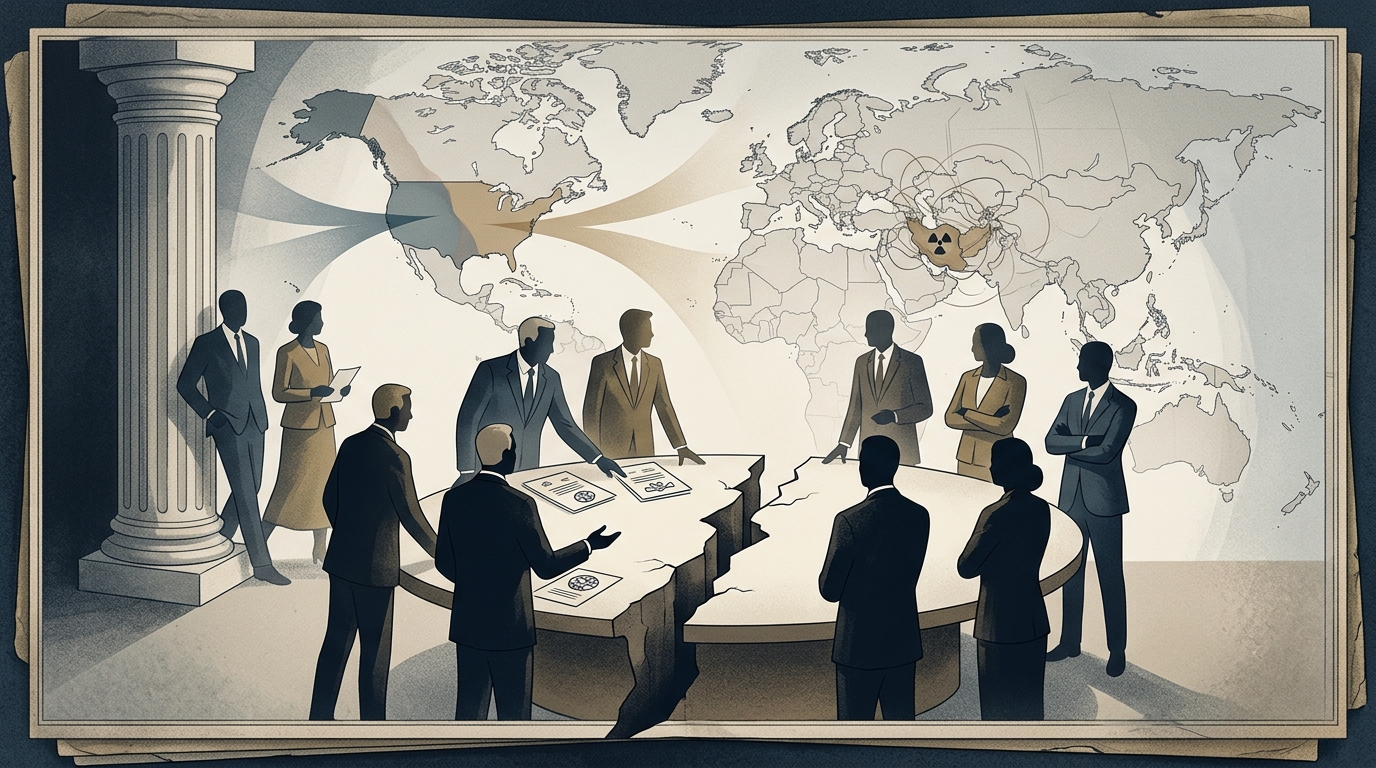
Diplomacy is, at its best, a high-wire balancing act. However, in the case of Washington’s negotiations with Tehran, the wire appears to have snapped—not due to external enemies, but because of the very forces tasked with holding it steady. According to explosive revelations by Axios, the White House is currently weathering a period of unprecedented internal friction, with top national security officials locked in a 'civil war' over the terms of a potential deal regarding Iran’s nuclear program.
A Clash of Doctrines: Hawks vs. Doves
The core of the disagreement lies not merely in the technical minutiae of uranium enrichment levels, but in a profound ideological struggle over the United States' role in the Middle East. On one side, a group of 'realists' within the State Department argues that an imperfect deal is vastly preferable to the chaos of an unconstrained, nuclear-armed Iran. This faction believes that the diplomatic path is the only viable way to prevent a new regional conflagration that would inevitably draw American forces back into the fray.
Conversely, key figures within the National Security Council (NSC) are raising alarms. They contend that Tehran has failed to demonstrate the necessary good faith and that lifting sanctions would provide the Ayatollah’s regime with the financial windfall needed to further empower its proxies in Lebanon, Yemen, and Gaza. This internal friction has manifested as strategic delays, contradictory messaging to international allies, and a sense of paralysis that the Iranian side has been quick to exploit.
The Israel Factor and the Congressional Shadow
The situation is further complicated by intense pressure from Israel. The government in Jerusalem has made it unequivocally clear that it reserves the right to take unilateral action if it deems any agreement a threat to its national survival. Inside the White House, hardliners fear that a 'weak' deal would trigger a historic rift with America’s closest regional ally, leading to unpredictable and potentially violent consequences.
Simultaneously, the domestic political landscape in the U.S. acts as a significant deterrent. With elections on the horizon, the administration is acutely aware that any perceived concession to Iran will be weaponized by Republicans and skeptical Democrats alike. The ghost of the 2015 Joint Comprehensive Plan of Action (JCPOA) looms large over the Oval Office, turning every potential signature into an act of extreme political risk.
The Geopolitical Chessboard and the Russian Connection
One cannot ignore the reality that Iran is no longer the isolated actor it once was. Tehran’s bolstered military cooperation with Moscow, particularly following the invasion of Ukraine, has fundamentally altered the calculus. Some U.S. advisors warn that Iran is using the negotiations as a stalling tactic while deepening its ties with the Russia-China axis. This new reality splits the President’s advisors: Should the U.S. close the Iran chapter to focus on the Indo-Pacific, or would a deal now be viewed as a sign of retreat in the face of a rising authoritarian bloc?
In conclusion, the 'civil war' within the White House reflects a superpower struggling to redefine its influence in an increasingly multipolar world. The ultimate decision will not only determine the fate of Iran’s nuclear ambitions but will also serve as a litmus test for American foreign policy credibility for the coming decade. The question remains: can a divided administration produce a unified and effective global strategy?




