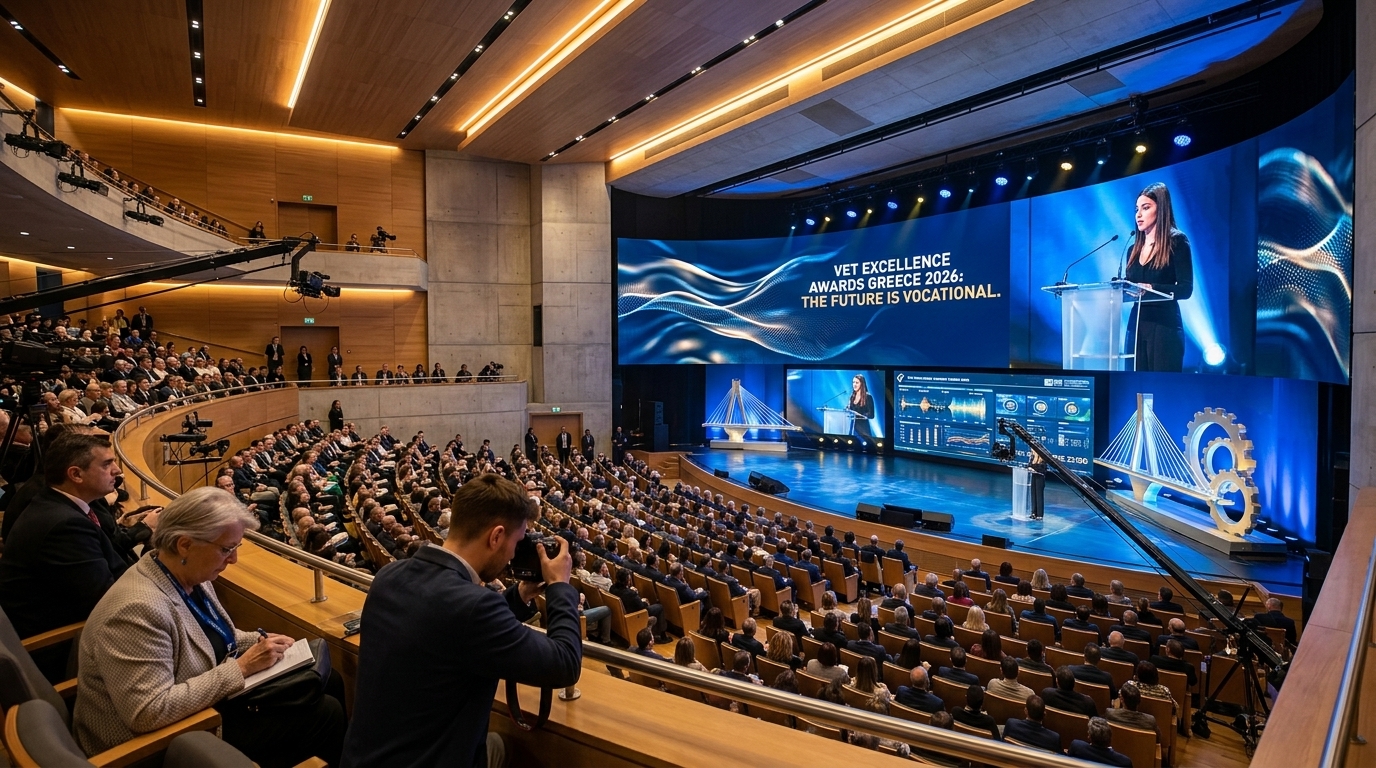
In an era where the traditional academic model is being redefined under the pressure of rapid technological evolution, Vocational Education and Training (VET) in Greece is finally finding its rightful place. The VET Excellence Awards Greece 2026 ceremony, organized by the Hellenic-German Chamber of Commerce and Industry, was not just an awards gala but a powerful statement about the future of work in the country.
This year's winners —instructors, businesses, and educational institutions— were selected not only for their performance but for their ability to bridge the gap between theoretical knowledge and real-market needs. In a Greece struggling with the paradox of simultaneous unemployment and a shortage of skilled personnel, dual education is emerging as the "golden ratio."
The Dual Education Model as a Growth Catalyst
The collaboration with the Hellenic-German Chamber brought the German model of dual education to the forefront, combining classroom learning with practical apprenticeship in a real work environment. In 2026, this model has evolved, integrating AI elements and digital simulations, allowing students to experiment in safe environments before entering actual production.
The awarded companies proved that investing in training is not a cost, but a strategic choice. "We are not just looking for employees; we are co-shaping the professionals of tomorrow," said a representative from one of the winning industries. This approach reduces the adjustment time for new workers and dramatically increases productivity, creating an ecosystem where knowledge flows bi-directionally from the school to the business and vice versa.
Digital Skills and the Green Transition
A central feature of this year's awards was the emphasis on "green" and digital skills. The educational structures that stood out have integrated programs for the circular economy, renewable energy management, and the application of Artificial Intelligence in industrial production (Industry 5.0).
- AI Specialization: Programs teaching technicians how to collaborate with AI systems for infrastructure maintenance.
- Sustainable Construction: Training in low-carbon materials and zero-emission building techniques.
- Digital Management: Training executives in using big data to optimize the supply chain.
This shift shows that vocational education is no longer just about manual labor, but high-tech specialties requiring continuous updates and critical thinking. The "best of the best" in 2026 are those who managed to teach their students not just the "how," but the "why" behind every technological application.
The Social Dimension and Restoring the Prestige of VET
For decades, vocational education in Greece was considered a "solution of necessity" for those who failed to enter university. The VET Excellence Awards 2026 are systematically working to overturn this stereotype. Excellence in training is now accompanied by high salaries, professional security, and social recognition.
"Our society must understand that an excellent network technician or a specialized wind turbine maintainer is just as necessary and respected as a computer scientist," it was noted during the event.
The participation of many young women in traditionally male-dominated sectors, who even won significant awards, is another hopeful sign for the modernization of Greek society. Inclusion and equal opportunities in education are now evaluation criteria for the excellence awards.
Conclusions and Outlook
The VET Excellence Awards Greece 2026 is not the end of a journey, but the starting point for a closer connection between education and economic reality. The challenge for the coming years remains the expansion of these best practices throughout the country and ensuring that innovation in education reaches even the most remote technical school. With the support of institutions like the Hellenic-German Chamber, Greece seems to be walking a path where knowledge is transformed into value, and excellence is not a privilege of the few, but a goal for everyone.