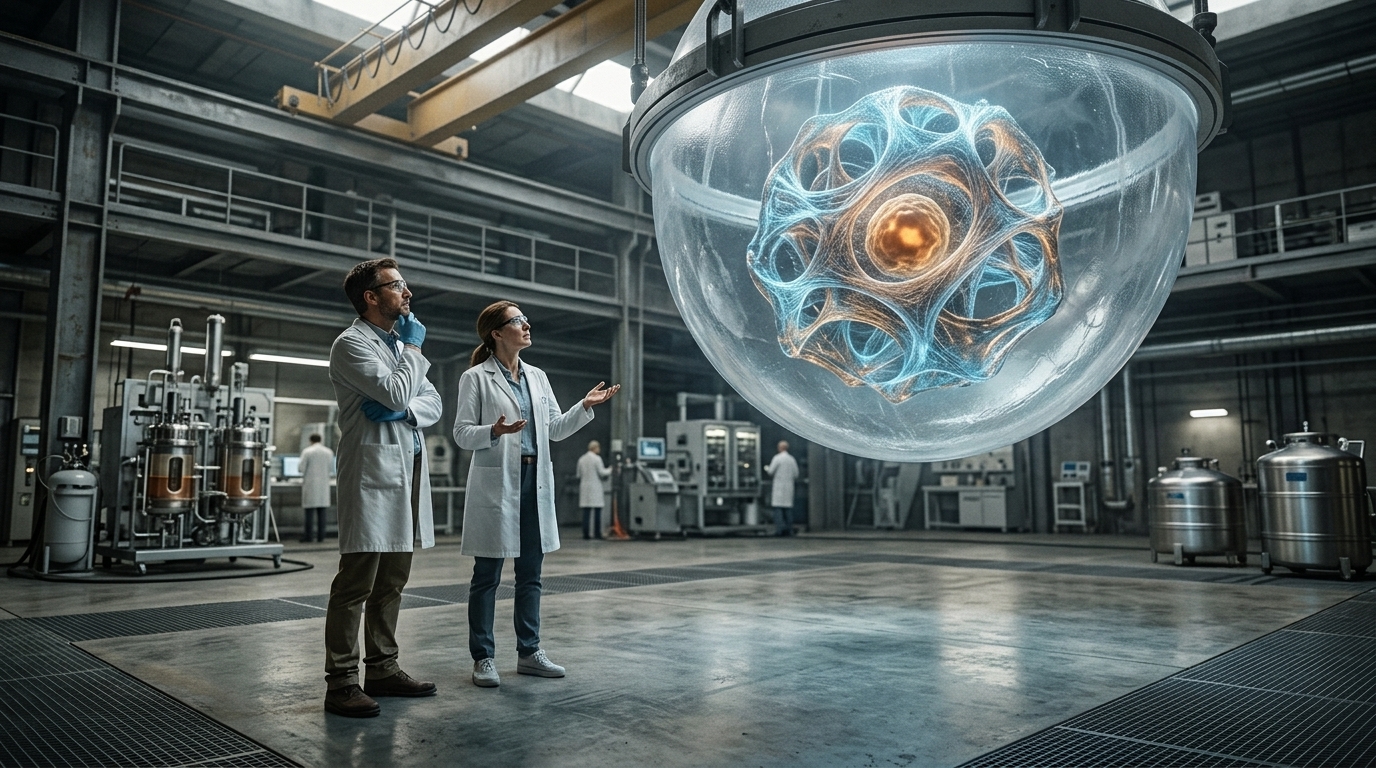
Humanity stands at the precipice of one of the most profound discoveries in the history of science. Researchers at the University of Minnesota, in collaboration with international synthetic biology centers, have announced the creation of a 'synthetic cell' which, despite being constructed entirely from non-living chemical components in a laboratory, exhibits the fundamental properties of life: metabolism, growth, and self-replication. This achievement is not merely a technical victory; it is a philosophical and scientific revolution that begs the question: what, ultimately, is life?
The Transition from Chemistry to Biology
For decades, biology relied on the analysis of existing organisms. Synthetic biology, however, reverses these terms. Instead of trying to understand life by dismantling it, scientists are now attempting to construct it from the ground up (the bottom-up approach). The research team utilized a 'minimal genome,' stripping away every unnecessary piece of information and keeping only the absolute essential genes that allow an organism to survive and divide.
This synthetic cell did not emerge from natural evolution but from the precise design of molecular systems. Scientists managed to encapsulate genetic material and enzymes within lipid vesicles (microscopic fat bubbles), creating an environment where chemical reactions could self-organize. The result was an entity capable of drawing energy from its surroundings and creating copies of itself, following the laws of thermodynamics and biochemistry in a manner previously thought to be the exclusive domain of nature.
Applications: From Medicine to Climate Change
The implications of this discovery are nearly limitless. In the field of medicine, synthetic cells could function as 'smart drugs.' Imagine microscopic organisms designed to identify and destroy cancerous cells without affecting healthy tissues, or to produce insulin directly inside the body of a diabetic patient. Because these cells are fully controlled, side effects could be minimized.
On the environmental front, synthetic life offers solutions that once belonged to the realm of science fiction. We could design cells that 'feed' on carbon dioxide, helping to mitigate the greenhouse effect, or organisms that break down plastic in the oceans. The ability to program matter at the cellular level means that biology is transforming into a new form of engineering, where the code is not digital (0 and 1) but genetic (A, T, C, G).
Ethical Dilemmas and the Creator's Responsibility
However, the ability to 'play God' carries immense responsibilities. The creation of synthetic life raises serious bioethical questions. What happens if such an organism escapes the laboratory into the ecosystem? How can we ensure this technology is not used to create new forms of biological weapons? Scientists argue they have integrated 'kill switches' into the genome of these cells, rendering them unable to survive outside controlled environments.
'We are not just creating a tool, but a new form of existence. Our responsibility is proportional to the power we are gaining,' states one of the lead researchers.
Furthermore, there is the issue of intellectual property. Can a corporation own the patent for a form of life? If life becomes an industrial product, how does our perception of the sanctity of nature change? These questions will occupy legislators and philosophers for decades to come, as the line between the 'natural' and the 'artificial' continues to blur.
Conclusion: Toward a New Biological Paradigm
The creation of the first synthetic cell is only the beginning. As the computational power of artificial intelligence meets synthetic biology, the pace of discovery will accelerate exponentially. Perhaps in a few years, the distinction between a robot and a living organism will no longer be clear. What is certain is that science has just opened a door that will never close, leading us into a future where life itself is the ultimate canvas for creation.