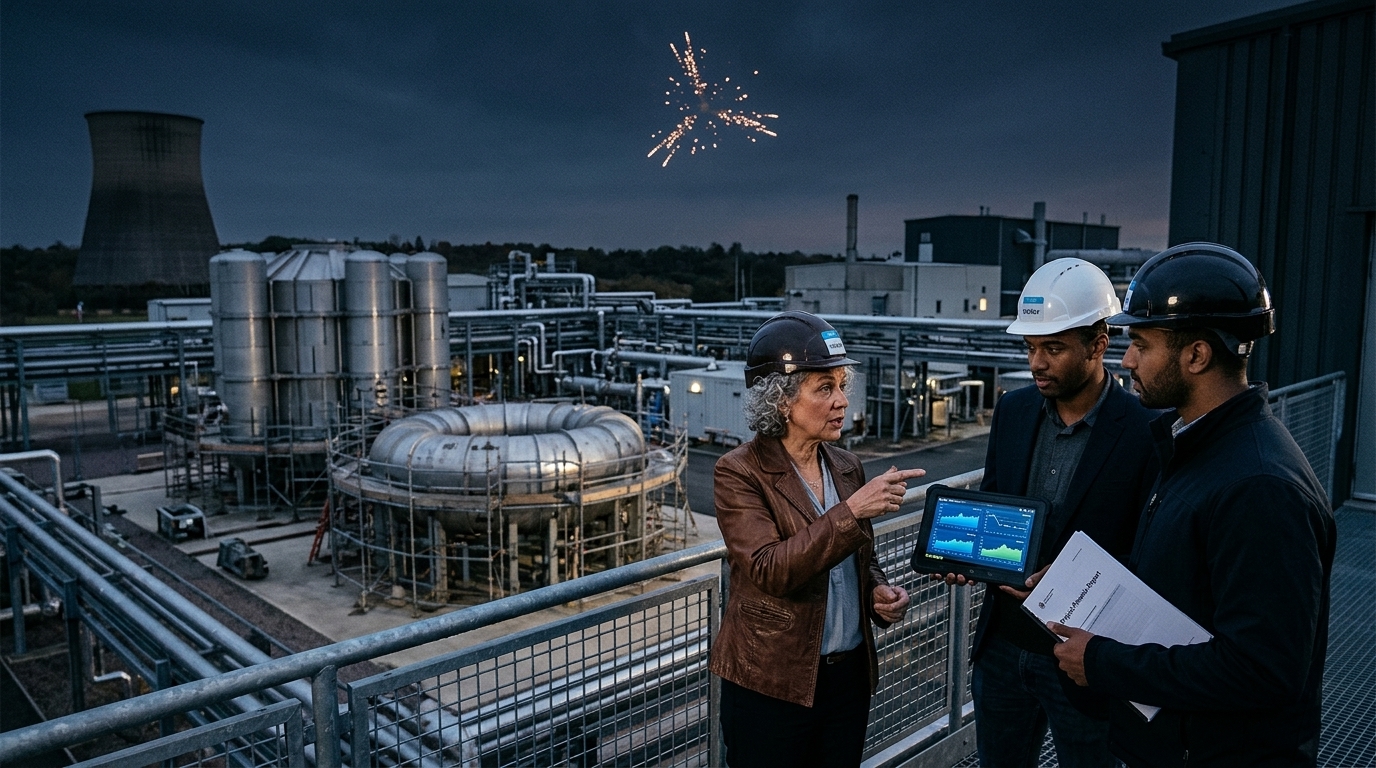
As the United States prepares to celebrate the Fourth of July in 2026, three of the most promising companies in the nuclear energy sector have their own reasons for celebration. TerraPower, Oklo, and X-energy have recently announced significant milestones in the development of next-generation reactors, signaling a potential shift in the global energy landscape. However, behind the press releases and sleek presentations, the reality of the nuclear industry remains an exercise in patience, massive capital, and geopolitical challenges.
The Moment for TerraPower and SMRs
TerraPower, the company founded by Bill Gates, has finally broken ground on its Natrium reactor project in Kemmerer, Wyoming. This is no ordinary power plant. It is a sodium-cooled fast reactor that promises greater safety and efficiency than traditional light-water reactors. The choice of Wyoming, a state historically reliant on coal, is both symbolic and practical: nuclear energy offers a transition path for communities hit hard by the move away from fossil fuels.
At the same time, Oklo, the startup backed by OpenAI’s Sam Altman, has received crucial approvals for the site layout of its first commercial "micro-reactor." Oklo’s approach is different: instead of giant facilities, it proposes small, modular units (SMRs) that can power industrial sites or remote communities. X-energy, for its part, is moving forward with its Xe-100 reactor, which uses TRISO fuel pebbles—considered "meltdown-proof"—offering a solution for high-temperature heat production in industrial processes.
Why These Milestones Matter
The significance of these developments cannot be understated for three key reasons. First, the demand for energy from Artificial Intelligence (AI) data centers has skyrocketed. Tech giants like Microsoft and Google are desperately seeking zero-emission power sources that operate 24/7, something wind and solar cannot guarantee without expensive battery storage.
Second, the revival of the nuclear sector is a central pillar of energy security. Following the invasion of Ukraine and the subsequent energy crisis, the need for domestic, stable energy production became imperative. The new startups promise to decouple the West from fossil fuels and, eventually, from reliance on uranium supply chains controlled by autocratic regimes.
The Dark Side: Why Milestones Aren't Enough
Despite the optimism, there are serious hurdles that make these milestones less "revolutionary" than they appear. The biggest problem is fuel. Many of these advanced reactors require HALEU (High-Assay Low-Enriched Uranium), a type of uranium that until recently was only produced at commercial scale by Russia. Building a Western supply chain for HALEU is a process that will take years, if not decades.
Furthermore, there is the issue of cost and scale. Nuclear energy remains the most expensive form of electricity generation in terms of initial capital expenditure (CapEx). While startups promise that mass production of modular reactors will drive down costs, for now, every project is essentially a prototype. The history of nuclear power is littered with delays and budget overruns. NuScale, another pioneer, saw its flagship project in Utah canceled last year due to rising costs, sending a warning signal through the entire industry.
The Regulatory and Acceptance Challenge
The U.S. Nuclear Regulatory Commission (NRC) is known for its rigor, and rightly so. However, its operating framework was designed for the massive reactors of the 1970s. Startups are struggling to convince regulators that their new designs are inherently safer and require less bureaucratic overhead. Without a radical reform of the licensing process, even the most innovative designs will remain "locked" on paper.
Finally, public acceptance remains an unpredictable factor. Although the younger generation is more positive toward nuclear energy as a climate change solution, the issue of nuclear waste has not yet been definitively resolved at a political level. Startups propose reactors that can "burn" old waste, but this technology is still in the research phase.
Conclusion
The milestones of TerraPower, Oklo, and X-energy are welcome news at a time when the climate crisis demands bold solutions. They are proof that hardware innovation is not dead. However, the distance from a successful prototype to a grid powered by hundreds of small reactors is vast. July 4th, 2026, may have found the industry in a celebratory mood, but the real test will be whether these reactors produce even a single kilowatt-hour before the end of the decade.