More than fifty years have passed since Gene Cernan left the last human footprint in the lunar dust during the Apollo 17 mission. Today, NASA, in collaboration with international partners and the private sector, stands on the precipice of a new era. The Artemis III mission is not merely a rerun of a glorious past; it is the foundation of a future where the Moon serves as a gateway for the exploration of Mars. As the launch window approaches, the technical and strategic details coming to light reveal the sheer magnitude of the endeavor.
The Technological Architecture of the Return
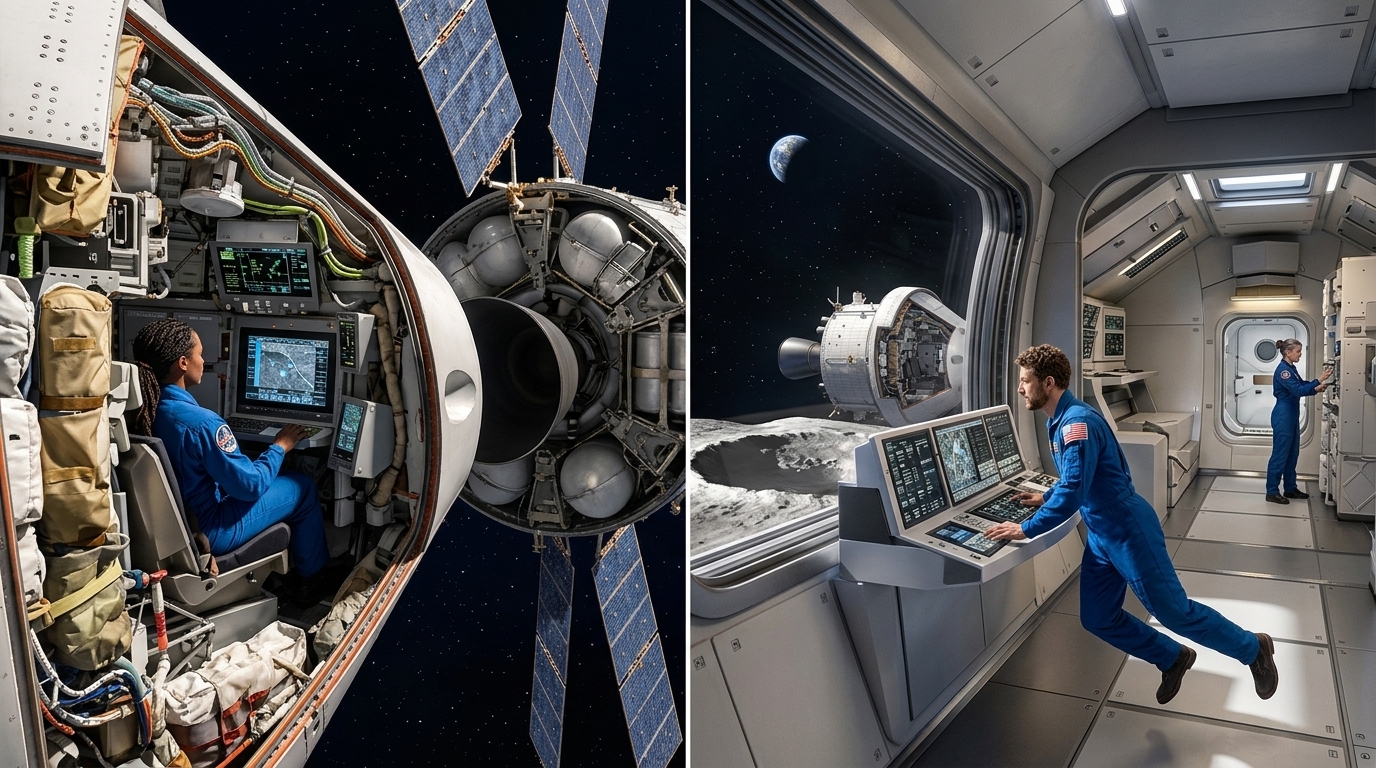
The architecture of the Artemis III mission relies on a complex sequence of systems that differ radically from the Apollo era. At its core is the Space Launch System (SLS), the most powerful rocket ever built, which will carry the Orion capsule and its four-member crew toward lunar orbit. However, the defining difference lies in the landing system. Instead of a single lunar module, NASA has opted for SpaceX’s Starship HLS (Human Landing System).
Starship will launch separately, refuel in low Earth orbit from a series of tanker spacecraft, and then travel to the Moon to await Orion. This in-space propellant transfer process is one of the greatest technical hurdles. Docking the two spacecraft in lunar orbit and transferring two astronauts to Starship for the descent to the surface is a precision choreography that will test the limits of modern engineering. Unlike Apollo, which was a self-contained unit, Artemis is a modular, distributed effort.
The Target: The Dark and Frozen South Pole
Unlike the Apollo missions that landed in the Moon's equatorial regions, Artemis III targets the South Pole. This is a region of extreme contrasts, where mountain peaks are bathed in perpetual sunlight while crater floors remain in eternal darkness and at temperatures approaching absolute zero. Why was this difficult region chosen?
The answer lies in water. Satellite observations have confirmed the existence of water ice in "permanently shadowed regions" (PSRs). This water is not only vital for astronaut sustainability but can also be broken down into hydrogen and oxygen, providing rocket fuel and breathable air. The South Pole is essentially the "gas station" of the future solar system, and Artemis III will be the first mission to explore it on the ground. This resource-driven approach marks the shift from exploration to utilization.
Social and Geopolitical Dimensions
NASA has committed that Artemis III will carry the first woman and the first person of color to the lunar surface. This move carries profound symbolism, reflecting a humanity that returns to space more united and representative. However, beyond the symbolism, there is stark geopolitical competition. China, with its own ambitious program, is also targeting the South Pole, creating an atmosphere that many liken to a new "Space Race."
The Artemis Accords, signed by dozens of nations (including Greece), set the framework for peaceful and transparent exploration. Nevertheless, resource management and the ownership of lunar territories remain thorny issues that will define international relations in the 21st century. The success of Artemis III will consolidate American leadership in this new frontier, while simultaneously paving the way for a global economy that extends beyond the confines of Earth.
New Suits and Surface Survival
Another significant innovation is the AxEMU suits, developed by Axiom Space. The old Apollo suits were rigid and limited movement. The new suits are designed like wearable "miniature spacecraft," offering greater mobility, protection against abrasive lunar dust, and resilience to the extreme temperatures of the South Pole. Astronauts will spend about a week on the surface, conducting experiments and collecting samples that could change our understanding of the solar system's history.
"We are not just going back to leave flags and footprints. We are going to stay, to learn, and to prepare for the next giant leap: Mars."
In conclusion, Artemis III represents the most ambitious undertaking of our time. It is a test of human ingenuity, political will, and our ability to collaborate with artificial intelligence and robotics to conquer the unknown. The videos and simulations recently released are not just PR material; they are the roadmap for the expansion of human civilization into the stars. The Moon is no longer a destination; it is a laboratory and a stepping stone.