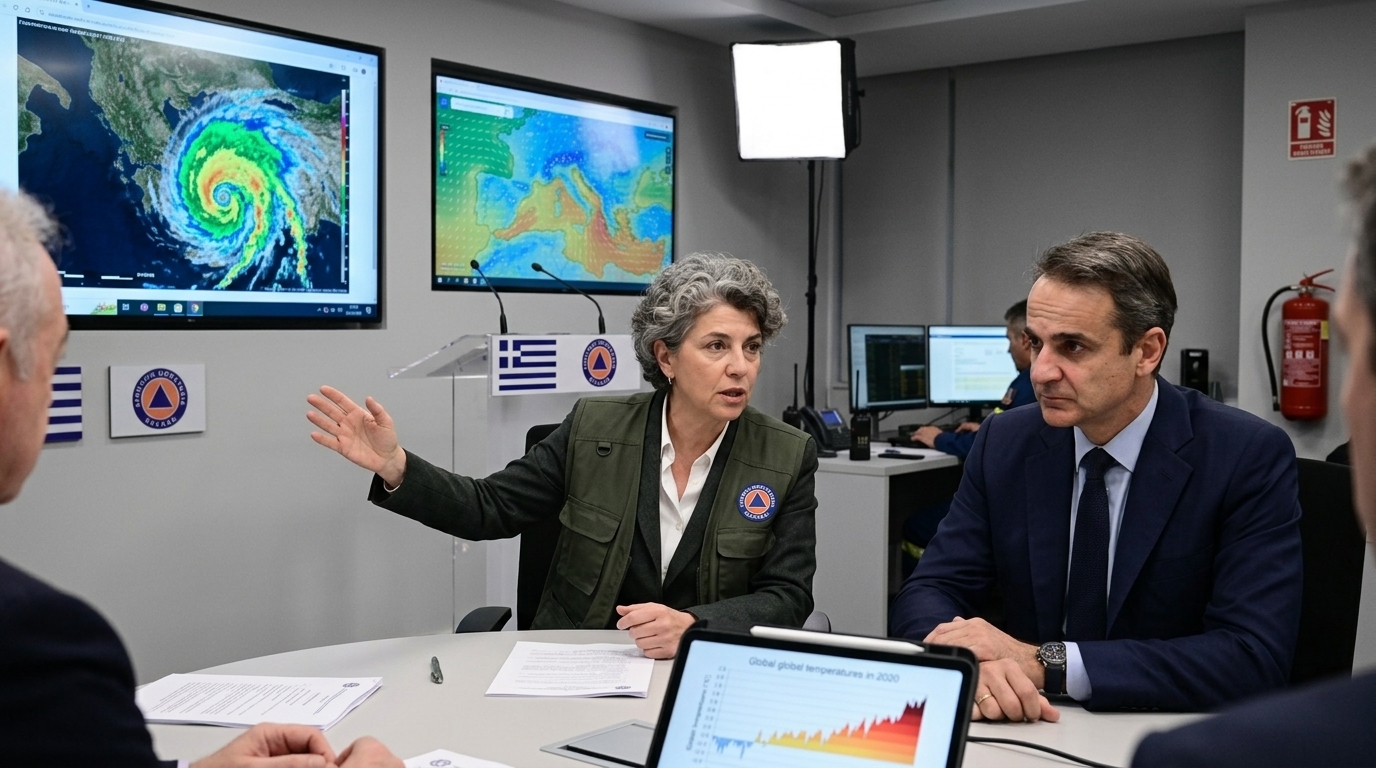
The climate crisis is no longer a distant threat confined to academic papers; it is a vivid, violent reality reshaping the global risk map. In a revealing interview with Business Monitor, Efthimios Lekkas, Professor of Dynamic Tectonic Applied Geology and Disaster Management, sounds the alarm over the speed at which these phenomena are evolving. According to Professor Lekkas, humanity has moved past the stage of "climate change" into "climate crisis," and we are now heading rapidly toward "climate collapse" unless a radical overhaul of our strategies occurs.
The Transition from Change to Crisis
Professor Lekkas emphasizes that the primary difference observed today is not just the intensity of the phenomena, but their frequency and sequence. Previously, a "100-year event"—such as a biblical flood or a catastrophic heatwave—allowed societies and ecosystems time to recover. Today, these events repeat every five years or even more frequently, creating a phenomenon of "disaster accumulation." The energy trapped in the atmosphere due to the greenhouse effect fuels extreme storms, cyclones, and prolonged droughts in ways that existing infrastructure cannot manage.
The scientific community is now observing "compound hazards." For instance, a prolonged period of drought renders the soil unable to absorb water, resulting in a subsequent heavy rainfall causing flash floods. This chain reaction makes crisis management extremely difficult, as traditional predictive models often fail to capture the dynamics of this interaction. The concept of "stationarity" in engineering—the idea that the past is a reliable guide to the future—is effectively dead.
The Mediterranean as a Climate Crisis Hotspot
Particular emphasis was placed on the geographical position of Greece and the wider Mediterranean basin. Professor Lekkas characterized the Mediterranean as one of the most vulnerable spots on the planet. The enclosed sea of the Mediterranean warms faster than the open oceans, acting as an "energy reservoir" that fuels phenomena like Mediterranean cyclones (medicanes). Greece, with its diverse geomorphology, is on the front line, facing the dual threats of forest fires in the summer and devastating floods in the autumn.
- Rising sea temperatures are altering local microclimates and biodiversity.
- Desertification threatens vast areas in the Eastern Peloponnese and the Aegean islands.
- Infrastructure built in the 70s and 80s is not designed for today's hydraulic loads.
The professor noted that "prevention" in the traditional sense is no longer enough. A complete redesign of infrastructure based on resilience is required. This means that roads, bridges, and drainage networks must be constructed to specifications that withstand conditions previously considered impossible or highly improbable.
Geopolitical Implications and Social Cohesion
Beyond the environmental and economic costs, Efthimios Lekkas highlighted the geopolitical dimension of the crisis. Resource scarcity, primarily water and arable land, will inevitably lead to new migratory flows and potential conflicts. "Climate refugees" are no longer a theoretical term but a reality that will pressure Europe's borders in the coming years. The destabilization of regions due to extreme phenomena can trigger a domino effect on the global economy and security.
"We do not have the luxury of waiting. Nature is warning us in an increasingly violent manner. Adaptation is not an option; it is a condition for the survival of future generations."
In concluding his analysis, Lekkas stressed the need for citizen education. Civil Protection must begin in schools and local government. Knowing how to react in a crisis can be the difference between life and death. The state, on the other hand, must invest in early warning systems and stop treating disasters as "extraordinary events," instead integrating them into the core of national strategic planning. The cost of inaction far outweighs the investment required for a resilient future.