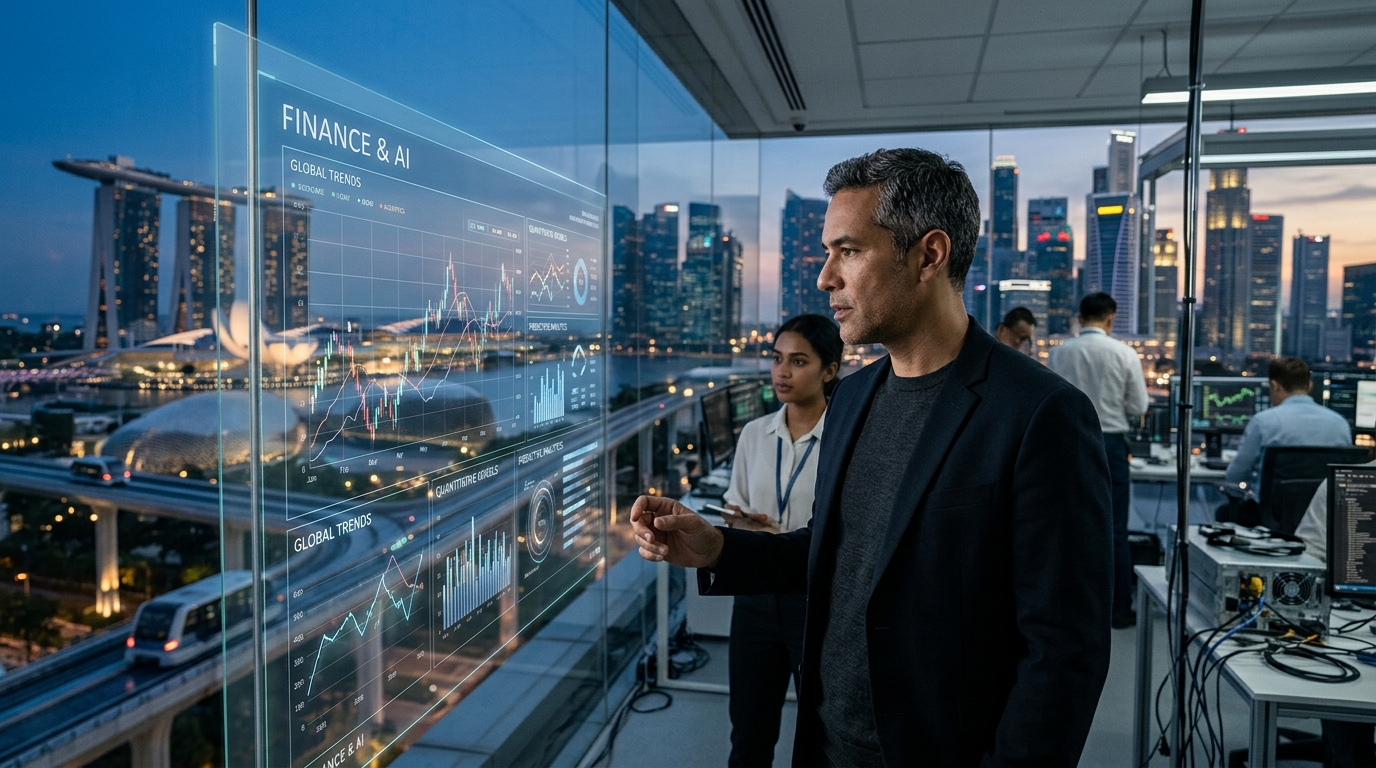
As of June 15, 2026, the global economy stands at a pivotal juncture. The image of the economist hunched over complex spreadsheets and static models is a relic of the past. Today, economic science is no longer merely the study of resource allocation; it is a hybrid discipline that weds classical theory with advanced computational power and Artificial Intelligence (AI). The demand for professionals who can bridge the gap between financial strategy and technological innovation has never been more urgent.
The Shift from Analysis to Real-Time Forecasting
In the past, economists relied on historical data to predict the future—a process often likened to driving a car while looking only at the rearview mirror. The integration of Generative AI and Large Language Models (LLMs) into economic analysis now allows for the processing of unstructured data—ranging from news reports and social media posts to satellite imagery of commercial ports—in real-time. This "high-frequency data economy" enables analysts to identify trends before they are reflected in official indices.
For the modern economist, proficiency in Python or R is no longer an "extra skill" but the primary language of communication with the market. The ability to train and oversee algorithms that execute thousands of Monte Carlo simulations within seconds provides unprecedented precision in risk management and strategic planning. This shift is not just about speed; it is about the depth of insight that was previously humanly impossible to achieve.
Human Judgment in the Age of Algorithms
Despite the dominance of machines, the role of the human economist is not being abolished; it is being elevated. AI can identify correlations with staggering efficiency, but it struggles to understand causality and socio-political context. This is where the value of the "economist of the future" lies: in the ability to interpret AI findings through the lens of ethics, geopolitics, and human psychology.
"AI can provide the answer, but only a human can ask the right question," notes a senior strategist from a leading Wall Street firm.
The bridge between finance and technology requires a new generation of professionals possessing "algorithmic intuition." This means knowing when an AI model is "hallucinating" or when its predictions are biased due to flawed training data. The ethical dimension of economics is becoming a central pillar, as decisions made by automated systems impact the livelihoods of millions. The economist must now act as a safeguard against the "black box" nature of automated finance.
The Global Context and the Role of the Diaspora
For nations like Greece and its global diaspora, this evolution presents a unique opportunity. As highlighted by the Hellenic News of America, Greek economists excelling abroad are often at the forefront of this technological revolution. The transfer of expertise from major financial hubs like New York and London to the Greek economy can accelerate the digital transformation of domestic banks and enterprises.
- Education: Academic institutions must integrate data science into economics curricula to remain competitive.
- Fintech: The growth of the financial technology sector can attract venture capital and retain high-level talent.
- Governance: Utilizing AI for tax evasion detection and public expenditure optimization requires specialized economic oversight.
Conclusion: The Economist as a Systems Architect
Economics is now synonymous with ecosystems. The economist of 2026 is not an isolated scholar but a systems architect who combines mathematical rigor with philosophical inquiry. The challenge is not to compete with Artificial Intelligence but to harness it to create a more equitable and efficient global market. The bridge between finance and technology has been built, and those who cross it first will define the trajectory of the coming decade. As we move forward, the successful economist will be the one who maintains human empathy while wielding the power of the machine.