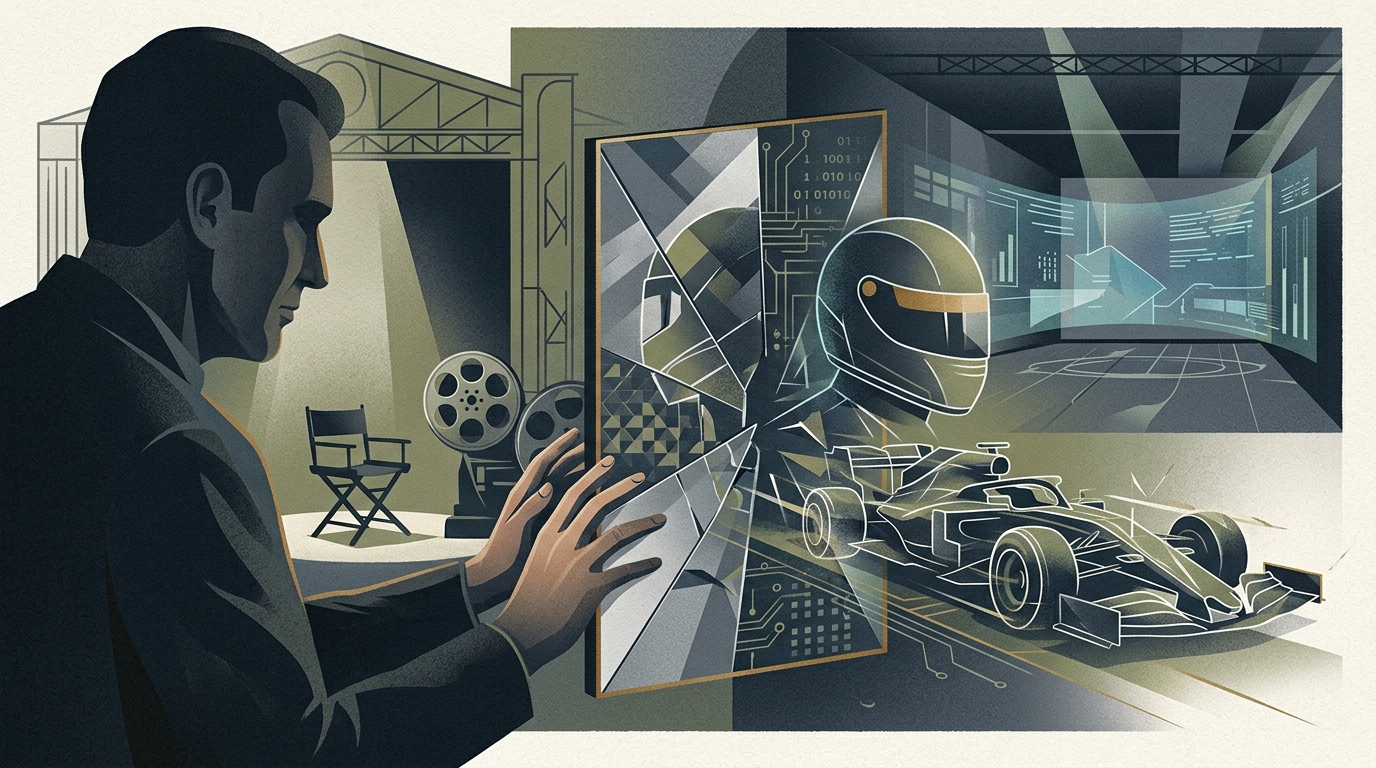
In an era where the boundaries between physical reality and digital simulation are becoming increasingly blurred, Jodie Foster, one of the most respected voices in global cinema, has caused a stir with her recent remarks. The occasion was the highly anticipated film "F1," directed by Joseph Kosinski and produced by Jerry Bruckheimer and Lewis Hamilton. Foster, upon viewing footage from the film, publicly questioned whether what we are seeing is the product of human effort or the result of sophisticated Artificial Intelligence (AI) algorithms.
Foster's intervention is not merely a critique of an action movie. It is a profound existential inquiry into the very essence of art in the digital age. The actress, who began her career in a time when film stock was the only truth, identifies a "strange perfection" in Brad Pitt's appearance and the racing sequences that makes her feel uneasy. This sensation, known in psychology as the "Uncanny Valley," describes the aversion humans feel when encountering something that looks almost perfectly human, yet remains palpably artificial in some indefinable way.
Technological Excess and the Pursuit of Realism
The irony in the case of the "F1" movie is that director Joseph Kosinski—renowned for "Top Gun: Maverick"—has invested massive amounts of money and effort to avoid traditional CGI. He utilized specially designed IMAX cameras mounted inside actual racing cars, with actors subjected to real G-forces during filming. Nevertheless, the post-production processing, color grading, and potential use of AI for stabilization or facial enhancement create a result that, to Foster, feels "fake."
The question arises: When does realism cease to be realistic? In their attempt to provide a flawless visual experience, producers may end up removing the "human grit." AI can smooth out wrinkles, correct lighting in every frame, and make movement appear incredibly fluid. However, as Foster argues, art is often found in the imperfections. Her skepticism reflects the fear of an entire generation of creators that technology is not merely assisting the narrative but replacing it entirely.
The Ethics of Acting and the Threat of the Digital Twin
The debate sparked by Foster is directly linked to the recent SAG-AFTRA strikes in Hollywood. A central issue was the use of AI to create "digital twins." If an actor can remain eternally young or if their performance can be digitally altered after the fact, what remains of the authenticity of the moment? Foster, having witnessed the evolution of cinema from the inside, views AI as a threat to the "intellectual property" of human expression.
- The use of AI for de-aging actors like Brad Pitt or Tom Cruise.
- The creation of fully digital environments that mimic real F1 tracks with terrifying accuracy.
- The ability of algorithms to analyze audience reactions and adjust editing for maximum emotional manipulation.
These tools, while impressive, create a sense of alienation. Foster wonders if in the future we will even need actors, or if a data model capable of reproducing their features will suffice. The "F1" movie, with its staggering budget approaching $300 million, serves as a laboratory for this new era.
The Audience in the Age of Deepfakes
Another factor influencing Foster's perception is the audience's crisis of trust. We live in an age where deepfakes are a daily occurrence. When a viewer sees something "too good to be true," their first thought is no longer "what a great achievement," but rather "what software did this?" This suspicion poisons the cinematic experience.
Foster points out that if we lose faith in the truth of the image, we will also lose our connection to the story. Drama requires empathy, and empathy requires the belief that what we are seeing comes from a human being who feels, suffers, and ages. The "F1" movie, despite its technical brilliance, risks being remembered as a cold feat of engineering rather than a cinematic masterpiece.
"Art is the evidence of human existence. If we hand it over to algorithms, what will be left to remind us of who we are?"
In conclusion, Jodie Foster's critique serves as a warning. It is not a voice against progress, but a plea for the preservation of the human soul on the big screen. As Hollywood marches toward the full integration of Artificial Intelligence, the question remains: Do we want movies that are perfect, or movies that are true?