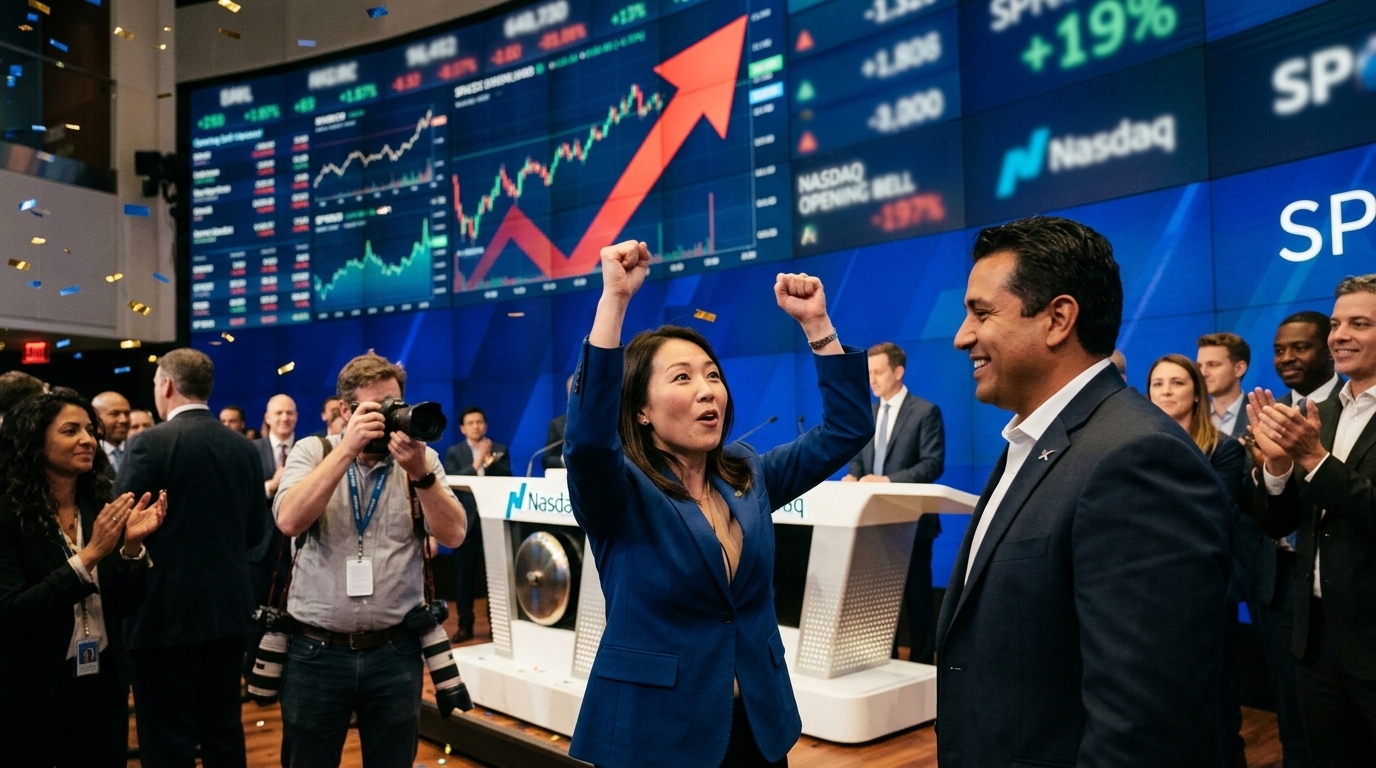
June 12, 2026, will be etched in the annals of global finance as the day space ceased to be a scientific dream and formally became a commercial commodity. SpaceX, the company founded by Elon Musk with the audacious vision of colonizing Mars, made its long-awaited debut on the Nasdaq index. The result? An explosive 19% surge on its first day of trading, shattering all previous records for market capitalization for a newly listed company.
SpaceX's initial public offering (IPO) was not merely a financial maneuver; it was a geopolitical statement. After years of speculation and constant delays, the company decided to open its books to the investing public, revealing a financial robustness that surprised even the most optimistic Wall Street analysts. The opening price, set at the top of the range, was surpassed within the first minutes of the session, driving the company's valuation past the $250 billion mark.
The Driving Force: Starlink and Starship
The success of the listing was built on two pillars: the profitability of the Starlink network and the operational readiness of the Starship system. Starlink, which now boasts over 15 million subscribers worldwide, provides the necessary cash flow that makes SpaceX a viable business rather than just a research laboratory. According to filings with the Securities and Exchange Commission (SEC), revenue from telecommunications services increased by 45% over the last year, offering investors the security of recurring revenue.
"You aren't just buying shares in an aerospace company; you are buying a stake in the future infrastructure of human civilization," said a leading Goldman Sachs analyst during the opening ceremony.
On the other hand, Starship, the largest and most powerful launch system ever built, has now proven its reliability with dozens of successful landings and reuses. SpaceX's ability to reduce the cost of access to space by 90% compared to traditional players (such as Boeing and Lockheed Martin) gives it an undeniable competitive advantage that the market was quick to price in.
Market Reaction and Investor Frenzy
Demand for shares was so high that many retail investors found themselves excluded from the initial allocation. In Europe, interest was particularly intense, with brokerage firms reporting record requests for access to US markets. The 19% jump on the first day created a climate of euphoria, but also raised questions about whether this is a new "bubble" or the true value of a company that monopolizes a sector with limitless prospects.
Institutional investors, however, are focusing on SpaceX's long-term contracts with NASA and the US Department of Defense. The company has managed to become the primary transport provider for the International Space Station and the Artemis program, which aims to return humans to the Moon. This close relationship with the US government provides a safety net rarely found in high-risk technology companies.
Challenges and the "Musk Factor"
Despite the triumph, SpaceX faces significant challenges. The dependence on Elon Musk's personality remains a factor of instability. Investors worry about how his other ventures, such as X (formerly Twitter) and Tesla, might distract him or lead to regulatory issues. Furthermore, increasing competition from the Chinese space agency and Jeff Bezos' Blue Origin means that SpaceX cannot afford to rest on its laurels.
The environmental impact of frequent launches is also a point of contention. With the company planning daily Starship launches from Texas and Florida, pressure from environmental organizations is expected to intensify. Managing these social and regulatory pressures will be crucial for maintaining the stock price at these elevated levels.
Conclusion: The Dawn of a New Economy
SpaceX's success on the Nasdaq is not just a win for Musk, but a milestone for humanity. It marks the transition from space as a field of state power projection to space as a field of economic development. For the global market, this development serves as a wake-up call regarding the necessity of investing in space infrastructure, ensuring that the world does not remain a mere spectator in a race that has only just begun to accelerate.