

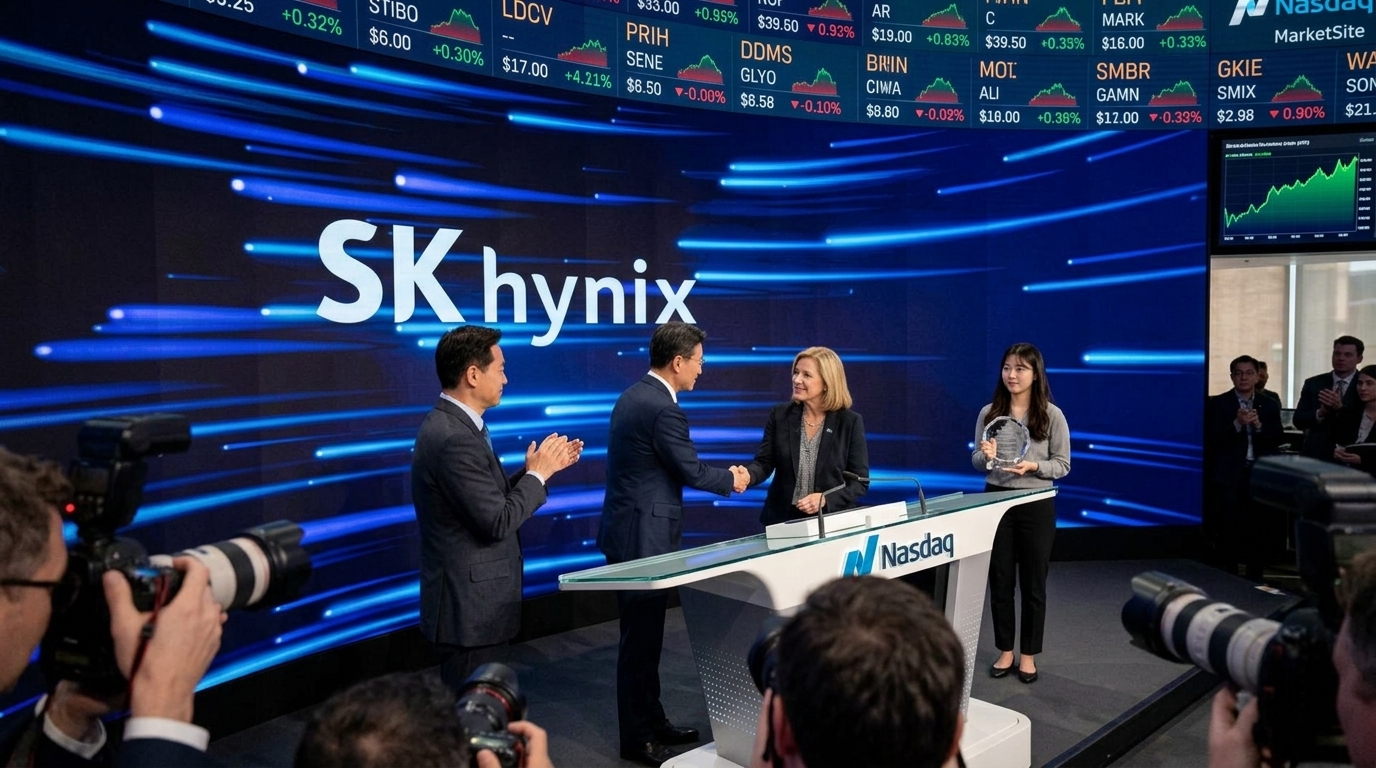
In a historic moment for the global semiconductor industry, South Korean giant SK Hynix made a stunning debut on the Nasdaq Stock Market in New York, with its shares surging 13% on the first day of trading. This move is not merely a successful cross-listing; it signals a fundamental shift in AI investment focus toward the hardware companies that build the physical infrastructure required for large language models. SK Hynix, the world’s second-largest memory chipmaker, is now recognized as the undisputed leader in High Bandwidth Memory (HBM) technology—the essential fuel for Nvidia’s AI processors.
The HBM Dominance and the Nvidia Alliance
The explosive stock performance reflects investor confidence that SK Hynix holds a strategic monopoly over the most critical component of AI infrastructure. While Nvidia designs the GPUs that power the AI revolution, those processors are effectively paralyzed without the specialized HBM produced by the Korean firm. HBM allows for the transfer of massive datasets at speeds that traditional DDR memory cannot match, making it the primary performance bottleneck for high-end AI systems.
Analysts note that SK Hynix has successfully outmaneuvered its long-time rival, Samsung Electronics, in this specific niche. The company’s ability to deliver next-generation memory (HBM3E and now HBM4) with superior production yields has made it Nvidia’s preferred partner. Listing on the Nasdaq allows the company to tap directly into the world’s deepest pool of liquidity to fund the colossal capital expenditures required for new fabrication plants (fabs) in both South Korea and the United States.
Geopolitical Strategy and the American Pivot
SK Hynix’s decision to list on the Nasdaq is as much a geopolitical maneuver as it is a financial one. As the "chip war" between the US and China intensifies, a closer tie to the American financial system provides an additional layer of security and alignment with Washington’s strategic interests. The company has already committed to building a $4 billion advanced chip packaging facility in Indiana, an investment bolstered by incentives from the US CHIPS Act.
This move reassures American investors wary of over-reliance on East Asian supply chains. By listing on the Nasdaq, SK Hynix offers a "safe" haven for capital seeking exposure to AI hardware without the risks associated with direct investment in Chinese firms or the singular reliance on Taiwan’s TSMC, which remains under the constant shadow of cross-strait tensions with Beijing.
Competition and the Road Ahead
Despite the first-day triumph, the path forward is not without hurdles. Samsung Electronics is aggressively restructuring its memory division to close the HBM gap, while US-based Micron Technology is also striving to increase its market share, banking on the "Buy American" sentiment among US tech giants. However, SK Hynix currently enjoys a significant first-mover advantage and a deep technical integration with Nvidia that is difficult to disrupt in the near term.
The 13% jump suggests that the market is now pricing SK Hynix not as a commodity memory maker, but as an "AI infrastructure play." This re-rating is crucial for its future valuation. As AI models become increasingly complex, the demand for memory is growing exponentially, often outpacing the demand for raw compute power. SK Hynix sits at the epicenter of this dynamic, ready to capitalize on the insatiable need to feed the digital brains of the future.
- Market capitalization soared, placing the company among the global tech elite.
- Institutional demand far exceeded initial projections during the listing process.
- HBM3E technology remains the gold standard for AI data centers worldwide.
In conclusion, SK Hynix’s Wall Street premiere is a landmark event. It confirms that the AI revolution has moved beyond the phase of software promises into the phase of hard industrial reality, where dominance is determined in silicon foundries and high-precision assembly lines.





