

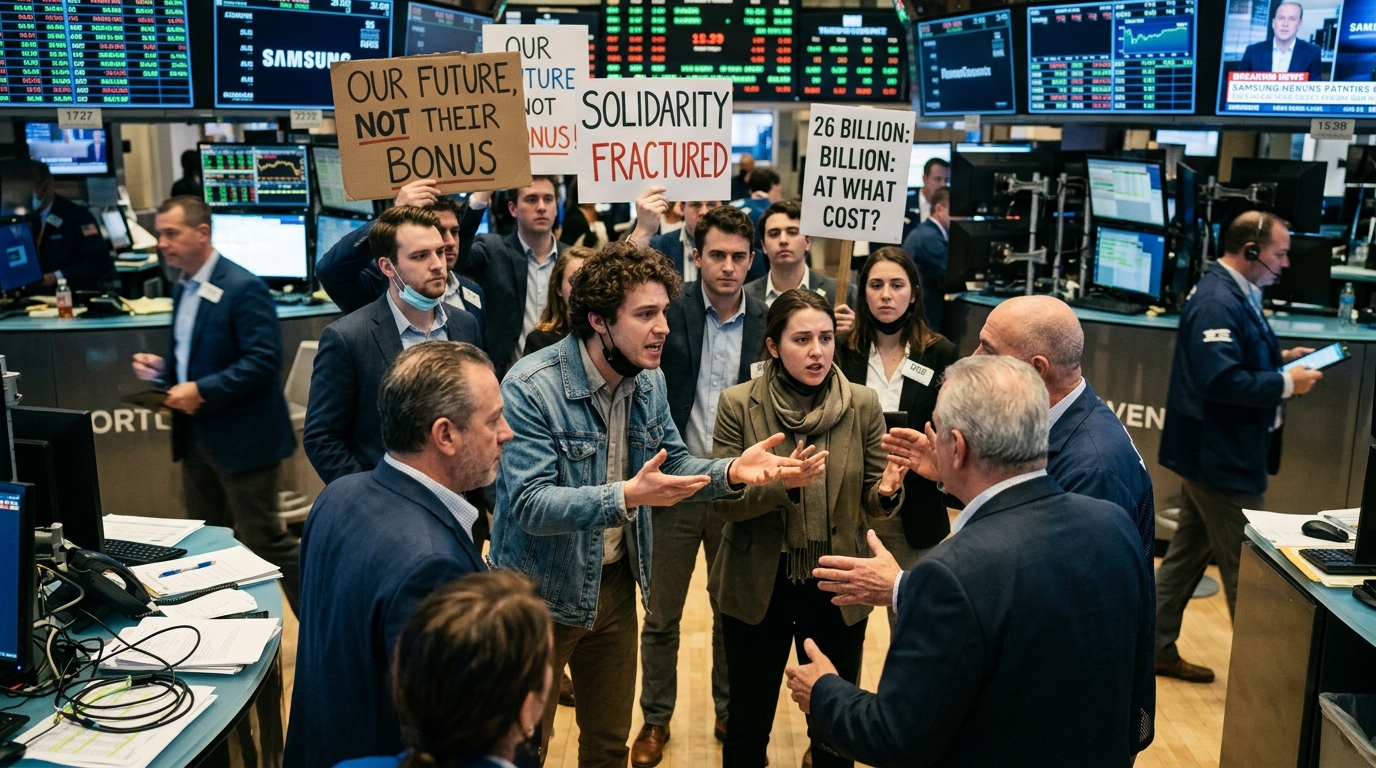
In the heart of Suwon, South Korea’s "Samsung City," the atmosphere this July 2026 is far from celebratory, despite the announcement of a benefits package that would make any other worker on the planet rejoice. The National Samsung Electronics Union (NSEU), led by a new generation of labor organizers, managed to secure a staggering $26 billion deal in bonuses and benefits—a share of the windfall profits generated by the company’s dominance in High Bandwidth Memory (HBM) chips for Artificial Intelligence. However, what began as a triumph for the 34-year-old union leader has curdled into a bitter internal conflict that exposes deep fractures in the modern tech landscape.
The Evolution of Unionism: From Megaphones to Data Sheets
For decades, South Korean unionism was synonymous with red headbands, militant rallies, and an ideological war against the powerful chaebols. But the new generation, the so-called "MZ" (Millennials and Gen Z), has rejected that aesthetic. The NSEU leadership utilized spreadsheets, market analysis, and the rhetoric of "fair compensation" to squeeze management. The $26 billion victory was the zenith of this strategy. But success brought with it the curse of comparison.
The problem lies in the distribution. While engineers in the Memory division, who produce the critical chips for Nvidia, saw their incomes skyrocket, their colleagues in home appliances and mobile divisions received significantly smaller payouts. This "AI hierarchy" has created two classes of workers within the same company. Employees not on the bleeding edge of semiconductor fabrication feel sidelined, arguing that Samsung’s overall success relies on the ecosystem, not just a single product line.
The Shadow of Automation and the Price of Speed
Behind the numbers lies a darker reality. Samsung, in its desperate bid to reclaim lost ground from SK Hynix in the HBM3E and HBM4 markets, has imposed grueling work schedules. The bonus agreement included clauses that many now view as a "Trojan Horse" for further automation on the production lines. Management, having paid out this massive sum, is now pushing for the introduction of AI-driven control systems that could render thousands of jobs redundant by 2028.
- Pay inequality between the Memory and Foundry/Mobile divisions has reached historic highs.
- Workers report a "burnout culture" driven by the relentless deadlines imposed by Nvidia and other AI clients.
- The integration of AI in manufacturing is reducing the need for human oversight, sparking fears of future layoffs.
- Union leadership is being accused by the rank-and-file of being "bought off" with a lump sum, sacrificing long-term job security.
The divide is not just economic but moral. Many young workers are questioning whether the battle for bonuses was worth the loss of workplace solidarity. "We won the money, but we lost our unity," a software engineer told Bloomberg anonymously. The bitterness is exacerbated by the fact that Samsung’s management used the deal as a PR tool to soothe shareholders, while internal employee satisfaction surveys are in a freefall.
The Future of Labor in the Age of Super-Profits
The Samsung case is a harbinger for the global tech sector. As AI generates unimaginable wealth for a few strategic sectors, the pressure for redistribution will intensify. However, if this redistribution is not accompanied by a new social contract that protects workers from technological obsolescence, union "victories" will remain hollow. The challenge for the NSEU’s Millennial leader is now to reunite a fractured workforce before the very AI they help build makes them expendable.
"We are no longer fighting for bread; we are fighting for our relevance in a world where algorithms are valued more highly than human experience."
In conclusion, the $26 billion "victory" is a lesson for the modern economy: in the age of AI, money alone cannot buy stability. Samsung stands at a crossroads, needing to decide whether it will remain a tech giant with a human face or a profit-generating machine that consumes its own creators.





