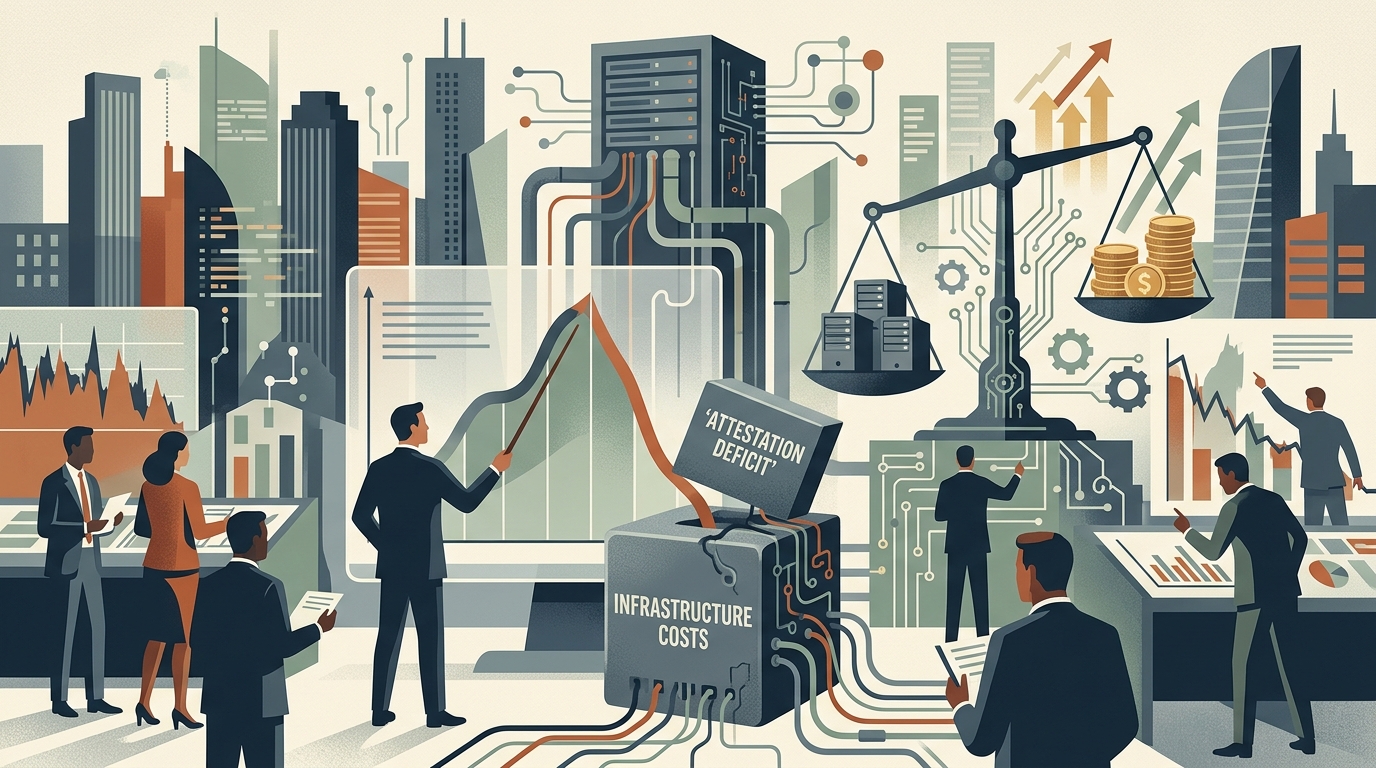
As of June 2026, the artificial intelligence industry stands at a critical juncture. After years of frantic growth, where success was measured by parameter counts and GPU cluster sizes, economic reality is beginning to impose its own rules. A recent report from DigitalToday highlights a growing concern in Silicon Valley and global tech hubs: the development model based exclusively on giant models—the Big Model-centric landscape—may be reaching its limits, not due to a lack of intelligence, but due to resource exhaustion.
The Billion-Dollar Wall and Energy Asphyxiation
Training frontier models, such as GPT-5 and its successors, no longer costs millions, but billions of dollars. This cost is not just about purchasing hardware (chips), but primarily about energy consumption and access to high-quality data. Tech giants like Microsoft, Google, and Meta are forced to invest in their own nuclear power plants or massive wind farms to power their data centers. However, the return on investment (ROI) is starting to be questioned by shareholders.
As market analysts point out, the linear increase in computing power no longer translates into a linear increase in model intelligence. We are in a phase of diminishing returns, where gaining an extra 5% in accuracy requires 100% more energy and training time. This paradox creates an economic 'bubble' around compute, which threatens to burst unless more efficient methods are found.
From Inference to Profitability: The Real Challenge
If training is the one-time cost, inference—running the model for users—is the continuous hemorrhage. Every query a user submits to a GPT-4o or Gemini 1.5 Pro level model costs the company a fraction of a cent, which cumulatively across billions of users creates astronomical operating expenses. The free provision of such services, which characterized the 2023-2025 period, is becoming unsustainable.
- Increase in subscription fees for premium models.
- Imposition of strict rate limits even on paid accounts.
- A shift toward 'hybrid AI,' where most processing occurs locally on the user's device.
This pressure is leading to a new strategy: model distillation. Companies are trying to take the 'knowledge' of a massive model and condense it into a smaller, more agile model (SLM - Small Language Model), which can run at 1/10th of the cost without significant quality loss in specific tasks.
The Rise of Specialized Models (SLMs)
2026 appears to be the year of the 'small.' Instead of one model that does everything, businesses are turning to specialized models for legal, medical, or programming issues. These models are trained on targeted datasets and require far fewer resources. The success of DeepSeek and other companies focusing on architectural efficiency shows that the path to the future is not necessarily gigantism.
"The era of brute force in artificial intelligence is ending. The next phase will be decided by the elegance of algorithms and their energy prudence, not by who has the most GPUs," says a senior executive at a major cloud provider.
In conclusion, the cost crisis is acting as a catalyst for innovation. The need for survival is forcing researchers to abandon the easy solution of scaling and return to basic research for smarter architectures. For the global economy, this means a transition from the AI of demonstration to the AI of substance and profitability.