

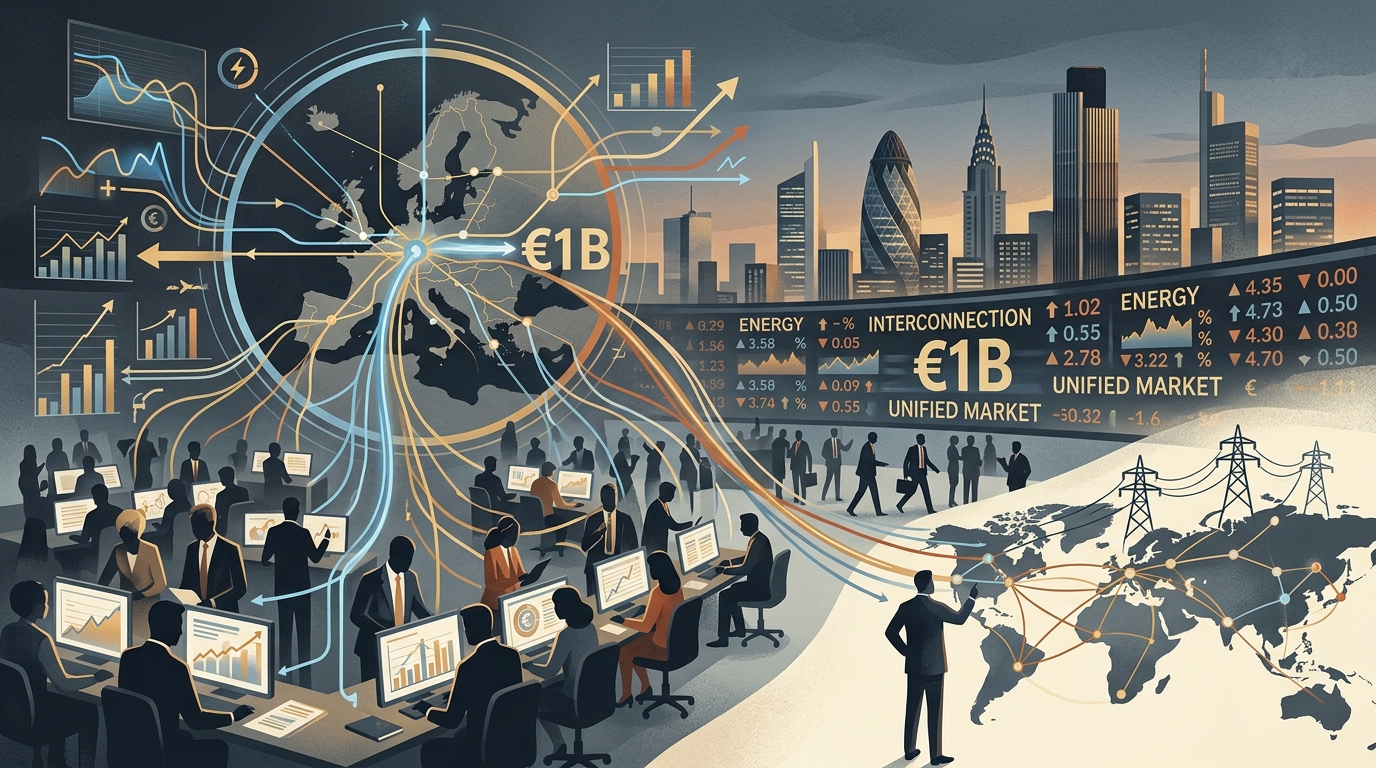
At a time when the energy crisis continues to cast its shadow over the European economy, the need for structural changes in how the electricity market operates has become imperative. Minister of State Stavros Papastavrou, in his recent interventions, has pointed to the core of the issue: Europe cannot thrive energetically as long as it remains fragmented into 27 different national markets. The stake is not merely political but deeply economic, with the potential benefit from strengthening interconnections estimated at 1 billion euros.
The Fragmentation Trap and the 'Energy Paradox'
The current architecture of the European energy market resembles a mosaic rather than a unified space. Despite efforts toward convergence, wholesale prices vary significantly from state to state, often due to the lack of sufficient capacity in cross-border interconnections. This phenomenon creates 'energy islands' and prevents the optimal allocation of generated energy, especially from renewable energy sources (RES).
Mr. Papastavrou emphasized that the existence of 27 different regulatory frameworks and limited physical connections leads to inefficiency. When production in Greece is in surplus due to high solar radiation but cannot be exported to Central Europe because of grid 'congestion,' the value of this energy is lost. The €1 billion benefit mentioned refers precisely to this recovery of lost efficiency through integration.
Interconnections: The Backbone of the Green Transition
To achieve decarbonization goals, interconnections are no longer a luxury but a prerequisite. Greece, due to its geographical position, aspires to transform into an energy hub connecting Europe with Africa and the Middle East. Projects like the Great Sea Interconnector (Greece-Cyprus-Israel) and the GREGY interconnection with Egypt are pieces of a puzzle that transcends national borders.
- Price Reduction: The free flow of energy allows cheaper sources to prevail across the continent.
- Security of Supply: An interconnected Europe is less vulnerable to local outages or geopolitical blackmail.
- Grid Stability: Renewables are intermittent sources; interconnection allows for balancing loads over long distances.
However, the implementation of these projects often hits bureaucratic hurdles and national protectionism. Mr. Papastavrou's call for 'not 27 markets' is a plea to Brussels for more centralized and aggressive management of energy infrastructure.
The Role of Technology and the Greek Initiative
The Greek government is actively promoting the idea of a 'vertical energy corridor.' This means that Greece will not only be a consumer but also a critical transit point for green energy toward Northern Europe. The Minister of State's analysis highlights that technological progress in grid management (smart grids) must be accompanied by political will.
"Energy is the lifeblood of our economy. If our arteries are clogged at the borders, the entire organism of the European Union will suffer from a lack of competitiveness," government circles report, echoing Mr. Papastavrou's positions.
In conclusion, the transition from 27 national markets to a single European electricity market is the only way to ensure that the cost of the green transition is not disproportionately borne by consumers and businesses in the periphery. The 1 billion euros is just the beginning; the real gain will be a strong, autonomous, and competitive Europe.





