

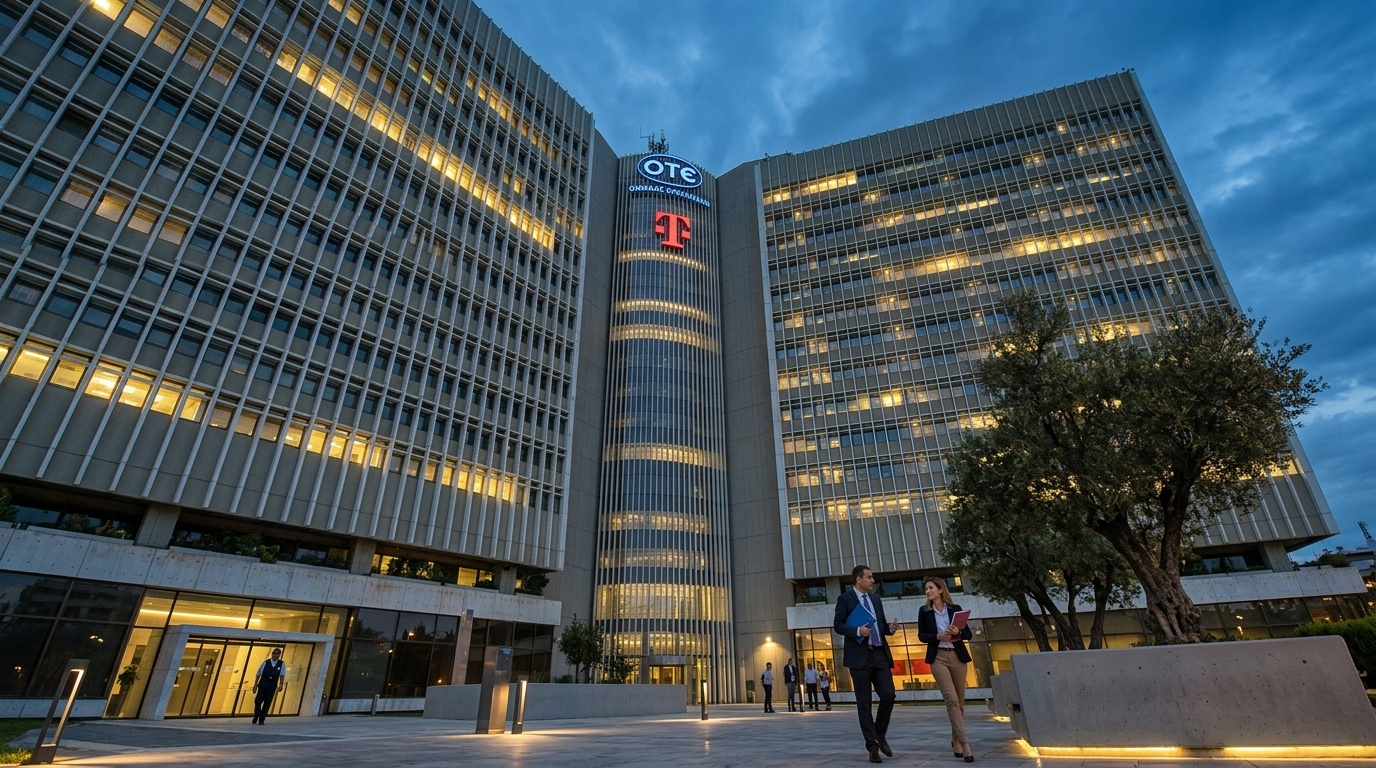
In the dynamic landscape of the Greek real estate market, few names carry the specific weight and historical significance of OTEestate. The subsidiary of the OTE Group, which manages one of the largest and most diverse real estate portfolios in Southeast Europe, is no longer a mere "guardian" of telecommunications infrastructure from the past. Today, with a portfolio value exceeding €1.28 billion and revenues recording double-digit growth, the company is emerging as a strategic investor redefining the concept of property utilization in the digital age.
Financial Surge and the Massive Dividend
The recent financial report of OTEestate reveals an impressive upward trajectory. The revenue increase is not accidental but the result of a carefully designed strategy focusing on optimizing the use of existing spaces and attracting high-quality tenants beyond the parent group. The decision for a higher dividend distribution to the shareholder—the OTE Group and, by extension, Deutsche Telekom—reflects strong cash flow and confidence in the company's future prospects.
The company's portfolio includes over 2,000 properties, ranging from iconic office buildings in central Athens to small telecommunications hubs in the provinces. The challenge for management has always been converting these passive assets into active income. The success of this effort is reflected in the revaluation of assets, favored by the general rise in commercial real estate prices in Greece, as well as targeted investments in renovations.
The "Hidden Card": Green Development and ESG
If one wonders what the real "hidden card" of OTEestate is, the answer lies in the word "sustainability." The company has launched an ambitious program for the energy upgrading of its buildings, transforming old concrete structures into modern, eco-friendly office spaces that meet the strictest international standards (LEED, BREEAM). In a market where demand for "green" offices far outstrips supply, OTEestate possesses the advantage of scale and location.
The emblematic "Megaron OTE" in Maroussi is the most characteristic example of this transformation. It is not just an aesthetic intervention but a complete renegotiation of the building's relationship with the environment and employees. The shift toward ESG (Environment, Social, Governance) is not just a matter of corporate social responsibility but a purely economic decision: sustainable buildings command higher rental values, lower operating costs, and greater long-term resilience.
From Telephone Exchanges to Data Centers
Another facet of the "hidden card" is the geographical dispersion and nature of the properties. Many of OTEestate's properties are located at key nodes ideal for the development of Data Centers and Edge Computing infrastructure. As Greece transforms into a regional digital hub, owning properties with existing fiber optic connections and high power supply constitutes a competitive advantage that few rivals can match.
Furthermore, the company is examining the optimal utilization of properties no longer necessary for telecommunications operations. This includes selling non-strategic assets or converting them into residential projects and mixed-use spaces, taking advantage of the momentum in Greek real estate. This flexibility allows OTEestate to operate more like a Real Estate Investment Trust (REIT) than a traditional infrastructure subsidiary.
Strategic Importance for the OTE Group
For the OTE Group, OTEestate represents a critical pillar of stability. During a period of intense competition in telecommunications and massive investments in 5G networks and fiber optics (FTTH), profitability from real estate offers a valuable breath of liquidity. Deutsche Telekom, closely monitoring the performance of its Greek subsidiary, sees OTEestate as a model that could be applied to other European markets.
In conclusion, OTEestate is not simply "sitting" on a €1.28 billion fortune. It is mobilizing it, modernizing it, and adapting it to the demands of the 21st century. Its "hidden card" is not just the square footage, but its ability to foresee the needs of tomorrow's market—whether they concern green energy or digital infrastructure. Its course in the coming years will serve as a barometer for how large corporate estates can be transformed into engines of national economic growth.





