

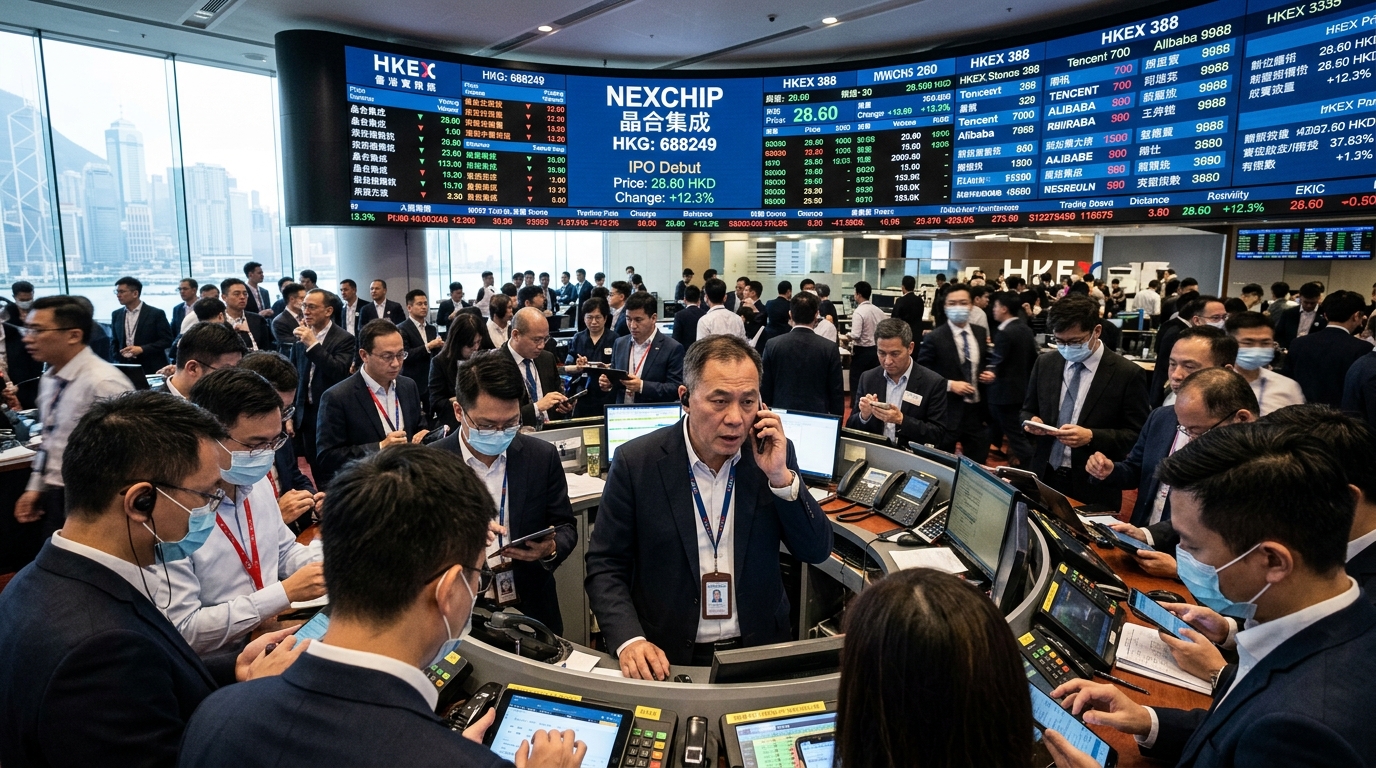
Today, Friday, July 10, 2026, global markets are focusing their attention on the Hong Kong Stock Exchange (HKEX), where Nexchip Semiconductor Corp. is making its long-awaited debut. Raising $890 million through a share sale is not merely a financial achievement for the Hefei-based company; it serves as a critical barometer for market confidence in the Chinese semiconductor industry at a time when geopolitical competition for silicon supremacy has reached its zenith.
The Strategic Significance of the Listing
Nexchip, which specializes primarily in Display Driver ICs (DDIC) and CMOS image sensors, has successfully climbed the ranks of global foundries. Its decision to list in Hong Kong, alongside its existing presence on Shanghai’s STAR Market, underscores China’s necessity to maintain open channels with international capital. In an environment where the U.S. is intensifying export restrictions on technology, Nexchip stands as a bulwark of China’s drive for self-sufficiency.
The success of this Initial Public Offering (IPO) comes at a moment when the AI semiconductor market is experiencing unprecedented growth. While Nexchip does not produce the cutting-edge 2nm processors that compete with Nvidia or TSMC, its position in the supply chain is vital. It produces the essential components for the automotive industry, smart devices, and 5G infrastructure—sectors now directly fueled by the integration of artificial intelligence.
The Challenge of Geopolitics and Technology
Investors who participated in the $890 million offering must weigh two opposing forces. On one hand, there is the guaranteed demand from China’s massive domestic market, which is generously subsidized by the government’s "Big Fund" for semiconductors. On the other hand, the risk of further Western sanctions remains a persistent Sword of Damocles. Nexchip has invested billions in expanding its production capacity for mature technologies (28nm and above), which, while less "glamorous" than leading-edge nodes, form the backbone of the global industry.
- Expansion of production in 28nm and 40nm nodes to meet demand in home appliances.
- Strategic shift toward Power Management ICs (PMICs) for electric vehicles.
- Strengthening partnerships with domestic smartphone manufacturers to reduce reliance on foreign foundries.
Market Analysis and Outlook
Nexchip’s listing in Hong Kong is also seen as a victory for the city’s exchange itself, which has struggled over the past two years to attract major tech offerings. The presence of a semiconductor company of this magnitude adds depth to the market and offers international investors a rare opportunity for direct exposure to China’s "Self-Reliance" strategy. However, analysts warn that the company’s profitability may be squeezed in the short term due to the massive capital expenditures (CapEx) required to purchase lithography equipment, which is becoming increasingly expensive and difficult to procure.
"Nexchip is not just a company; it is a symbol of the resilience of the Chinese supply chain," says a leading Hong Kong market analyst. "The market will judge it not only by its revenue but by its ability to innovate under pressure."
In conclusion, today marks a milestone. If Nexchip’s stock sees strong gains, it will pave the way for other Chinese tech giants to seek capital in Hong Kong. However, if the reception is cold, it will confirm fears that the fragmentation of the global tech market has begun to deeply affect the flow of capital.





