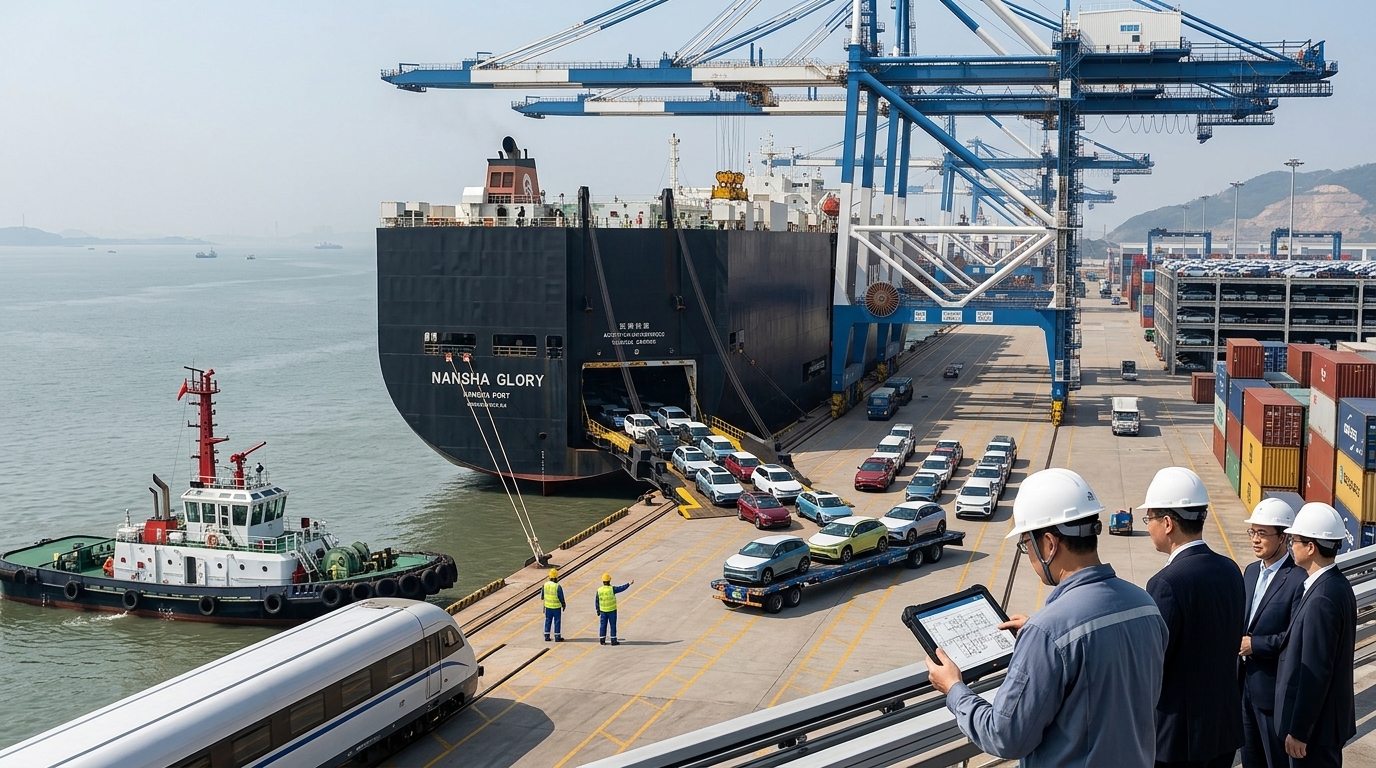
Deep within the Pearl River Delta, where China’s industrial engine meets the South China Sea, the Nansha Automobile Port in Guangzhou has transcended its role as mere infrastructure. It has become the strategic symbol of a tectonic shift in the global economy. As we move through the first half of 2026, the sight of thousands of New Energy Vehicles (NEVs) lined up for shipment onto massive Ro-Ro (Roll-on/Roll-off) vessels is the most vivid evidence of China’s dominance over the roads of the future.
The Strategic Significance of Nansha in the International System
Nansha Port has emerged as the largest automobile trade hub in southern China. Its geographical position makes it a critical gateway for the Greater Bay Area (GBA), linking the manufacturing powerhouses of Guangdong to markets in Southeast Asia, the Middle East, and Europe. Massive investments in specialized automobile terminals have allowed Nansha to handle volumes that would have been unthinkable a decade ago. Logistics efficiency here isn't just about speed; it’s about reducing per-unit costs, making Chinese vehicles even more competitive on the global stage.
Nansha does not operate in a vacuum. It is part of an integrated ecosystem that includes streamlined customs procedures, free trade zones, and direct links to the production lines of giants like BYD, GAC, and XPeng. This vertically integrated approach allows China to bypass traditional supply chain bottlenecks, offering a "just-in-time" export experience that Western competitors struggle to emulate.
New Energy Vehicles: The Tip of the Spear
In 2026, the conversation surrounding the Chinese auto industry is no longer about cheap imitations but about technological leadership. At Nansha, 70% of exported vehicles are now "New Energy." These cars integrate advanced autonomous driving systems, solid-state batteries offering ranges exceeding 1,000 kilometers, and software that essentially turns the vehicle into a mobile smartphone. The "Made in China 2025" strategy has clearly borne fruit, as the country has successfully controlled the entire value chain—from lithium mining to final port delivery.
- Increased capacity for next-generation Ro-Ro vessels.
- Digitized cargo management systems powered by AI.
- Collaborations with international shipping lines for direct routes to Europe and Latin America.
Geopolitical Challenges and Nansha’s Response
Despite commercial success, the landscape is fraught with obstacles. The European Union and the United States have imposed tariffs and restrictions, citing unfair state subsidies. However, Nansha serves as a pressure relief valve. Rather than being deterred, Chinese firms are using the port to diversify their destinations. We are seeing a vertical spike in exports to ASEAN countries and Africa, where the demand for affordable and reliable electric mobility is immense.
"Nansha is not just a port; it is China’s answer to Western protectionism," industry analysts state.
Furthermore, China is investing in its own fleet of vehicle carriers. BYD and SAIC have already launched their own dedicated ships, reducing reliance on foreign shipping companies. This means that even if tariffs rise, operational costs remain controlled, allowing Chinese companies to maintain their market share through sheer logistical efficiency.
Conclusion and Outlook
The momentum at Nansha highlights a broader truth: the global automotive industry has permanently shifted East. While traditional powers in Europe and Japan struggle to pivot toward electrification, China has already built the infrastructure to dominate the next phase. Nansha will continue to expand, integrating green technologies into its operations and strengthening its role as the central nerve center of global vehicle trade. For the consumer in Athens, Berlin, or Bangkok, the car they drive tomorrow will most likely have begun its journey from the piers of Nansha.