

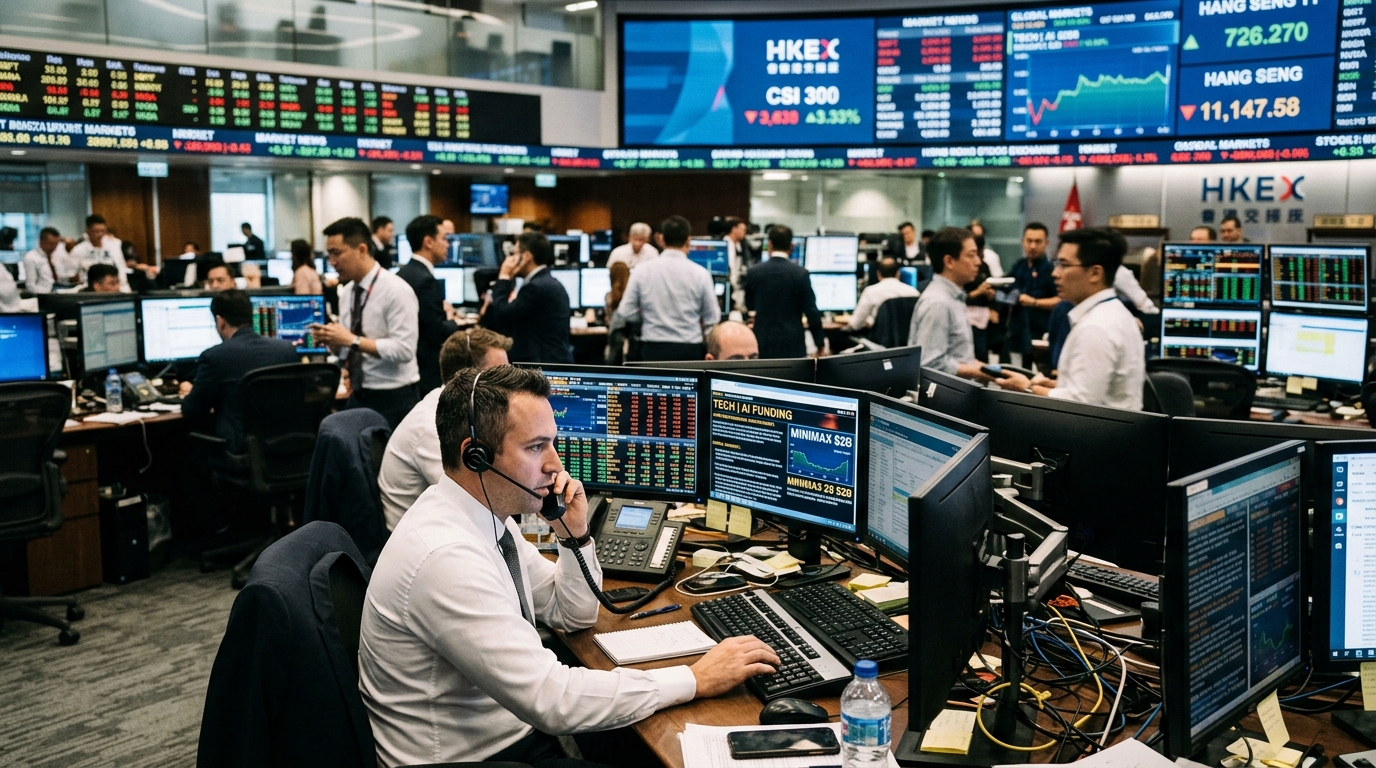
In the high-stakes theater of global Artificial Intelligence, China has just executed a move that demands the world’s attention. MiniMax, one of the most formidable contenders in the realm of Large Language Models (LLMs), has announced a staggering $2 billion funding round. Backed by titans such as Alibaba and Tencent, this capital injection is more than just a financial milestone; it is a strategic declaration of intent in an era where technological sovereignty has become the ultimate prize for nation-states.
The Rise of China’s 'Six Tigers'
Based in Shanghai, MiniMax belongs to an elite cohort of Chinese startups known as the "Six Tigers of AI." Alongside peers like Moonshot AI and Zhipu AI, MiniMax is racing to bridge the gap with Silicon Valley giants like OpenAI and Google. Founded in 2021 by veterans of SenseTime, the company has rapidly developed models that rival GPT-4 in specific benchmarks, particularly in understanding the complexities of the Chinese language and Eastern cultural nuances.
"Artificial Intelligence is no longer just a matter of elegant code; it is a battle of infrastructure, data, and immense capital. MiniMax’s $2 billion round proves that the market sees a viable alternative to the American monopoly," noted a senior tech analyst in Shanghai.
MiniMax’s strategy is built on a sophisticated hybrid model. On one hand, it develops proprietary, high-performance models for enterprise clients. On the other, it aggressively pursues an open-source strategy to foster a developer ecosystem that becomes tethered to its architecture. This approach is critical in a market where access to Nvidia’s cutting-edge H100 or B200 chips is severely restricted by US export controls.
Geopolitics and the Silicon Shield
This funding arrives amidst a climate of intense geopolitical friction. As Washington continues to tighten the noose around high-end semiconductor exports to China, companies like MiniMax are forced to be exceptionally creative with algorithmic efficiency. Their ability to attract such massive investment suggests they have found ways to maximize performance even on less powerful hardware—a feat of engineering that could have long-term implications for the global hardware-software balance.
- Algorithmic Efficiency: MiniMax focuses on training models that require significantly less compute power without compromising on reasoning capabilities.
- Consumer Monetization: The success of their 'Talkie' app—a social AI chatbot—demonstrates a rare ability to turn bleeding-edge tech into a profitable consumer product.
- Strategic Alliances: With Alibaba as a lead investor, MiniMax gains preferential access to massive cloud compute resources, essential for scaling their operations globally.
The Open-Source Gambit and Global Influence
Why is MiniMax betting so heavily on open-source? The answer lies in the battle for standards. If MiniMax’s models become the foundational layer for developers across Asia, the Middle East, and Africa, China will have successfully controlled the 'operating system' of the next industrial revolution. This digital soft power is arguably more valuable than short-term revenue. By providing high-quality open-source alternatives, they offer a 'third way' for nations wary of total dependence on US-based AI infrastructure.
However, significant hurdles remain. China’s Cyberspace Administration (CAC) maintains strict oversight of AI-generated content, ensuring it aligns with "socialist core values." This regulatory framework could act as a friction point for global expansion, as Western users and enterprises might be hesitant to adopt systems perceived as being under state-level content control. Nonetheless, with $2 billion in its coffers, MiniMax has the runway to dominate its massive domestic market before pivoting to a broader international strategy.
Conclusion: A New Bipolar AI World
The investment in MiniMax signals the end of the initial 'AI gold rush' and the beginning of a consolidation phase. We are moving into a period where only the players with the deepest pockets and the most astute strategic positioning will survive. MiniMax is no longer just a startup; it is a national champion tasked with proving that innovation can thrive even under the weight of sanctions and rigid state oversight. The global AI landscape is officially becoming bipolar, and the stakes have never been higher.





