

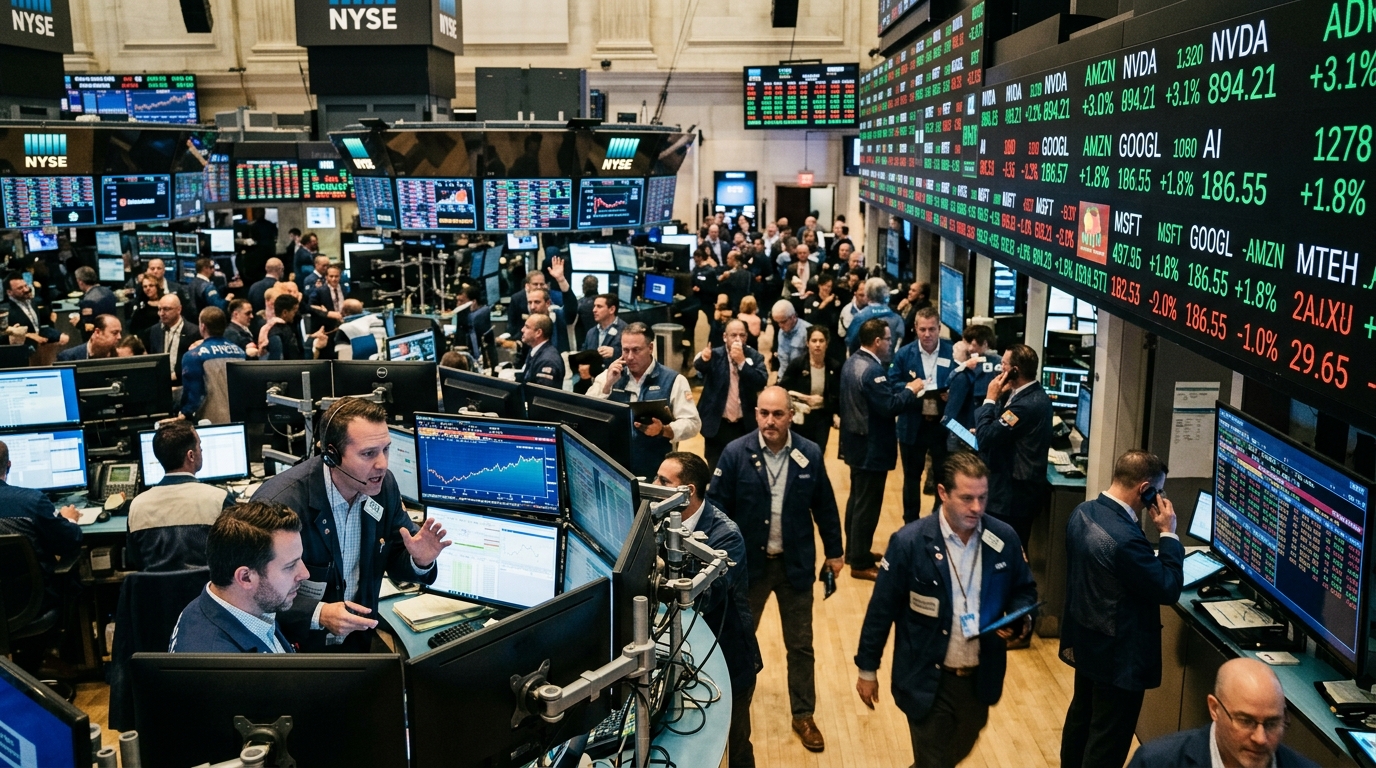
The narrative of Wall Street over the past few years can be distilled into two letters: AI. As we navigate the summer of 2026, the momentum that began three years ago shows no signs of fatigue. US indices, led by the S&P 500 and the Nasdaq, continue to shatter records, fueled by an insatiable appetite for companies that are no longer just promising but are now proving their profitability through Artificial Intelligence. The recent surge in stocks is not merely a speculative fever; it is a confirmation that the market views AI as the new backbone of the global economy.
The Transition from Promise to Reality
If 2023 and 2024 were the years of "grand promises," 2026 is the year of "grand proofs." Investors are no longer satisfied with mere mentions of AI during earnings calls. They are looking for concrete data: increased profit margins, reduced operational costs, and new revenue streams generated by the implementation of Generative AI. Wall Street has become more discerning, separating the true leaders from those merely riding the wave.
Tech giants, the so-called "Magnificent Seven," have now expanded or transformed, with semiconductor companies and cloud infrastructure providers taking the lead. Demand for computing power remains at record levels, as every industry—from pharmaceuticals to heavy manufacturing—integrates AI models into its daily operations. This horizontal expansion of the technology is what keeps valuations high, despite elevated interest rates that would traditionally weigh down growth stocks.
The Energy Thirst and New Winners
An interesting twist in the current market is the emergence of utilities and energy companies as "indirect" AI winners. The data centers required to train and run Large Language Models (LLMs) consume vast amounts of electricity. This has led to an unexpected rally in the stocks of companies involved in nuclear energy and renewables, as Wall Street realizes that AI cannot exist without stable and abundant power.
- Semiconductor firms remain the core of the ecosystem, with orders for next-generation chips booked out for the next two years.
- Software as a Service (SaaS) is entering a new phase where AI is not an add-on feature but the very foundation of the code.
- Cybersecurity is emerging as a critical sector, as AI-driven attacks require equally sophisticated defensive solutions.
"The market is no longer buying the future; it is buying the efficiency that AI provides in the present," says a senior analyst at Goldman Sachs.
Risks and the Shadow of a "Bubble"
Despite the euphoria, the debate over a potential "bubble" remains relevant. Critics point out that price-to-earnings (P/E) ratios in certain sectors are reminiscent of the dot-com era in 1999. However, proponents of the current rally argue that, unlike 1999, today's tech giants possess massive cash reserves and real profits. The risk lies not in the technology itself, but in the speed at which businesses can recoup the enormous investments made in AI infrastructure.
Furthermore, the geopolitical landscape remains a volatile factor. Restrictions on technology exports and the US-China competition for AI supremacy create pockets of uncertainty. Wall Street currently seems to overlook these risks, betting on American dominance in software design and innovation. The market's ability to absorb shocks and return to an upward trajectory reflects a deep-seated belief that AI is the fourth industrial revolution in full swing.
Conclusion
Wall Street is not just "hungry" for AI; it is dependent on it for its future growth. As long as corporate earnings continue to justify high stock prices, this trend will remain strong. However, investors should be prepared for increased volatility as the market transitions from the excitement of discovery to the hard reality of execution and global competition.





