

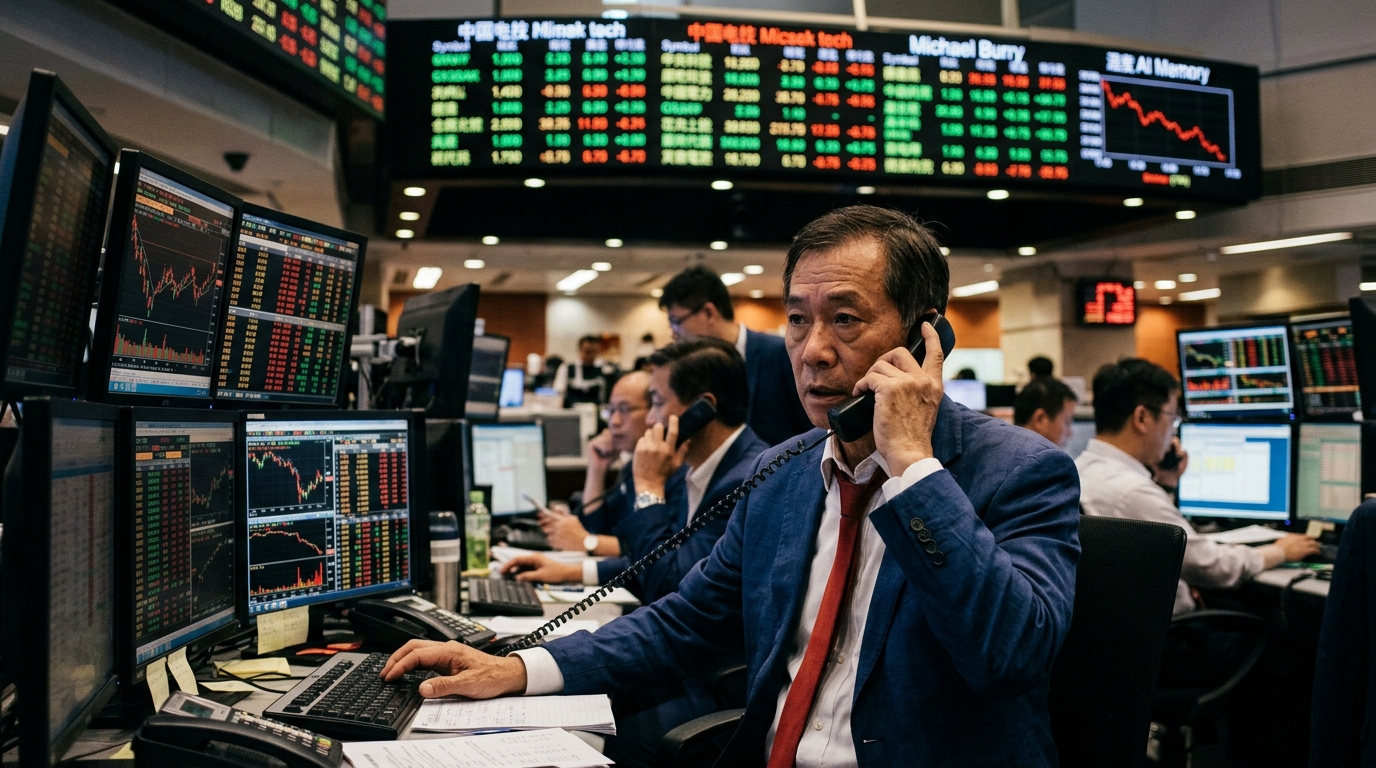
In the world of high-stakes investing, few names command as much awe and debate as Michael Burry. The man who famously predicted the 2008 U.S. housing market collapse is now turning his gaze East, but not where most would expect. While the world remains fixated on the Artificial Intelligence (AI) explosion, Burry, through Scion Asset Management, is executing a strategic pivot: exiting overvalued South Korean AI-memory stocks and positioning aggressively in Chinese e-commerce giants, Alibaba and JD.com.
The Korean AI-Memory Unwind: End of a Cycle?
For nearly two years, South Korea has been the epicenter of investor interest due to its dominance in High Bandwidth Memory (HBM) manufacturing, an essential component for Nvidia's AI processors. Companies like SK Hynix and Samsung saw their valuations skyrocket to unprecedented heights. However, Burry appears to be sensing what is being called the 'AI-Memory Unwind'—a gradual cooling of the market as supply begins to catch up with demand and profit margins face downward pressure.
Burry’s thesis is rooted in the cyclicality of the semiconductor industry. When euphoria reaches its zenith, sophisticated investors look for the exit. South Korea, while technologically advanced, is now facing the risk of a correction, as AI expectations have been fully baked into stock prices, leaving little room for further upside without massive fundamental surprises.
Alibaba and JD.com: The Return of Value
Conversely, the Hong Kong market and Chinese tech firms have endured a multi-year period of underperformance, driven by regulatory crackdowns from Beijing and geopolitical tensions. Alibaba and JD.com are trading at earnings multiples reminiscent of companies in terminal decline, despite remaining profitable powerhouses with massive cash reserves. Burry sees a classic 'deep value' investment opportunity here.
His strategy isn't merely a bet against AI, but a bet on valuation sanity. Alibaba, for instance, has begun integrating its own large language model (LLM), Tongyi Qianwen, across its services, from cloud computing to retail. JD.com is investing heavily in supply chain automation powered by AI. For Burry, these companies offer AI exposure at a 'bargain price' compared to hardware manufacturers currently in bubble territory.
Geopolitical Risk and the Hong Kong Market
Of course, investing in China is not without its perils. The potential for new U.S. tariffs or further technology export restrictions remains high. However, the Hong Kong market seems to be benefiting from a repatriation of capital. Many institutional investors, following Scion’s lead, are beginning to realize that negative sentiment toward China has reached extreme levels, creating a potential inflection point.
- Alibaba is now the largest position in Burry's portfolio, accounting for over 20% of its total value.
- JD.com follows closely, with Burry increasing his stake by 80% in the last quarter alone.
- The exit from the Korean market is driven by a desire to lock in gains from the 2024-2025 AI rally.
In conclusion, Michael Burry's move serves as a powerful signal to the global market. While the masses chase the next Nvidia, the 'Big Short' investor chooses patience and value in the neglected Chinese market, betting that the true power of AI will be manifested not by those who make the chips, but by those who use them to dominate global commerce.





