

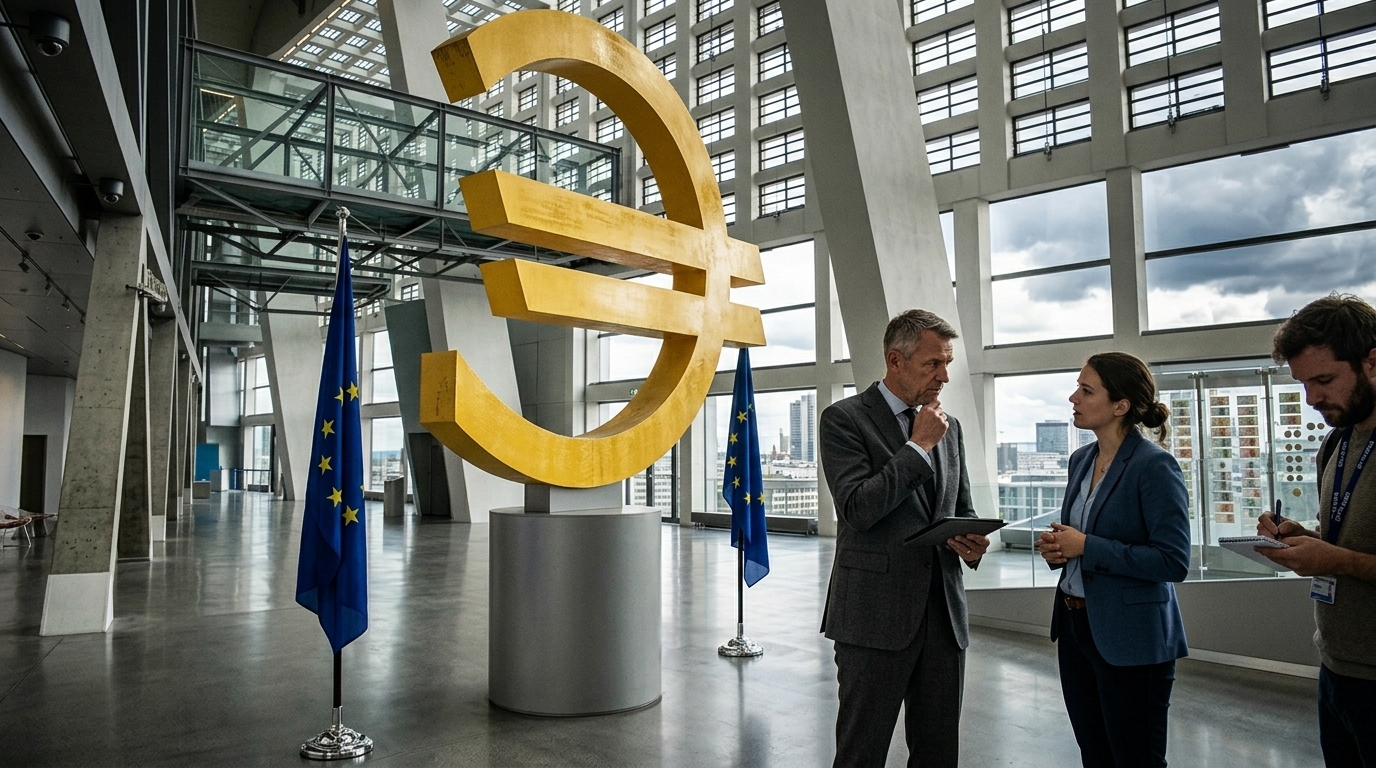
The European Central Bank (ECB) currently stands before one of the most complex challenges in its history. Its decision to raise key interest rates to 2.25% is not merely a technical adjustment of monetary policy, but a bold statement of intent in an environment fraught with tension. With inflation galloping at levels not seen in decades and the energy crisis strangling households and businesses, Frankfurt is forced to walk a tightrope: on one side lies monetary stability, and on the other, a deep economic recession.
The End of the Era of Cheap Money
For more than a decade, the Eurozone had become accustomed to a regime of zero or even negative interest rates. This era of "cheap money" was designed to stimulate growth following the debt crisis, but today's conditions have rendered it a thing of the past. The ECB's shift toward a more aggressive (hawkish) policy is a direct response to inflation that is no longer being labeled as "transitory." Increasing borrowing costs aims directly at cooling demand, hoping this will keep prices in check. However, in Europe's case, inflation is not driven solely by excess demand, but primarily by a massive supply-side shock in energy.
- Increased borrowing costs for sovereign states and corporations.
- Pressure on mortgages and the real estate market.
- Efforts to return inflation to the 2% target.
The Energy Vise and Geopolitical Instability
The root of the evil for the European economy remains energy. Dependency on Russian natural gas and the violent decoupling from it have created a void filled at an enormous cost. Electricity and gas prices act as an "indirect tax" that strips disposable income from consumers. By raising interest rates, the ECB cannot pump more gas into the pipelines, but it can prevent these price hikes from seeping into the broader economy and creating a wage-price spiral.
"Price stability is the essential prerequisite for sustainable growth, even if the short-term price is painful," sources within the central bank suggest.
However, this approach carries significant risks. Europe, unlike the US, is much more exposed to the war in Ukraine. Industrial production in Germany, Europe's engine, is already showing signs of fatigue as energy-intensive industries are forced to scale back operations. A sharp rise in interest rates at this timing could transform a mild slowdown into a prolonged recession.
The Risk of Fragmentation and the Case of Greece
A particular concern for Christine Lagarde is the so-called "fragmentation" of the Eurozone. As rates rise, bond yields for Southern European countries, such as Greece and Italy, tend to increase faster than those of Germany. This widens spreads and makes debt financing more expensive for already burdened economies. The ECB has deployed tools like the TPI (Transmission Protection Instrument) to prevent a new debt crisis, but their effectiveness remains to be proven in practice. For Greece, the challenge is twofold: maintaining fiscal discipline while the cost of money rises, without stifling the growth momentum built in recent years.
Conclusion: Toward an Uncertain Autumn
The Eurozone's trajectory in the coming months will depend on whether the ECB can achieve a "soft landing." The move to 2.25% is just the beginning of a journey that requires delicate handling. Citizens will be called upon to face increased living costs and more expensive credit, while governments attempt to support vulnerable groups without derailing deficits. The fight against inflation is necessary, but history will judge whether the ECB's cure was appropriate for an economy suffering from exogenous shocks.





