

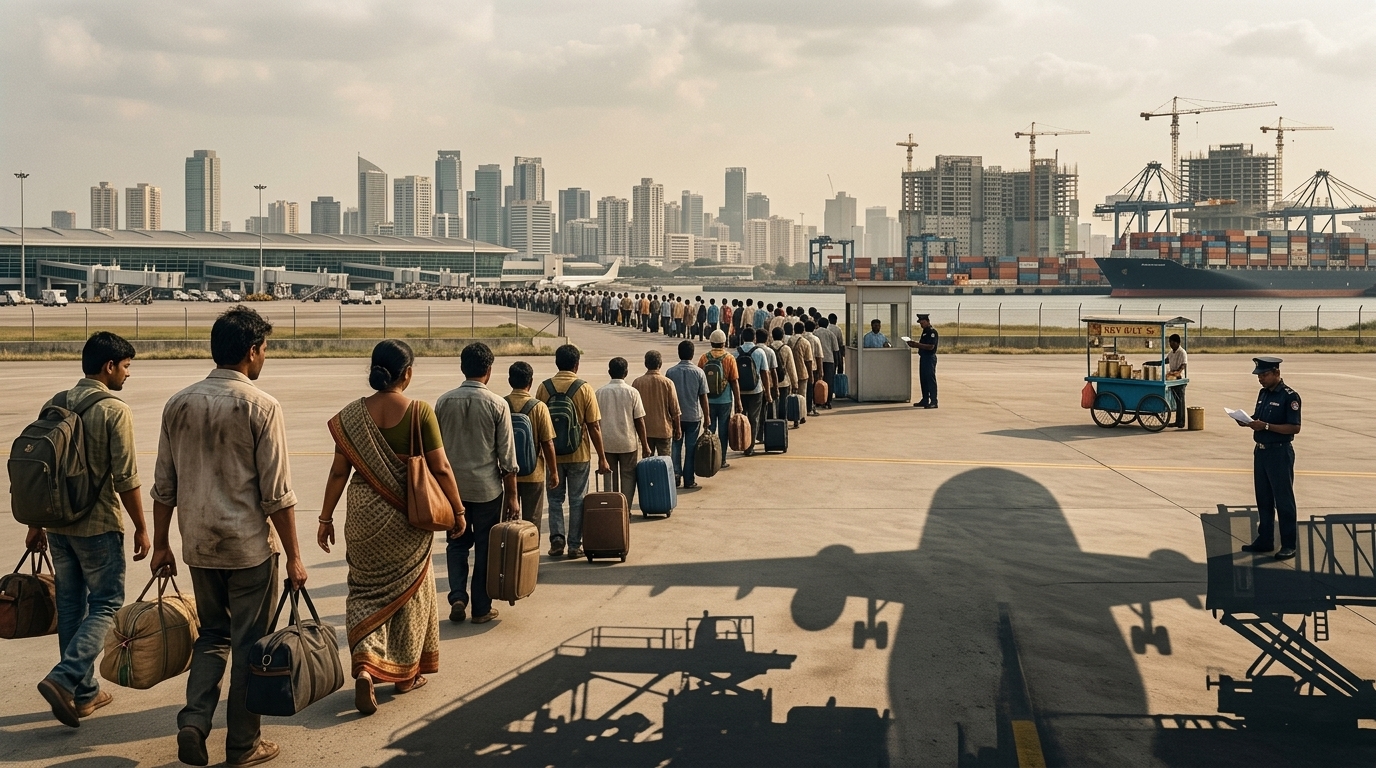
For decades, the blueprint for national prosperity was straightforward: manufacture goods and sell them to the rest of the world. From post-war Japan to 21st-century China, export-led industrialization was the 'gold standard' for transitioning from poverty to wealth. However, as automation diminishes the need for cheap factory labor and protectionism gains traction in the West, this model appears to be faltering. In this context, a provocative analysis by The Economist poses a question that was once considered economic heresy: Can exporting people—rather than products—become the new path to development?
The Decline of the Industrial Panacea
The traditional path to growth relied on moving peasants from farms to factories. Manufacturing offered mass employment, stable wages, and a foundation for technological skill-building. Today, however, 'premature deindustrialization' is hitting many developing nations. Robots are now cheaper than unskilled workers, meaning low-income countries can no longer compete solely on labor costs. Furthermore, global demand for physical goods shows signs of saturation, while demand for services and specialized labor is skyrocketing.
In this landscape, nations like the Philippines, India, Egypt, and Mexico have discovered an alternative: labor export. Instead of solely trying to attract foreign investment for factory construction, they train their citizens to work abroad. The remittances sent back by these migrants have become the cornerstone of many economies, often exceeding revenues from traditional exports or foreign direct aid.
The Economic Power of Remittances
The figures are staggering. Globally, remittances to low- and middle-income countries surpassed $650 billion in 2023. For some countries, such as Tajikistan or Lebanon, these funds represent more than a third of their GDP. Even in larger economies, the impact is transformative. Remittances act as a form of 'social security' funded directly by the global labor market, bypassing often corrupt or inefficient state bureaucracies.
- Stability: Unlike foreign investments that flee during crises, remittances often increase when the migrant's home country faces hardship.
- Direct Poverty Alleviation: Money goes straight to households for food, education, and healthcare.
- Foreign Exchange: They provide a critical source of hard currency for importing essentials and servicing national debt.
However, The Economist notes that this strategy is not without risks. 'Dutch disease' is a constant threat: a massive influx of foreign currency can appreciate the local currency, making domestic businesses less competitive and trapping the country in a cycle of migration dependence.
Brain Drain or Brain Gain?
The strongest argument against 'exporting people' is brain drain. When the best and brightest leave, the domestic economy loses its most dynamic element. Who will build local businesses, staff hospitals, or teach at universities? The Economist’s response is more nuanced. There is also the phenomenon of 'brain gain': the prospect of migration incentivizes more people to pursue higher education, raising the overall education level in the country, even if a percentage eventually leaves.
"Migration is not just a drain of resources, but a network. Migrants bring back knowledge, connections, and capital that can spark entrepreneurship in their home countries."
Furthermore, in the digital age, 'exporting people' is taking a new form: the export of services via remote work. A developer in Nairobi working for a London-based firm is 'exporting' their labor without leaving their family or spending their income abroad. This model combines the benefits of remittances with the retention of human capital within borders.
The Future of National Development
Can a country become wealthy solely through its migrants? Historical experience suggests that while remittances can lift millions out of poverty, they are rarely enough to transform a nation into an industrial powerhouse on their own. A delicate balance is required. Countries must treat their migrants as a strategic asset, facilitating the flow of capital and knowledge back home, while simultaneously improving local conditions so that returning—or staying—becomes an attractive option.
In an aging world, the demand for labor in wealthy countries will remain insatiable. Developing nations that manage to 'export' their workforce intelligently, by investing in education and maintaining ties with their diaspora, may find a path to prosperity that does not lead through the factory chimneys of the 20th century.





