

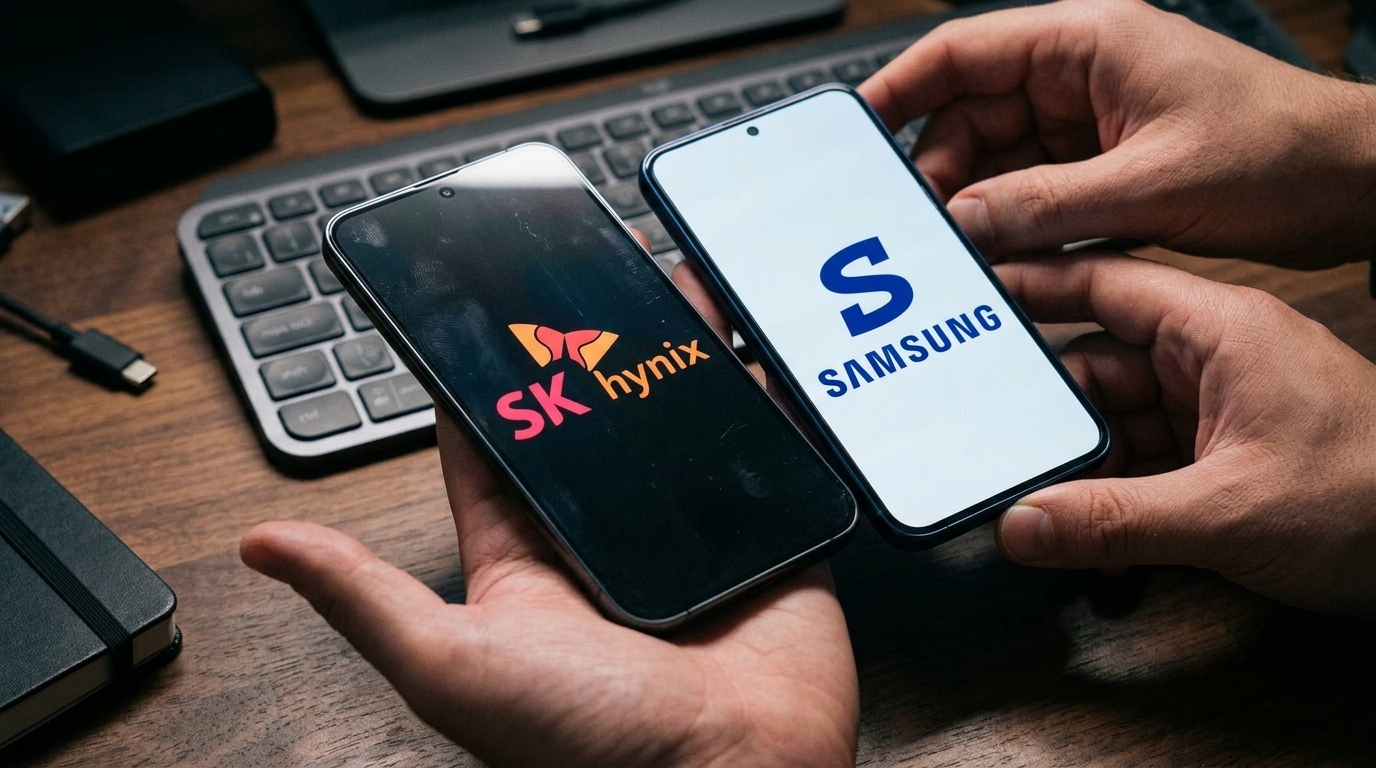
The global semiconductor market is experiencing one of its most volatile periods in recent years, with the latest wave of liquidations on Wall Street spreading like a contagion to Asian markets. The two pillars of South Korean technology, Samsung Electronics and SK Hynix, found themselves at the epicenter of a storm that isn't just about the numbers, but about investors' fundamental faith in the "AI narrative." The plunge in their stock prices is not merely a market correction; it is a warning shot regarding the overheating of a sector that promised to change the world but is now being called upon to prove its profitability in a high-interest-rate environment and geopolitical uncertainty.
The Domino Effect: From New York to Seoul
It all began when indices in New York, particularly the tech-heavy Nasdaq, started retreating under the weight of concerns over a slowing US economy and overvalued AI companies. When Nvidia, the undisputed leader of the sector, shows signs of strain, the vibration is felt across the entire supply chain. Samsung and SK Hynix, as the primary suppliers of High Bandwidth Memory (HBM)—the fuel for AI processors—are the first to take the hit.
The drop in Seoul was dramatic. Investors, fearing that demand for memory chips may have reached a "peak cycle," rushed to lock in profits. SK Hynix, which has a closer link to Nvidia due to its supply of advanced HBM3E chips, saw its stock slide to levels that triggered panic among retail investors. Samsung, on the other hand, is fighting on two fronts: struggling to close the gap in HBM technology while facing increasing competition from Chinese firms in traditional memory chips.
The Trap of Excessive Optimism
The question looming over the markets is whether the AI rally was a bubble similar to the dot-com era of 2000. Analysts point out that while the technology is real and transformative, the capital expenditures (CapEx) of Big Tech giants (Microsoft, Google, Meta) are so high that shareholders are beginning to demand immediate results. If enterprise AI adoption does not accelerate, the demand for the hardware produced by Samsung and SK Hynix could slow down abruptly.
- SK Hynix is heavily dependent on Nvidia's orders, making it vulnerable to any shift in sentiment in Silicon Valley.
- Samsung faces internal challenges with the yield of its advanced production lines, leaving it behind in the race for next-generation chips.
- The geopolitical chessboard, with US export restrictions to China, further complicates the plans of these Korean giants.
Geopolitics and Macroeconomics: The Silent Players
It’s not just technology pushing stocks down. Uncertainty surrounding the Federal Reserve's next moves and the possibility of a US recession creates an explosive mix. For South Korea, which relies heavily on semiconductor exports for its GDP, this decline is not just a corporate issue but a national economic concern. The government in Seoul is closely monitoring developments, as "chip diplomacy" between Washington and Beijing forces Samsung and SK Hynix to walk a tightrope.
Furthermore, the rise of Chinese companies like CXMT in the DRAM chip sector shows that the Korean monopoly on memory is being attacked from the bottom of the pyramid. While Samsung tries to dominate the high-end segment, it is losing market share in simpler chips used in consumer electronics, which are also seeing a downturn due to reduced global household purchasing power.
"The market is not punishing the technology itself, but the expectation of eternal growth without any reality checks," says a leading market analyst in Seoul.
In conclusion, the sell-off of Samsung and SK Hynix serves as a reminder that the semiconductor industry remains deeply cyclical. Artificial Intelligence may have changed the rules of the game, but it has not abolished the laws of economics. The coming days will require Asian giants to demonstrate not only technological superiority but also strategic flexibility to survive in a world that is now questioning the cost of progress.





