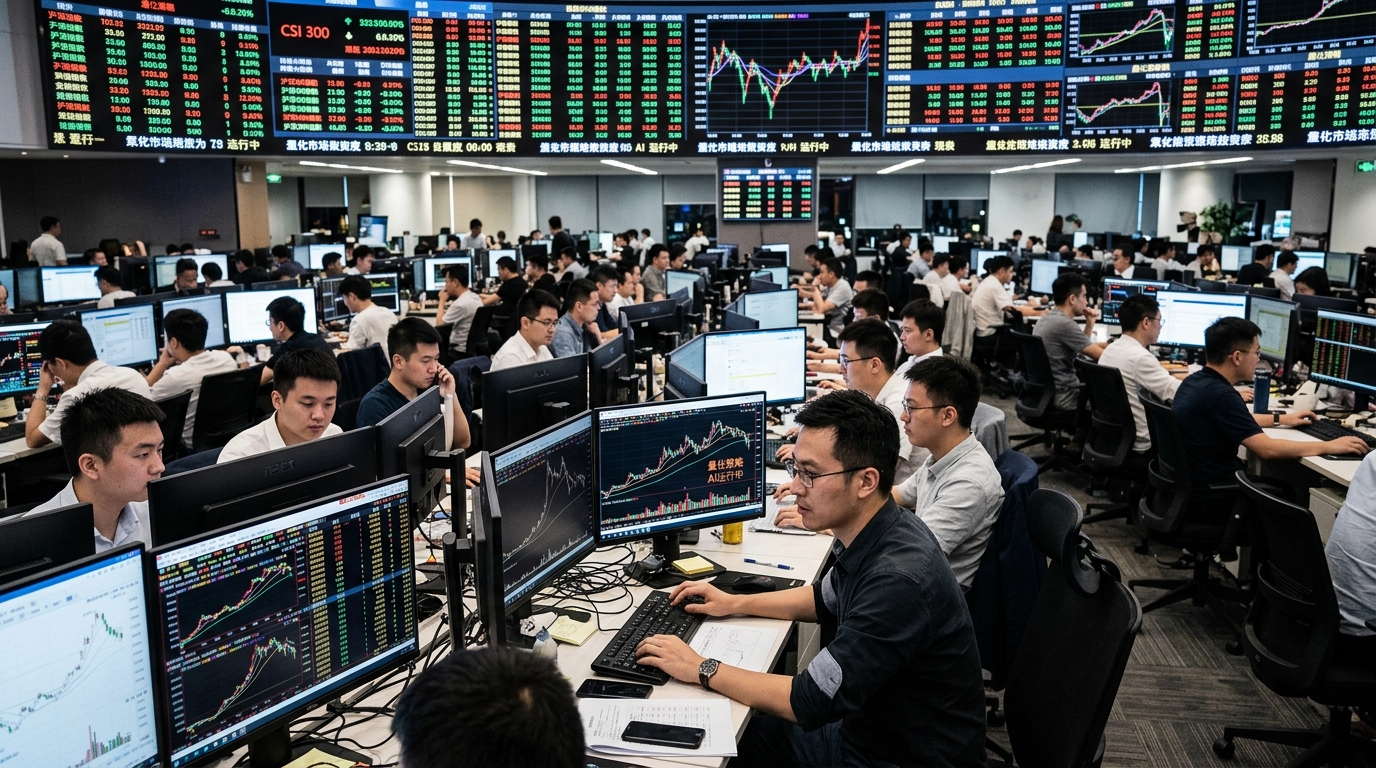
In the high-stakes financial hubs of Shanghai and Shenzhen, a silent revolution is fundamentally altering the landscape of the world’s second-largest economy. This is not a revolution of the streets, but one occurring within the server stacks of the nation’s premier quantitative (quant) hedge funds. As we move through July 2026, the dominance of Artificial Intelligence in Chinese equity markets has shifted from a theoretical edge to an undeniable reality, forcing a radical reassessment of the value of human intuition.
Recent data indicates that Chinese quant funds are being deluged with billions of dollars in fresh capital as AI-driven strategies consistently outperform traditional human fund managers. The magnetism of these funds lies in their capacity to ingest and synthesize staggering volumes of data—ranging from formal corporate filings to the chaotic churn of social media—with a velocity and precision that no human analyst can hope to replicate. In the Chinese market, characterized by its high volatility and the outsized influence of retail investors, AI has found its most fertile proving ground.
The AI Advantage in a Retail-Driven Ecosystem
The Chinese A-share market is unique among global financial systems due to the sheer volume of participation from individual retail investors. These millions of participants often trade on emotion, rumors, or fleeting trends, creating significant market "noise." For a human manager, this noise represents a chaotic risk. For a deep-learning model, however, it is a repository of exploitable patterns.
Algorithms deployed by firms such as High-Flyer Quant and Yanfu Investments have evolved far beyond basic statistical arbitrage. They now utilize specialized Large Language Models (LLMs) to perform real-time sentiment analysis across platforms like WeChat and Weibo, identifying shifts in the collective psyche of the retail "army" before these shifts manifest in price action. "The AI isn't just looking at balance sheets; it's decoding the social fabric of the market," notes a senior strategist in Shanghai. "It anticipates the herd's movement before the herd even knows it's moving."
Regulatory Tightropes and Systemic Risks
However, this ascension of the machines is not without its complications. The China Securities Regulatory Commission (CSRC) is maintaining a vigilant watch, haunted by the specter of systemic instability. The primary fear is that the concentration of capital into similar algorithmic strategies could trigger "flash crashes"—where automated sell-offs feed into one another in a catastrophic loop.
Beijing has responded by tightening reporting requirements for high-frequency trading and demanding greater transparency into the "black box" logic of these models. Yet, the regulatory scrutiny has done little to dampen investor enthusiasm. Institutional players, witnessing the diminishing alpha of human-led funds, feel they have no choice but to pivot toward silicon. This transition marks the twilight of the era of the investment "guru" who relied on experience and gut feeling to navigate the markets.
The Future of Wealth Management
As AI models become increasingly autonomous, the fundamental question remains: what is the future role of humans in finance? Within the offices of top-tier Chinese quants, the traditional trader is an endangered species, replaced by data scientists and machine learning engineers. Their task is no longer to pick stocks, but to curate the environments in which the algorithms evolve.
The success of China’s quant sector serves as a bellwether for global markets. If AI can achieve such dominance in a market as complex and politically sensitive as China’s, the total automation of global capital flows appears inevitable. For now, Chinese investors seem content to let the machines take the wheel, provided the returns remain as lucrative as they are today. The era of the silicon mandate has arrived.