

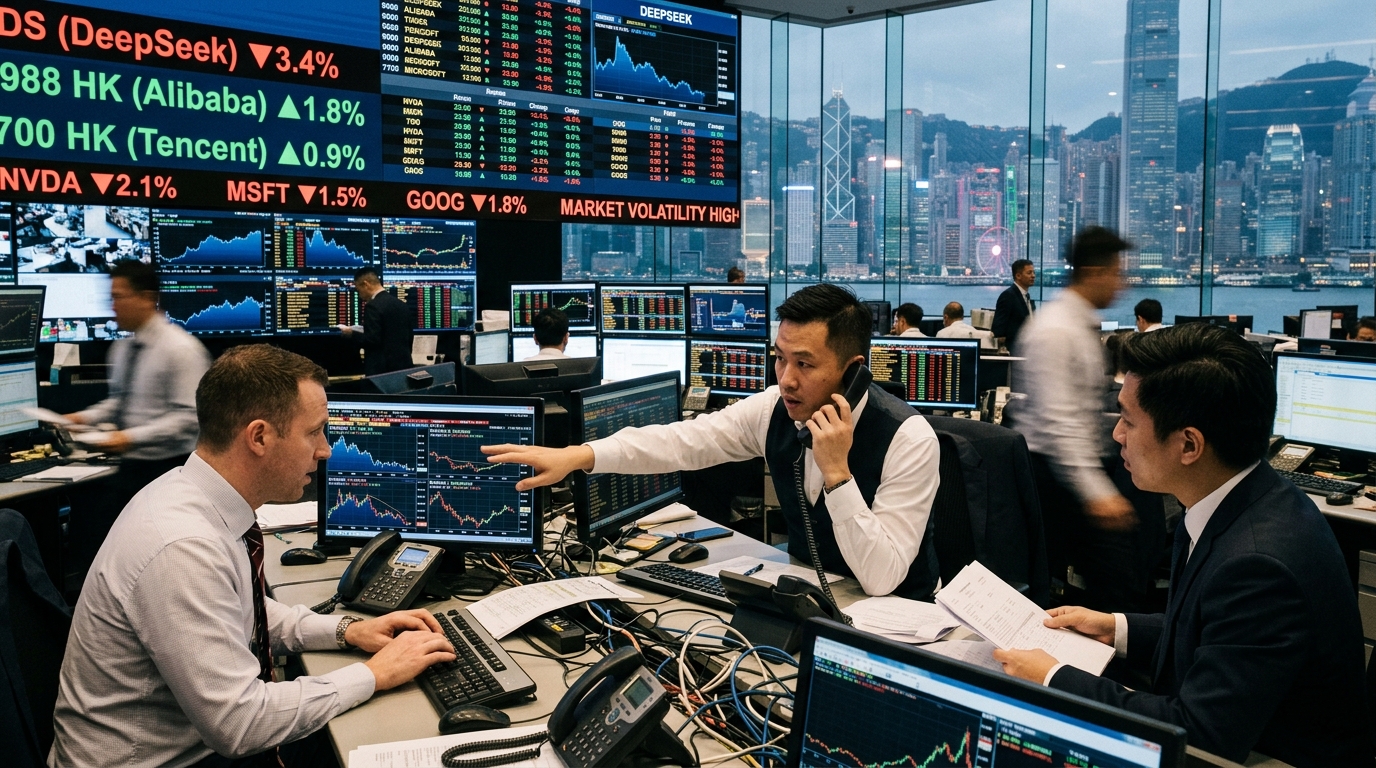
The global AI chessboard is being rocked by an economic earthquake originating from the East. While Silicon Valley has remained hyper-focused on building ever-larger, more expensive, and energy-hungry models, a quiet revolution in China is dismantling the dominant business paradigm. The news that AI usage fees in China, led by the emergence of DeepSeek, have plummeted to a mere 1/100th of their U.S. counterparts is not just a statistical anomaly; it is an existential threat to the Big Tech status quo.
The Economics of Disruption: The DeepSeek Shockwave
DeepSeek, a company that shares its roots with high-frequency quantitative trading, has achieved the unthinkable: delivering GPT-4 class performance at a fraction of the cost. Their strategy of aggressive pricing has ignited an unprecedented price war within China, dragging giants like Alibaba, Baidu, and ByteDance into a race to the bottom. When the cost of 1 million tokens drops from dollars to pennies, artificial intelligence ceases to be a luxury enterprise tool and transforms into a basic commodity, akin to electricity or bandwidth.
This 99% reduction in cost is not merely the result of state subsidies, but stems from a radical redesign of model architecture. DeepSeek utilized innovative techniques such as Multi-head Latent Attention (MLA) and a sophisticated Mixture-of-Experts (MoE) framework to drastically lower the computational overhead for both training and inference. The result is a model that was reportedly trained for less than $6 million—a staggering contrast to the hundreds of millions or even billions spent by OpenAI and Anthropic on their flagship models.
Innovation Under Constraint: The Sanctions Paradox
One of the most compelling aspects of this development is that Chinese success was catalyzed by U.S. export restrictions on high-end semiconductors. Sanctions that blocked China's access to NVIDIA’s cutting-edge H100 chips forced Chinese engineers to become exceptionally resourceful at the software layer. Instead of relying on the "brute force" of massive compute clusters, they pivoted toward algorithmic efficiency.
- Optimizing code for previous-generation GPUs and domestic hardware.
- Developing advanced chip-to-chip interconnect solutions.
- Focusing on high-quality data curation over sheer data volume.
This "forced innovation" has proven to be a double-edged sword for U.S. interests. While sanctions may have slowed China’s hardware progression, they accelerated software breakthroughs, creating a generation of models that are far more economically viable. Now, even U.S.-based developers and startups are beginning to favor DeepSeek, prioritizing ROI and efficiency over geopolitical loyalty or brand prestige.
The Silicon Valley Dilemma and the Road Ahead
The Western response is a volatile mix of admiration and dread. If high-level intelligence becomes this cheap, the business models of companies relying on high-margin subscriptions may face obsolescence. Silicon Valley now faces a pivotal choice: continue the path of scaling laws that require dedicated nuclear power plants, or pivot toward the "algorithmic elegance" demonstrated by DeepSeek.
"The metric of success has shifted. It is no longer about who possesses the most chips, but who can generate the most intelligence per watt and per dollar," industry analysts observe.
The migration of U.S. firms toward Chinese models also raises significant concerns regarding data sovereignty and national security. However, in the cutthroat world of global business, ROI often trumps ideology. If an enterprise can perform the same cognitive tasks at 1% of the cost using DeepSeek’s API, the pressure to adopt will become irresistible, forcing U.S. regulators and tech leaders into a corner. We are entering the era of commoditized intelligence, where the moat is no longer the model itself, but the efficiency with which it is delivered.





