

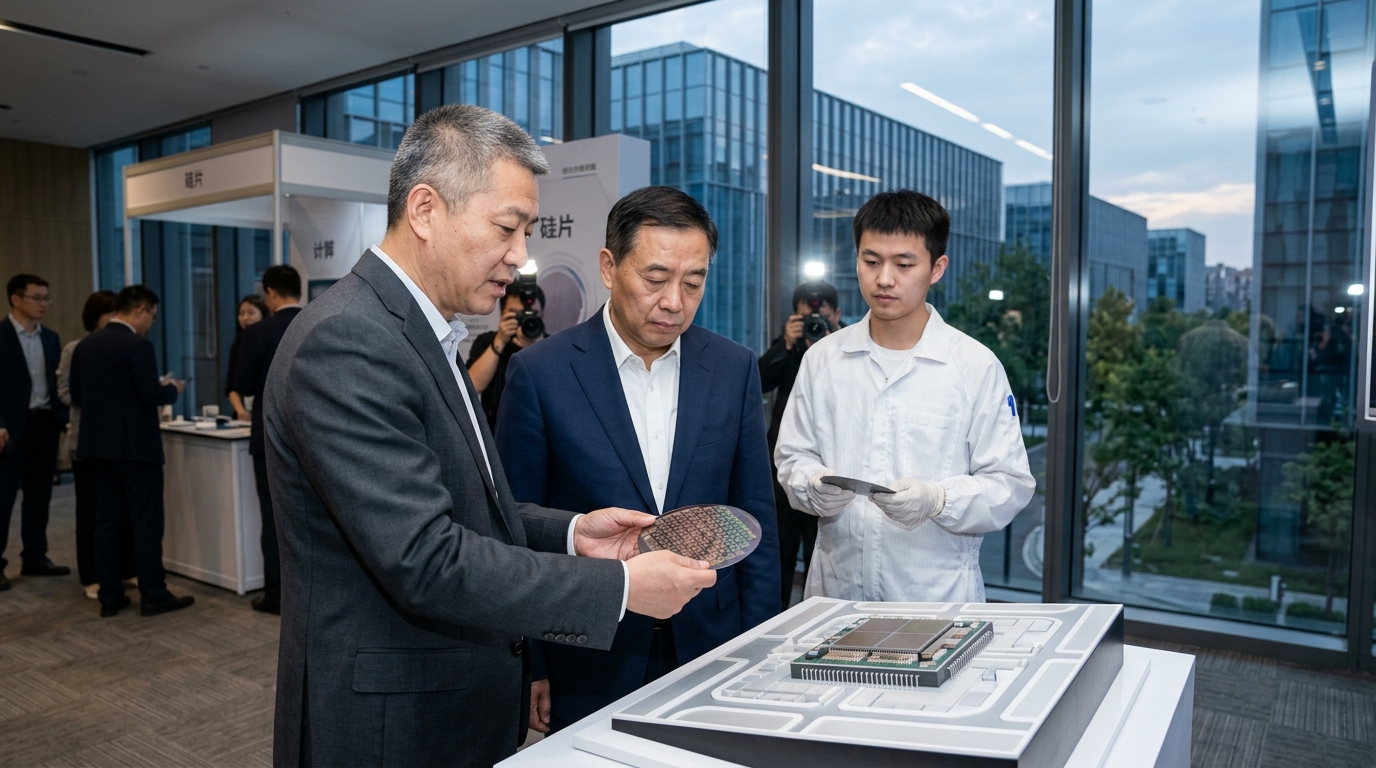
In a move poised to reshape the global technological landscape, China’s leading artificial intelligence developers, DeepSeek and Zhipu AI, are reportedly diving into the complex world of custom semiconductor design. This development, highlighted by reports from Pandaily and industry insiders, marks a critical pivot in China’s quest for "compute sovereignty" amidst tightening export controls imposed by the United States.
The Necessity of Autonomy: Breaking the Nvidia Dependency
For years, Nvidia’s dominance with its H100 and B200 processors has been the gold standard for training Large Language Models (LLMs). However, geopolitical friction and U.S. Department of Commerce restrictions have made accessing these components increasingly difficult and prohibitively expensive for Chinese firms. DeepSeek, which stunned the global community with the efficiency of its DeepSeek-V3 model, and Zhipu AI, often dubbed "China’s OpenAI," have realized that long-term survival hinges on controlling the hardware layer.
Designing custom Application-Specific Integrated Circuits (ASICs) allows these companies to optimize hardware specifically for their proprietary model architectures. For instance, the Mixture-of-Experts (MoE) architecture favored by DeepSeek requires massive memory bandwidth and specialized data routing—features that can be integrated far more efficiently into a ground-up chip design than into a general-purpose GPU.
Zhipu AI: The National Champion’s Vertical Integration Strategy
Zhipu AI is no minor player. Backed by the Chinese state, Alibaba, and Tencent, the company has developed the GLM (General Language Model) series, which directly rivals GPT-4. Its decision to invest in custom silicon reflects a vertical integration strategy similar to Google’s TPUs or Amazon’s Trainium chips. Analysts suggest that Zhipu aims to slash data center operational costs by at least 40% over the next five years, bypassing the heavy premiums found in the grey market for restricted Nvidia hardware.
"The AI battle won't just be won with algorithms; it will be won in the foundries. Whoever controls the silicon controls the future of intelligence," says a Shanghai-based industry executive.
DeepSeek: An Obsession with Efficiency
DeepSeek has already demonstrated an uncanny ability to achieve more with less. Their track record of training world-class models with a fraction of the compute resources used by Western giants like Meta or OpenAI is legendary. Entering the chip design arena is the natural evolution of this philosophy. Reports indicate that DeepSeek is focusing on chips that prioritize interconnect speed, addressing the data bottleneck between thousands of processors that remains the primary hurdle in scaling AI training.
The Fabrication Hurdle and Geopolitical Stakes
Despite their design prowess, a massive question mark remains over fabrication. With access to Taiwan’s TSMC restricted by sanctions, DeepSeek and Zhipu AI must rely on China’s domestic champion, SMIC. While SMIC has made strides in 7nm and 5nm processes, it still struggles with yields and the absence of advanced EUV (Extreme Ultraviolet) lithography machines. Furthermore, the global shortage of High Bandwidth Memory (HBM) presents another headache, as South Korean giants SK Hynix and Samsung face pressure to align with U.S. trade policies.
In conclusion, the foray of DeepSeek and Zhipu AI into custom silicon is not merely a business expansion; it is an act of geopolitical resilience. If they succeed in bridging the gap between software and hardware, China could emerge from chip isolation more formidable than ever, challenging Silicon Valley’s monopoly at the very heart of the computational revolution.





