

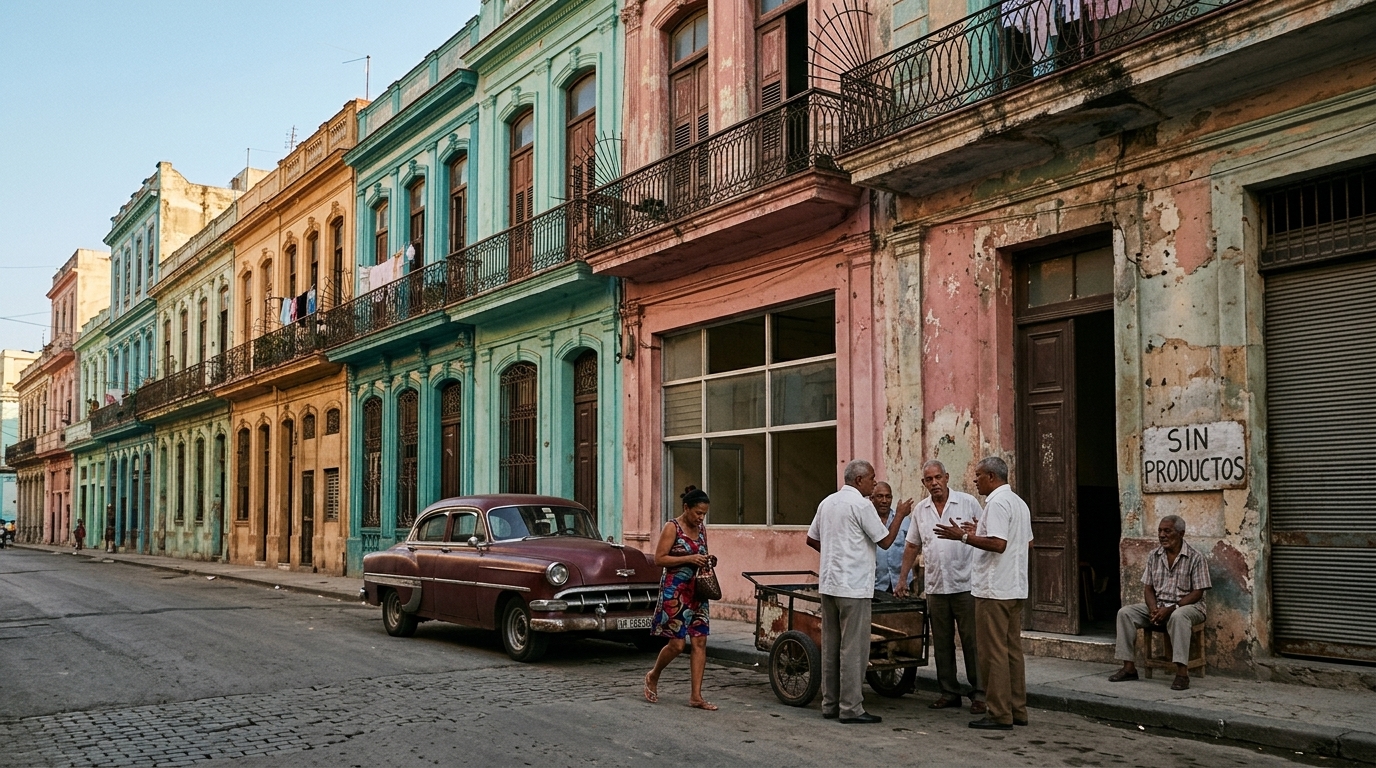
Cuba, the 'island of revolution' that for decades served as a global symbol of resistance to capitalism, now faces its most severe existential crisis since the collapse of the Soviet Union. The country’s economy is on life support, with skyrocketing inflation, chronic shortages of basic goods, and a crumbling energy grid that leads to frequent, widespread blackouts. Against this grim backdrop, Havana is attempting its own version of 'perestroika'—an opening to private enterprise that carries the haunting specter of 'crony capitalism.'
The term, coined by George M. Taber of Time magazine in the 1980s, describes a system where economic success depends on close relationships between business people and government officials. In Cuba’s case, the fear is that the transition away from state central planning will not lead to a free and fair market, but rather to a controlled economy where the new elite consists of the same individuals currently holding the reins of the Communist Party and the military.
The Rise of MIPYMES and the Shadow of the Military
In 2021, the Cuban government legalized small and medium-sized private enterprises, known as MIPYMES. While initially seen as a glimmer of hope for revitalizing production, questions quickly arose about who truly benefits. At the top of Cuba’s economic pyramid sits GAESA, a massive business conglomerate controlled by the Revolutionary Armed Forces (FAR). GAESA manages everything from tourism and luxury hotels to transportation and retail trade in hard currency.
Analysts worry that new private licenses are being granted selectively to relatives of officials or 'vetted' regime loyalists. This is creating a new class of 'socialist entrepreneurs' who enrich themselves through privileged access to imports and foreign exchange, while the average Cuban struggles to survive on wages decimated by the peso's devaluation.
'We are not seeing the liberation of the economy, but the evolution of the nomenklatura into an oligarchy,' critics of the system note.
The Failure of Monetary Reform
One of the biggest blows to economic stability was the infamous 'Tarea Ordenamiento' (Ordering Task) in 2021, which aimed to unify the two currencies circulating on the island. Instead of bringing order, it triggered inflation that exceeded all expectations, rendering the national currency nearly useless for purchasing imported goods. The government was forced to allow the use of dollars in special stores (MLC), intensifying social inequality between those with access to foreign remittances and those without.
The lack of foreign exchange has led to a dramatic reduction in food and fuel imports. Agricultural production has also collapsed due to shortages of fertilizers and equipment, forcing a country with fertile land to import 80% of its needs. Desperation has led to a massive wave of migration, with hundreds of thousands of Cubans—mostly young and educated—fleeing the island, causing a demographic drain that undermines any future recovery efforts.
The International Context and 'Allies'
Havana is pinning its hopes on traditional allies like Russia and China, but also on new partnerships with countries like the United Arab Emirates. Moscow, in particular, appears to be offering expertise in transforming the Cuban economy into a model reminiscent of the Russian transition in the 1990s. This includes granting long-term land leases and creating special economic zones with tax privileges for Russian investors.
However, the U.S. embargo remains a significant deterrent. Despite some easing by the Biden administration to support the private sector, Cuba’s inclusion on the list of state sponsors of terrorism hampers international banking and foreign investment. Cuba is trapped: it needs the U.S. to survive economically but fears that the political opening Washington would demand would mean the end of the Communist Party’s rule.
Conclusion: Survival or Transformation?
The question 'can Cuba be saved?' has no easy answer. If 'salvation' means preserving the current political system through economic gimmicks, then the path toward crony capitalism seems inevitable. However, if it means the prosperity of its people, deep structural changes are required, including the rule of law, transparency, and a reduction of the military's dominance in the economy. Without these, Cuba risks transforming from an ideological fortress into just another poor, oligarchic corner of the Caribbean, where the revolution is nothing more than a distant memory on tourist posters.





