

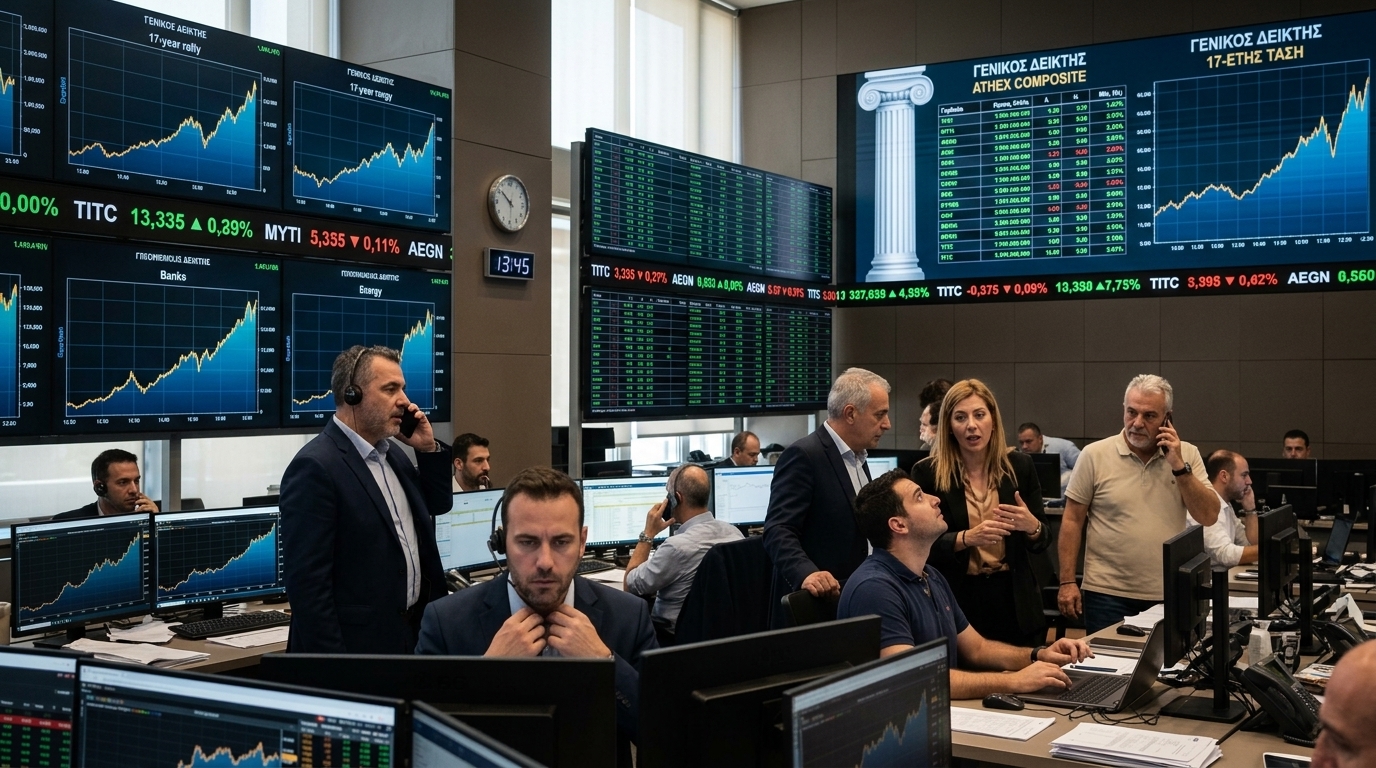
July 3, 2026, will likely be recorded in the annals of the Greek capital market as the moment when the Athens Stock Exchange (ASE) finally stepped out from the long shadow of the previous two decades. With the General Index surpassing 2,530 units and recording a weekly rise of 3.6%, the ASE is not just celebrating a 17-year high; it is celebrating its full reintegration into the radar of global institutional investors. This momentum is neither accidental nor an isolated event; it is the culmination of a multi-year effort of fiscal consolidation and structural reforms that are bearing fruit in a complex geopolitical environment.
The Hegemony of Banks and the Return of Liquidity
The banking sector, which for years was the "Achilles' heel" of the Greek economy, has now become the engine of growth. Following the full divestment of the Hellenic Financial Stability Fund (HFSF) and the return of Greek banks to robust profitability and dividend distributions, investor interest has surged. Alpha Bank, Eurobank, National Bank of Greece, and Piraeus Bank no longer just present improved balance sheets; they boast capital adequacy ratios that compare favorably with those of European giants.
The 3.6% weekly gain was largely fueled by foreign capital inflows. Major Wall Street investment banks and European pension funds are increasing their positions in Greece, seeing a market that, despite the rally, remains relatively undervalued compared to the P/E (Price-to-Earnings) ratios of Central European markets. The return to investment grade status a few years ago served as a catalyst, but today's rise reflects something deeper: the conviction that Greece has transformed into a stable pole in the Eastern Mediterranean.
Energy and Infrastructure: The New Protagonists
Beyond banks, the energy and infrastructure sectors are playing a central role in the current uptrend. PPC (Public Power Corporation), now transformed into a regional player in the Balkans, and Metlen (formerly Mytilineos), with its strong export orientation and presence in international commodity and energy markets, are the "pillars" of the large-cap index. The shift toward the green transition, supported by the Recovery and Resilience Facility (RRF) funds, has created an ecosystem of companies attracting ESG (Environmental, Social, and Governance) capital.
Investors are also focusing on the real estate and construction sectors, as major infrastructure projects like Hellinikon and new highways enter the completion or full operational phase. This diversification of the stock market board is crucial, as it reduces the market's dependence on a single sector and offers investors a more balanced risk profile.
Macroeconomic Context and Challenges
The trajectory of the Athens Stock Exchange cannot be viewed in isolation from the broader picture of the Greek economy. With GDP growth rates consistently above the Eurozone average and public debt declining faster than any other European country, the "Greek Story" remains compelling. However, challenges persist. Inflation, though receding, continues to pressure household disposable income, while high ECB interest rates act as a "brake" on credit expansion.
Furthermore, geopolitical instability in Ukraine and the Middle East continues to cause nervousness in international markets. The Athens Stock Exchange, despite its internal strength, remains exposed to a potential global sell-off. Maintaining the 2,500-unit level as a new support base will depend on continued political stability and the implementation of the next milestones of the Recovery Fund.
Conclusions and Outlook
The closing week leaves a sweet taste for investors, but also a responsibility for the country's political and business leadership. The challenge now is not just the rise of indices, but the deepening of the capital market. The listing of new companies, the strengthening of mid-cap stocks, and the attraction of more domestic retail investors are the next steps for a stock exchange that aims to reflect a modern, developed economy. 2026 appears to be the year when Athens ceases to be an "emerging" market in practice and becomes a mature destination for global capital.





